Factory RV blinds do their job and nothing else. They roll up flat, feel like vinyl because they usually are vinyl, and every rig on the lot has the exact same set.
Swapping them out is one of the fastest ways to make a camper feel like an actual home instead of a rental unit on wheels. And curtains solve more than looks.
The right panel blocks morning glare through a windshield, sections off a sleeping nook from a kitchen, or softens a hard-edged window frame nobody designed to be pretty.
This roundup pulls from twenty real RVs, vans, and campers, each one handling curtains, shades, or some combination of both in its own way. Woven bamboo, macramé, gingham, sheer linen, tasseled tie-backs. Some spent real money. Others used two dowels and a leftover fabric scrap.
Whatever your window looks like right now, one of these twenty rv curtain ideas will fit it.
1. Clip-On Café Curtains For Curves
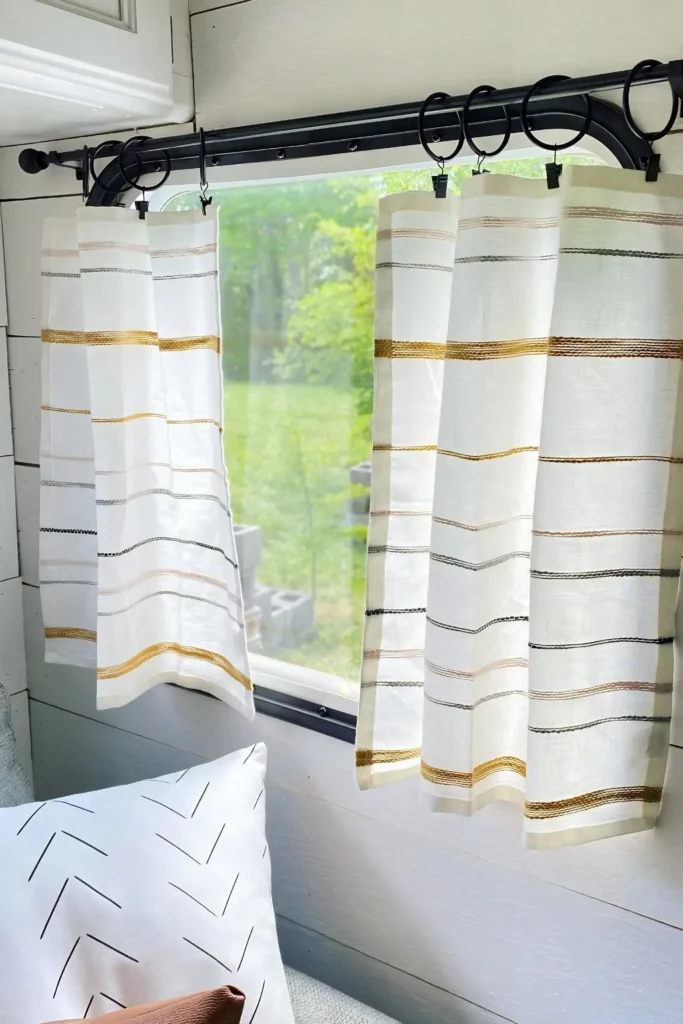
Clip rings turn a plain tension rod into café curtains without a single stitch.
- The rod curves with the window arch instead of fighting it, so both panels hang straight down.
- Sheer woven stripes in copper and charcoal let daylight through while still adding pattern.
- Café length covers just the lower half, keeping the view and the light up top.
- Clips pop off in seconds when a panel needs a wash.
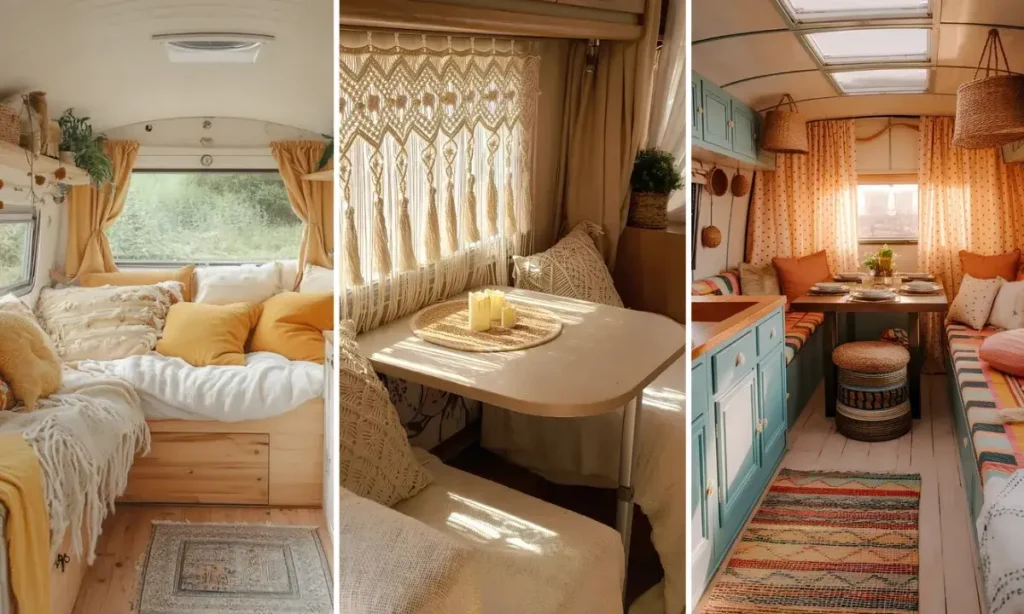
2. Dotted Print Instead Of Solid
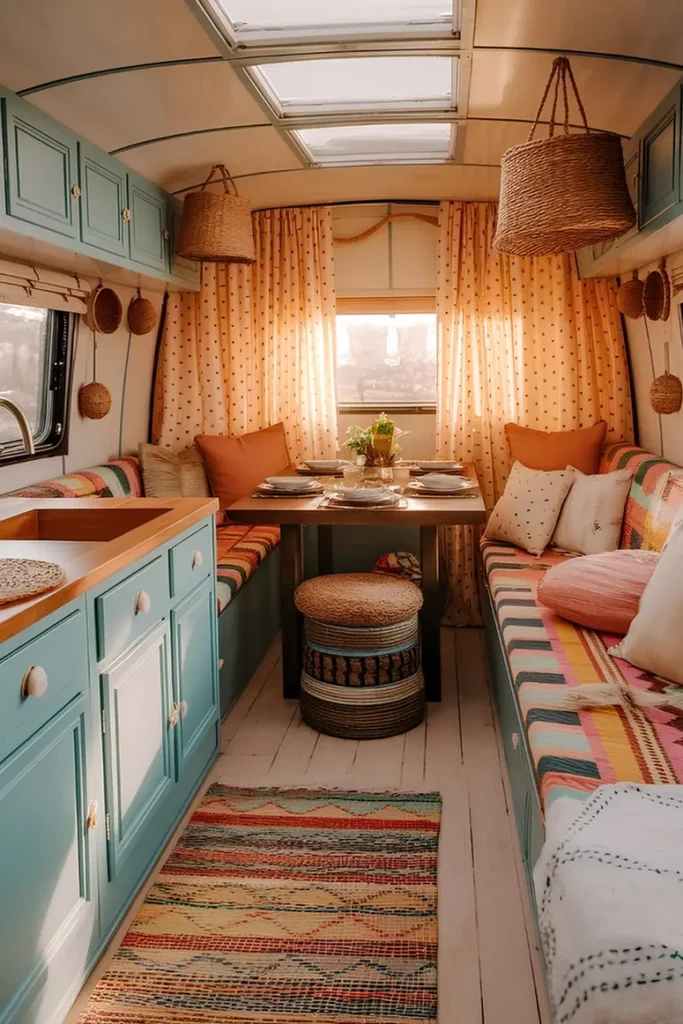
Most window treatment posts push solid neutrals for a “calming” RV. This dinette skips that advice entirely.
- A warm mustard sheer with a scattered dot print takes the place of a plain white panel.
- The pattern reads as texture from across the room, not busy, since the background stays sheer and pale.
- Paired with a teal cabinet run and a striped rug, the curtain becomes one more layer in a deliberately mixed palette instead of a neutral backdrop.
- Full-length panels pool slightly at the floor, softening the boxy dinette corner.
3. Macramé Panel As Focal Point
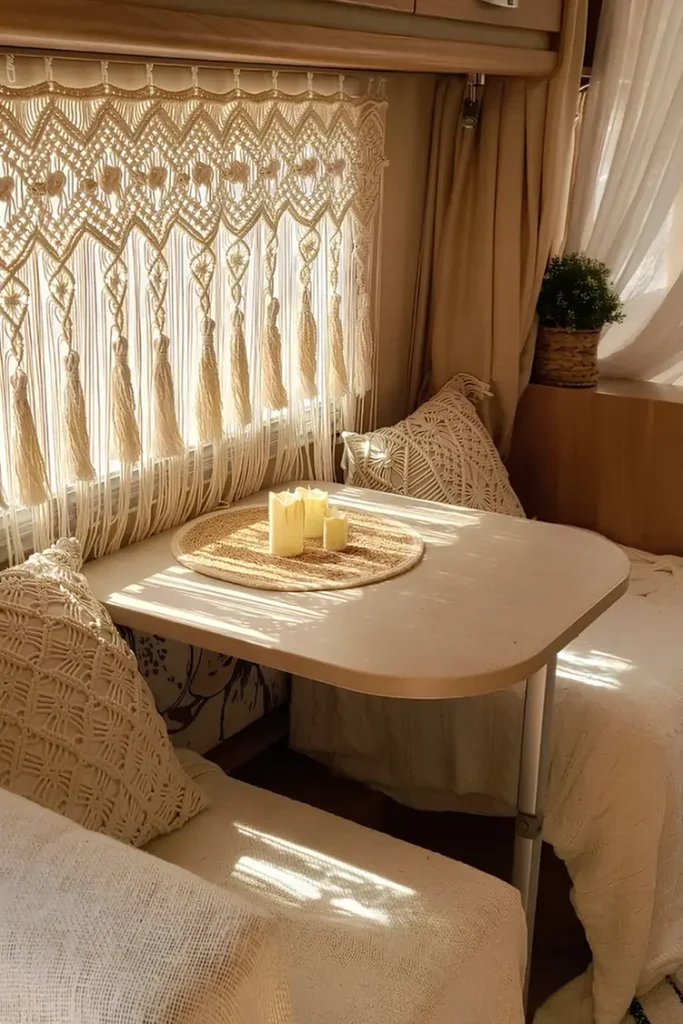
Skip the curtain rod entirely and treat the window like a canvas for one oversized macramé panel instead.
Hand-knotted diamond patterns stack into a deep tassel fringe that covers nearly the full window height.
Sunlight filters through the open knotwork in a way woven fabric never quite matches, casting soft rope-shaped shadows across the table below.
Heads up: cotton cord like this holds dust in the knots. A gentle shake-out every few weeks keeps the texture from going dull, and it should stay dry, since damp cotton takes a long time to fully release moisture in an enclosed space.
Mount the panel on the ceiling trim, not the window frame, so the fringe hangs a few inches past the glass on all sides.
Hanging it too tight to the glass, which flattens the tassels and hides the knotwork pattern.
4. Same Print Across Every Window
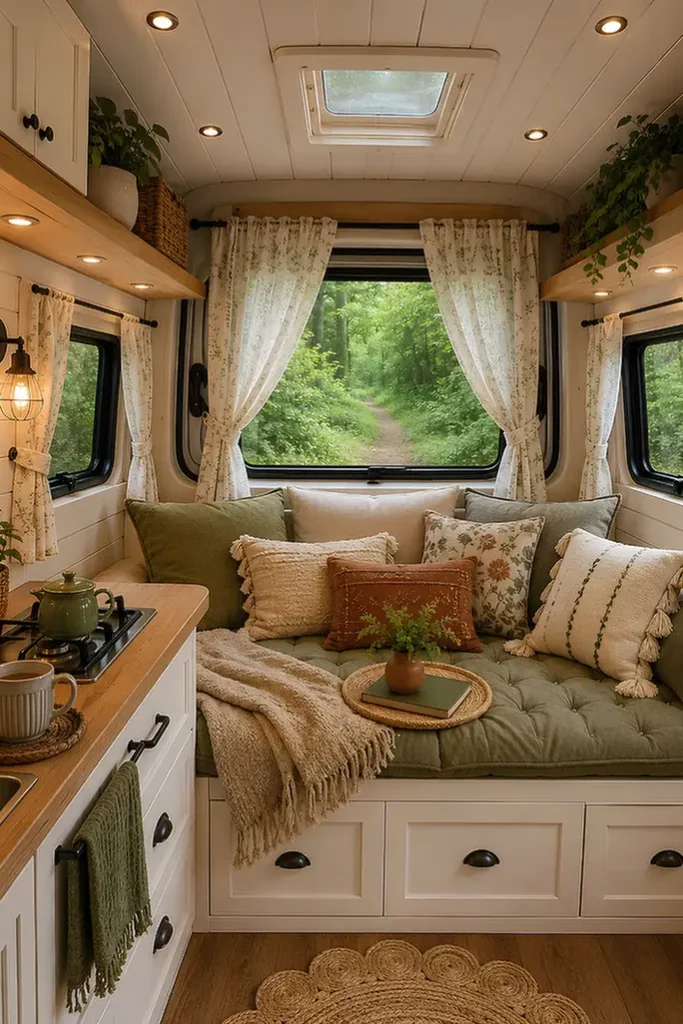
Curtains rarely match room to room in an RV, since most owners buy whatever fits each window opening.
This layout skips that. A soft botanical print in sage and rust repeats across the main window and both side windows, tied back the same way at each one.
The result reads less like separate window coverings and more like one continuous decorating decision, the kind of consistency that’s easy to overlook until a space without it feels scattered by comparison.
5. Matching Prints Across Two Layers
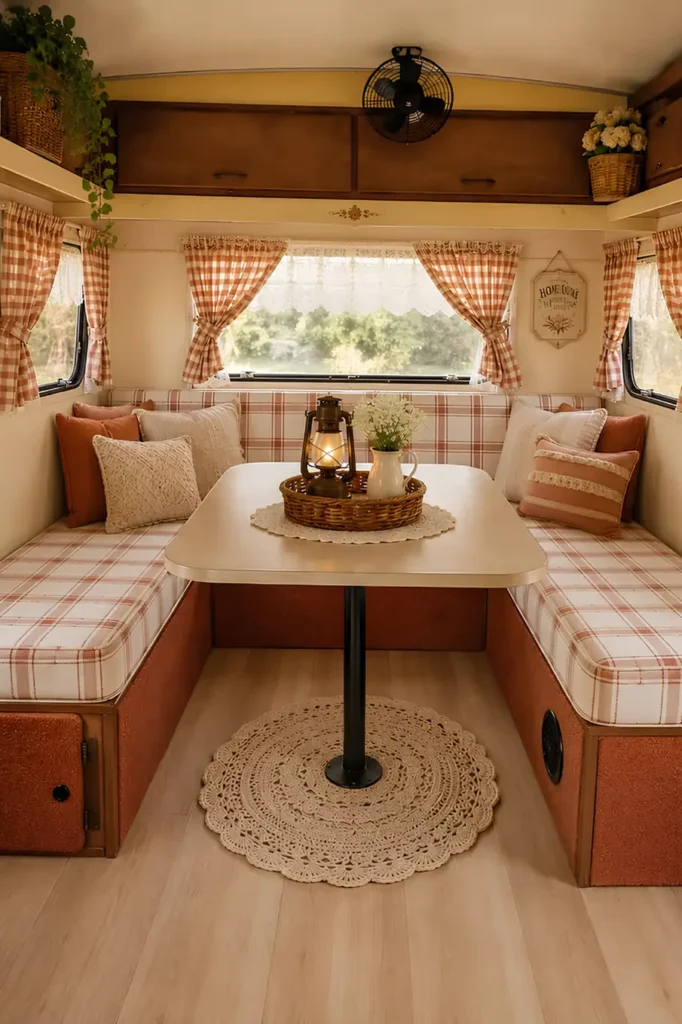
Vintage gingham curtains here don’t stand alone. They’re built to match the banquette cushions underneath, checked fabric in the same rust and cream running from the windows straight down to the seating.
A sheer lace valance layers behind the gingham panels, adding a second texture without competing for attention.
Tie-backs pull each panel open at the same height on all three windows, keeping the repeated pattern from looking crowded.
What to look for if copying this combination:
- Cushion fabric and curtain fabric close enough in tone to read as a set, not an exact match
- A neutral sheer layer behind any bold print, so the window still lets light through
- Consistent tie-back height across every window in the same room
6. Woven Shade Beats Factory Blinds
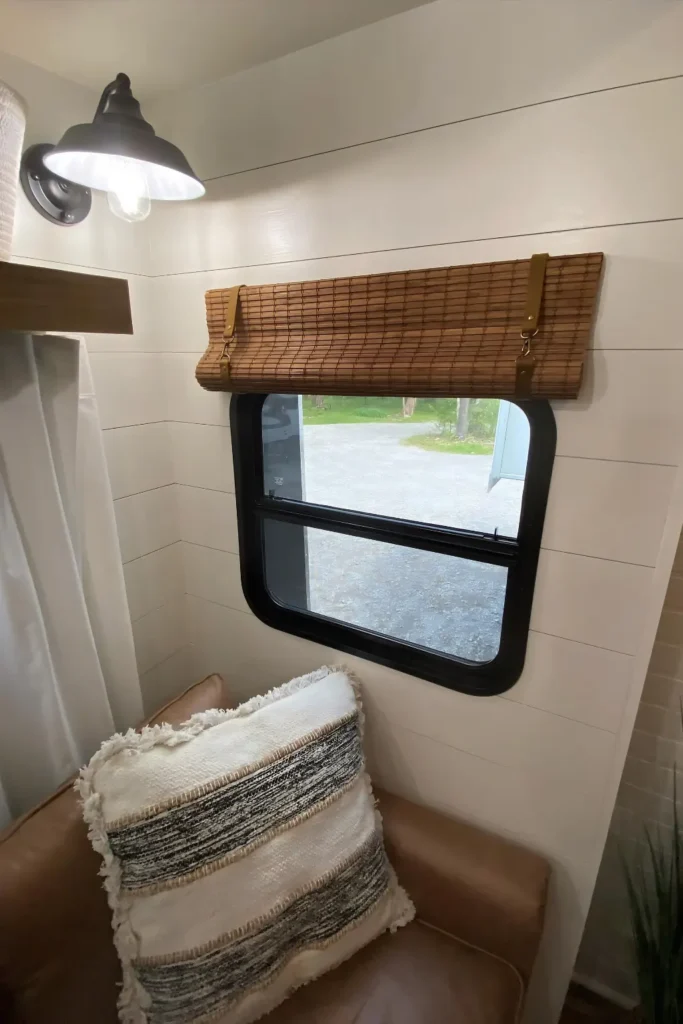
Most factory RV blinds roll up flat and vinyl, with a plastic wand that snaps eventually.
This one swaps in a woven bamboo roman shade held by two leather straps and brass buckles, the kind of hardware detail that reads as intentional rather than accessory.
Sun still gets filtered through the weave when it’s down. Fully raised, the whole shade folds into a slim stack that clears the window glass completely.
Leather takes on a little patina with heat and light over time, which most owners consider a feature, not a flaw.
7. Curtains That Double As Divider
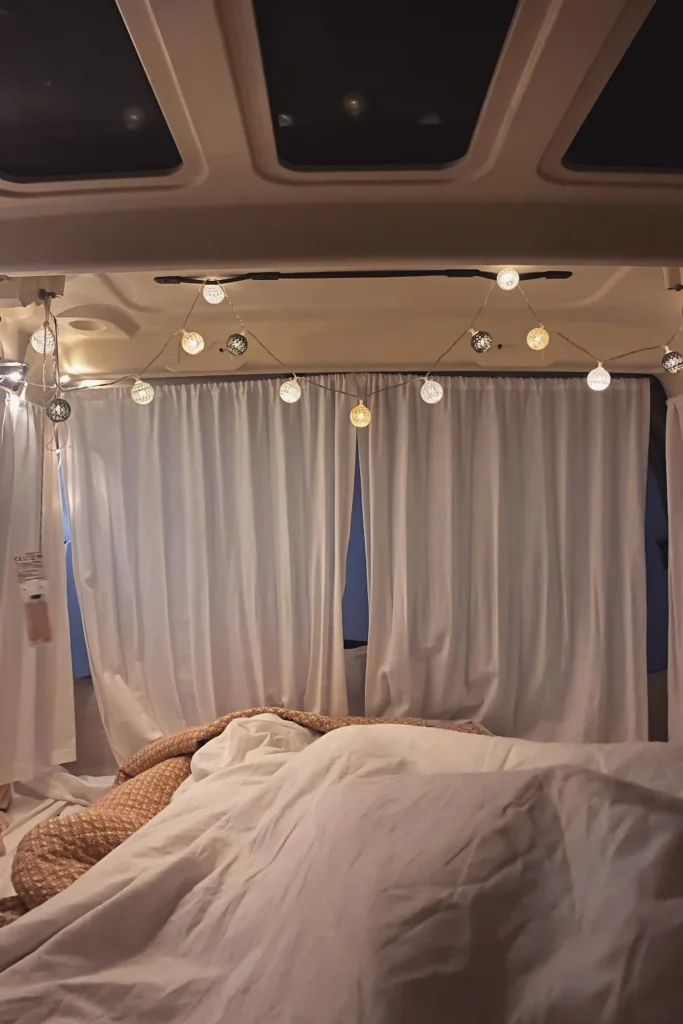
Cab curtains do double duty in a van or RV: block the windshield glare and section off the sleeping area from the front seats at the same time.
A simple rod-pocket panel in a soft grey gathers loosely enough to pull fully closed at night.
Tip: hang a warm string light along the same rod. It gives the space a soft glow after dark without adding a separate fixture to the ceiling.
Cotton-blend panels like this one hold up to regular pulling and closing better than a thin sheer would, since privacy curtains get handled daily.
💡 Quick Tip
Choose a rod that mounts flush to the ceiling trim, not the window frame, so the curtain covers the whole cab opening edge to edge with no gap for headlights to leak through.
8. Fringe Trim Dresses Up Sheers
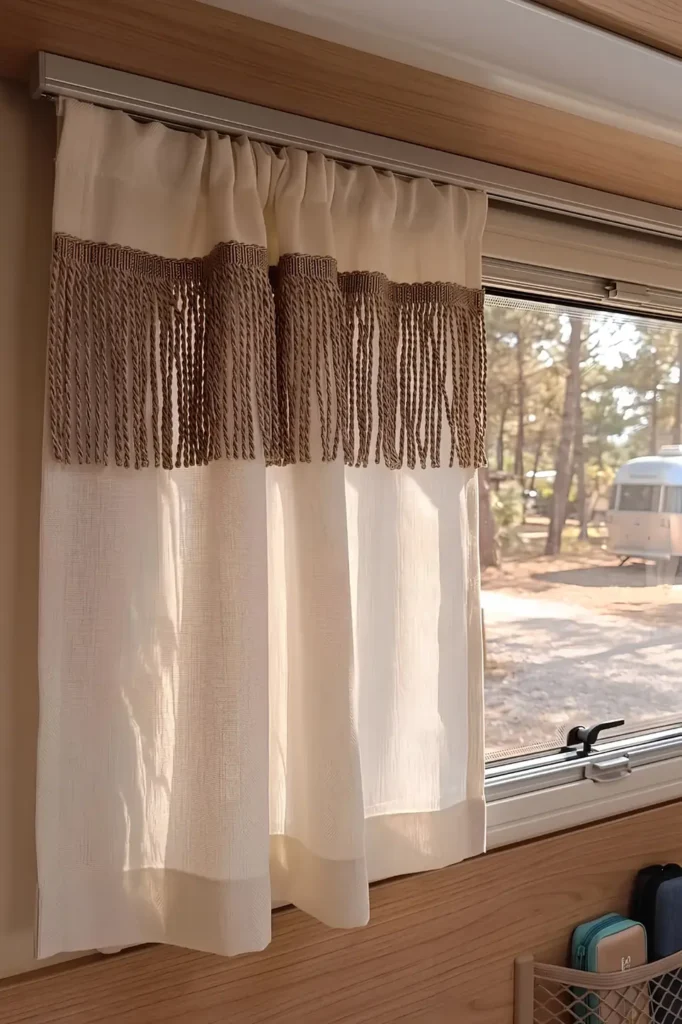
Most RV café curtains stop at a plain hem and call it done. This one adds a deep bullion fringe trim between the header and the panel, the kind of detail usually kept for house-scale window treatments.
The tassels catch light differently than flat fabric, so there’s movement even with the window shut. Mounted on a low-profile track instead of rings, the panel glides quiet and sits flush against the wood trim.
Cream linen fades evenly in direct sun, so rotating the panels side to side once in a while keeps the color from going patchy on one edge.
Breaks up a plain sheer panel without adding pattern or color.
Sits closer to the wall than rings, so nothing snags on nearby cabinets.
9. Tie-Backs Frame The View
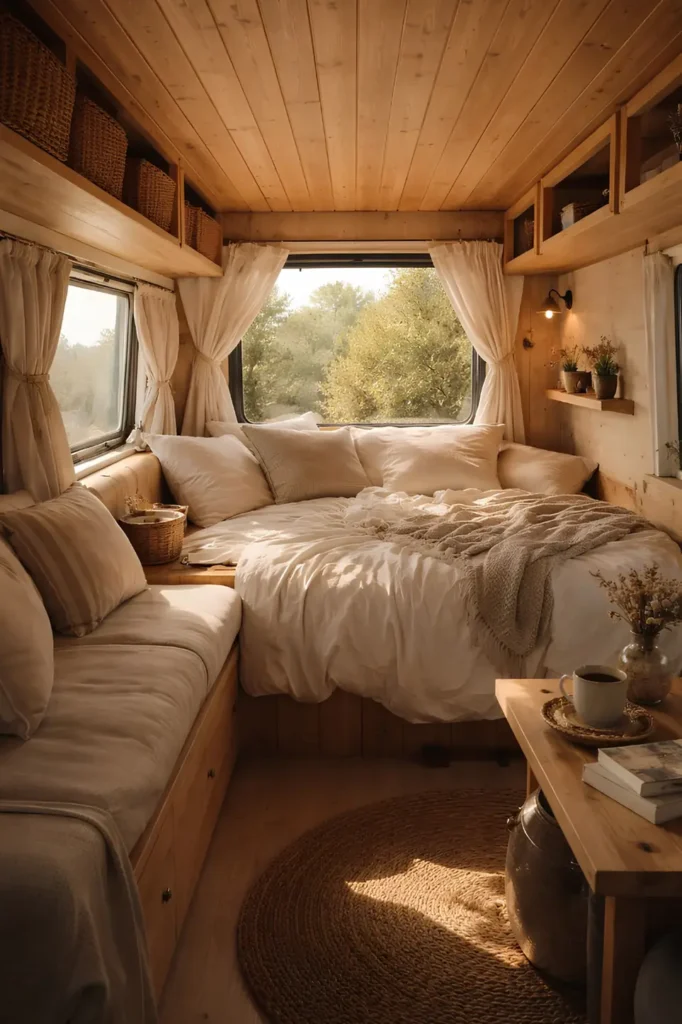
Plain white sheer panels here have one simple job: soften the light without blocking the trees outside.
Corded tie-backs pull each panel back toward the window frame, opening the view instead of draping fabric across it.
That one move keeps a low, wood-ceilinged nook with two skylights feeling brighter through the day.
Braided cord ties wear at the knot first with daily use. A slip-through loop style means swapping one cord later instead of stitching on a whole new tab.
10. Layer Blinds Under Curtains
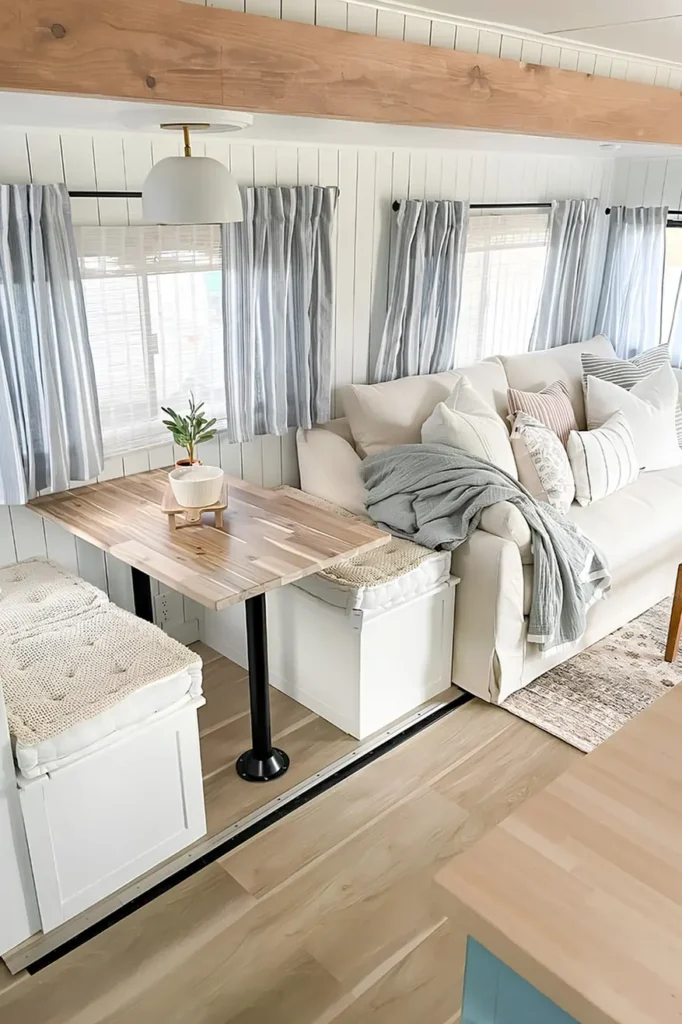
Most RVs get one window treatment and stop there, either blinds or curtains, rarely both.
This living space layers them. Mini blinds handle glare and privacy control up close to the glass. Striped grey curtains hang on a separate rod further out, softening the hard lines of the window frame and tying three windows together as one visual run.
The blinds do the practical work. The curtains do the styling work. Splitting the job between two layers means neither one has to compromise.
11. DIY Dowel Roll-Up Shade
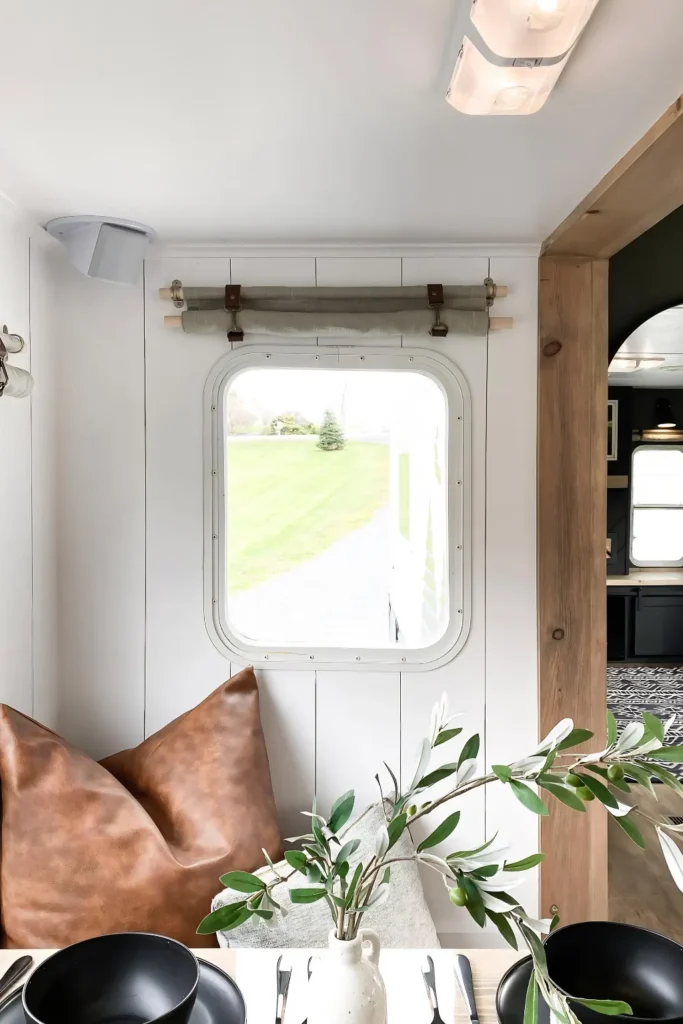
Two wooden dowels and a strip of linen turn into a roll-up shade for a fraction of what a store-bought roman shade costs.
The fabric wraps around the top dowel and rolls down to the bottom one, held in place by simple leather loop straps screwed straight into the wall.
No pull cords, no mounting brackets, no hardware kit. Rolling it up by hand each morning takes about ten seconds, and the linen stays loose enough that it never bunches or jams.
Two wood dowels, a length of linen, four leather loop straps, and screws.
No sewing needed if the fabric edge is already finished. Beginner friendly.
12. Curtain Color Echoes The Pillows
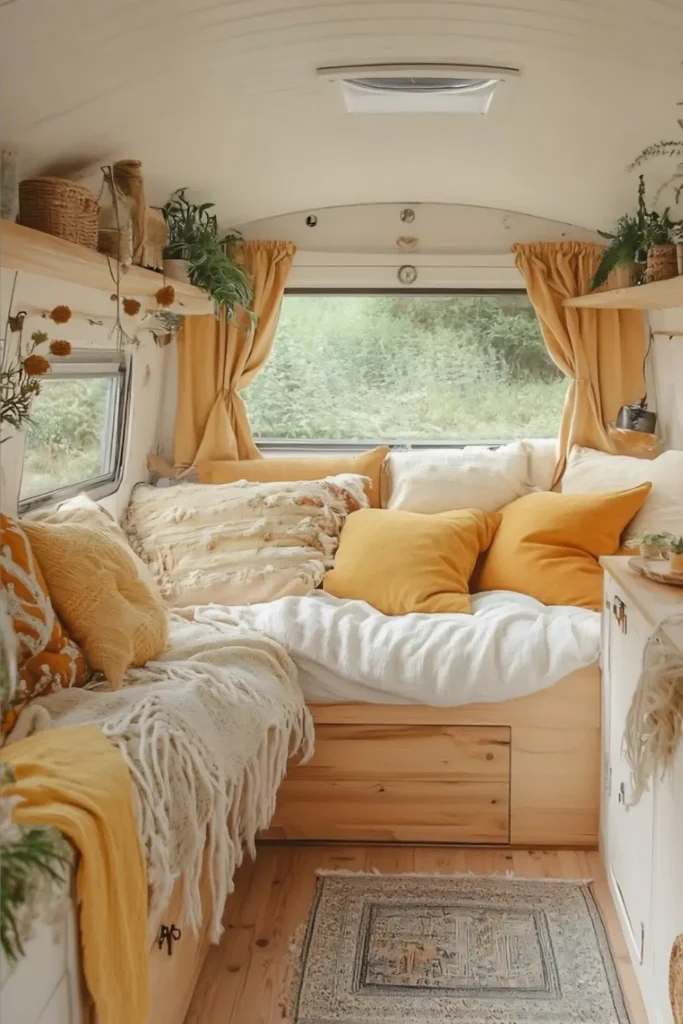
Neutral curtains work almost everywhere, which is exactly why they blend into the background instead of anchoring a room.
Here, saturated mustard panels get picked up again in two throw pillows and a folded blanket, so the color reads as one connected palette instead of three separate choices.
Loosely knotted at shoulder height, each panel stays tied back without hardware. That single small habit, tucking the fabric out of the way by hand, keeps a small sleeping nook from feeling boxed in by two heavy panels.
Recreate this look
13. Pattern Lives Only Up Top
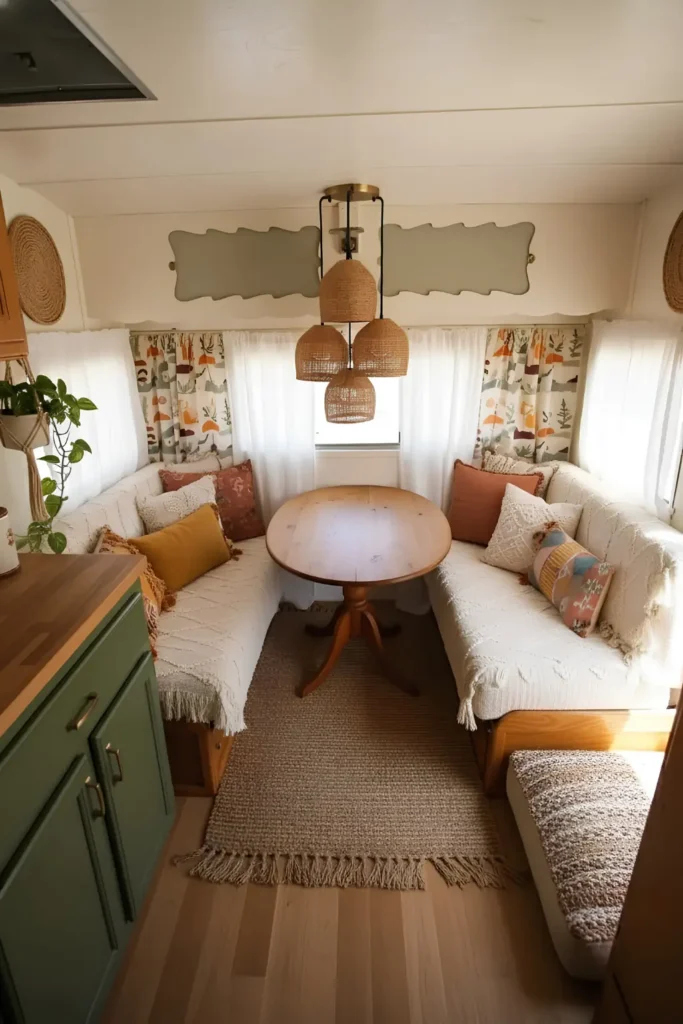
Most patterned curtains commit fully, floor to ceiling, print the whole way down.
This dinette takes a different approach. A printed valance panel sits above a full sheer curtain, so the pattern reads as a cornice detail rather than covering the entire window.
Printed fabric near the ceiling fades slower than a full panel would, since it gets less direct sun exposure than fabric hanging lower against the glass.
14. Café Curtains On A Panoramic Window
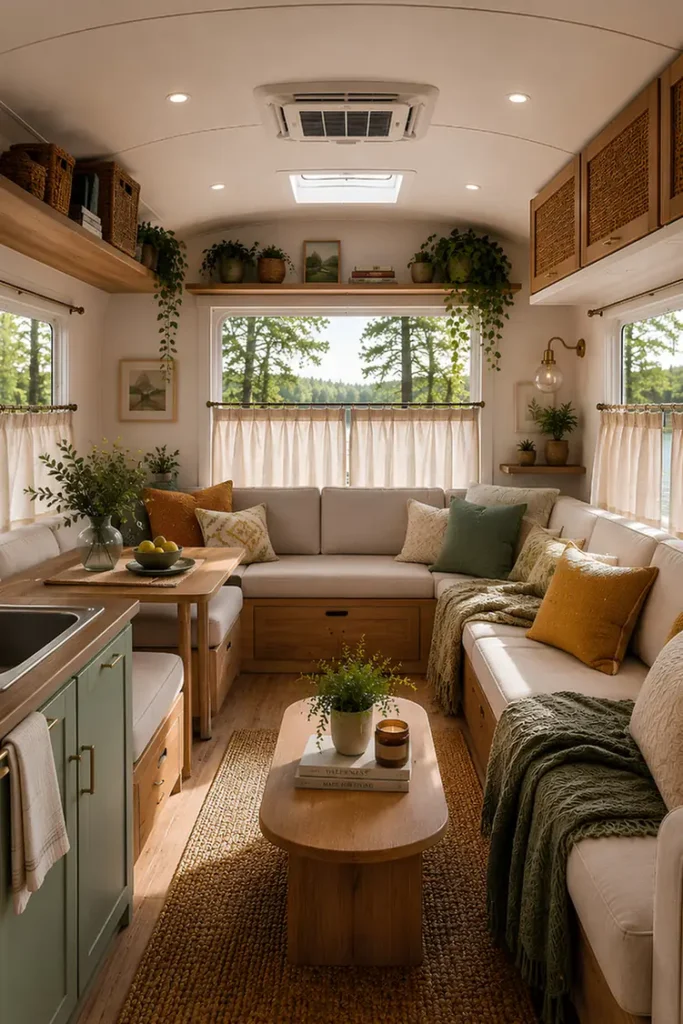
A full-width picture window like this one doesn’t need floor-length drapery to feel finished.
Ring-clipped café panels cover roughly the bottom two-thirds of the glass, hung on a slim rod that spans the entire opening in one continuous line rather than three separate small curtains.
Leaving the top third bare keeps the tree line fully visible from the seating area. Linen in a warm oatmeal tone stays close enough to the wall color that the curtains read as part of the room, not an accent competing with the sage and mustard pillows nearby.
Mount one slim rod across the full window width, not three separate rods.
Hem panels to cover about two-thirds of the glass, leaving the top open.
Choose a linen tone close to the wall color so the panels blend rather than pop.
15. Alternate Colors Down One Long Rod
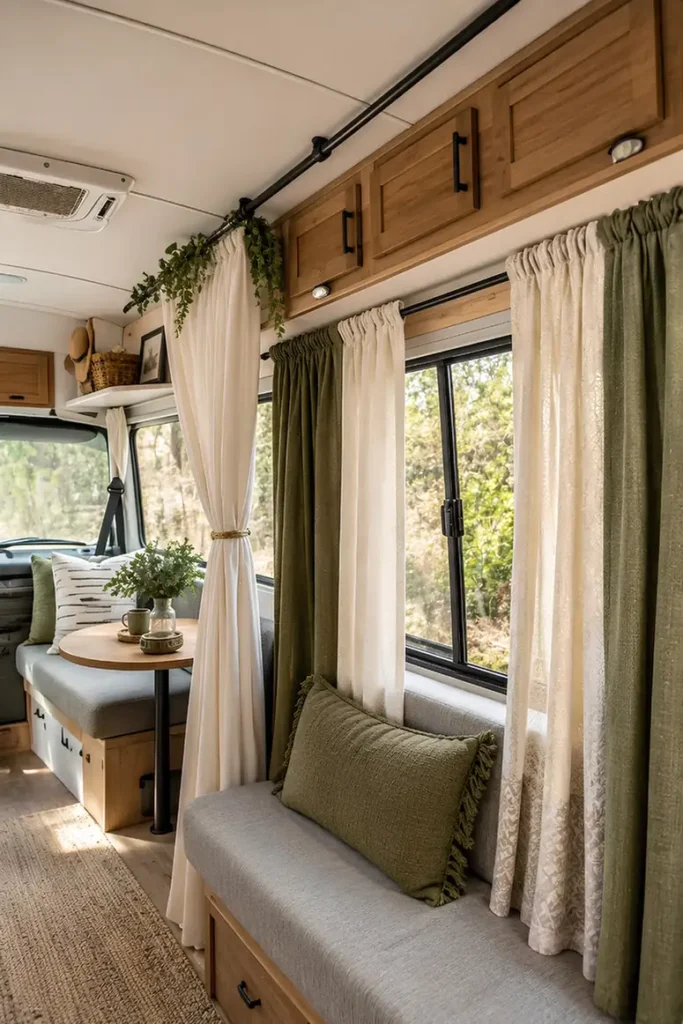
One continuous black rod runs the full length of this window wall, but the panels hung on it aren’t uniform.
Solid olive and sheer cream alternate side by side, so the pattern comes from color placement alone rather than a printed fabric.
A single rope tie-back at the front corner pulls just one cream panel back toward the cab, opening a sightline to the driver’s area without disturbing the rest of the run.
The rest stay loose, giving the long wall a slight ripple instead of a flat, uniform line.
Alternate solid and sheer panels on the same rod.
Tie back only one panel per window run for an asymmetrical opening.
Let a trailing plant spill over the rod near one end for softness.
16. Tasseled Ties Complete The Look
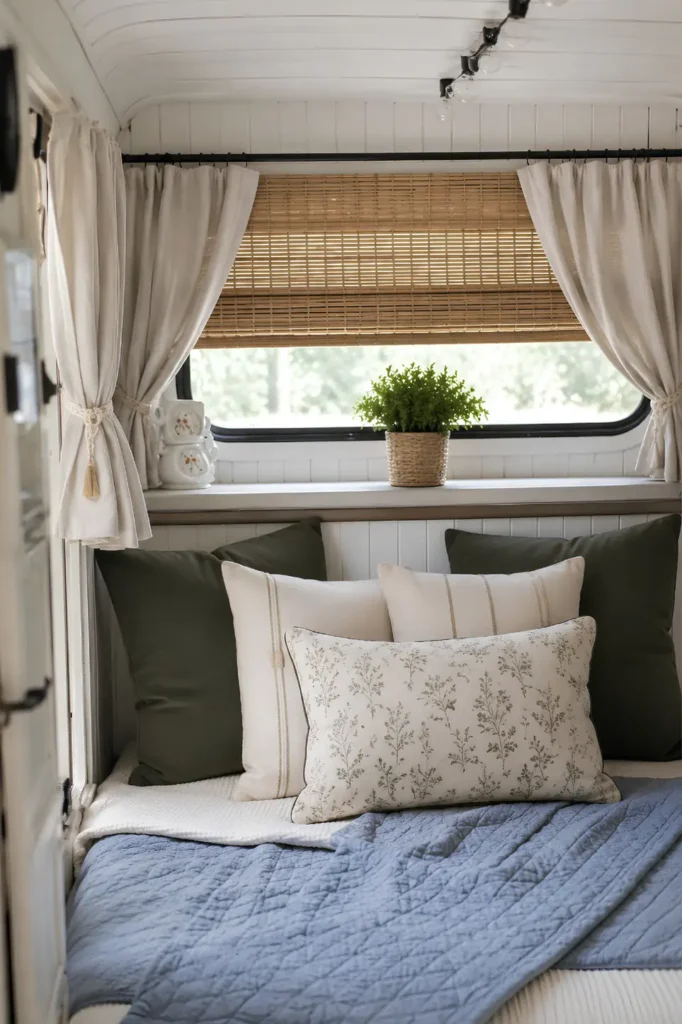
Rope tie-backs with tassel ends do more here than just hold the curtain open.
They add a handmade touch that matches the woven shade behind them, so two separate treatments read as one coordinated system instead of a curtain plus an afterthought.
- The tassel tail hangs loose below the knot, adding movement even when the fabric itself sits still
- A dressed sill, small ceramic pieces and a potted plant, keeps the whole window from feeling like just hardware and fabric
- Linen panels stay a shade lighter than the woven shade, so the layers read as intentional, not matched by accident
17. A Swagged Valance Softens Hard Lines
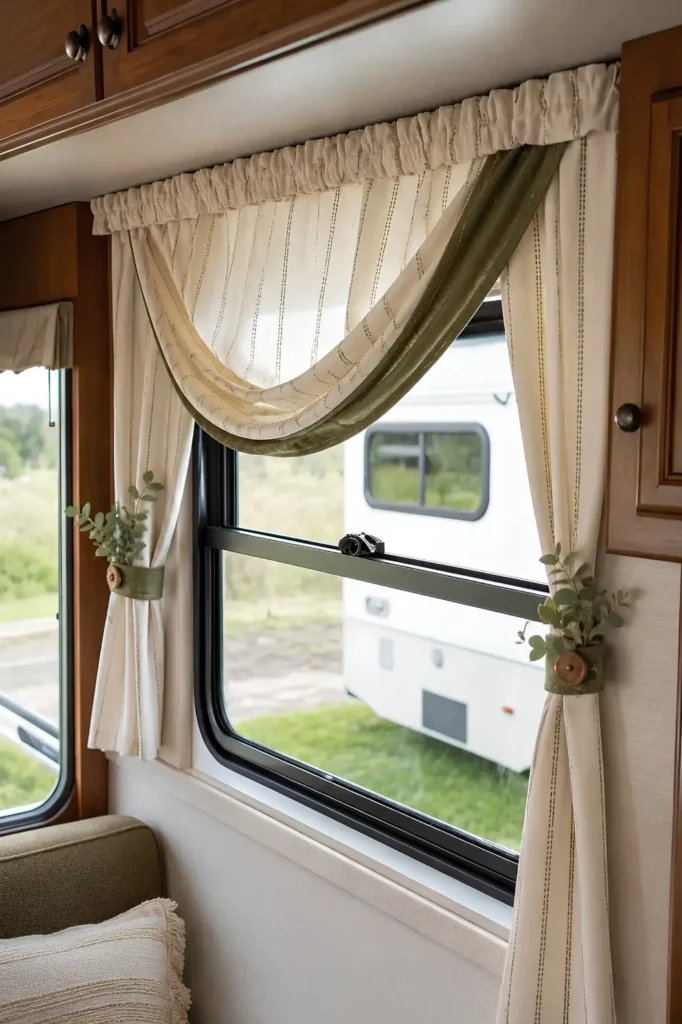
Straight panels aren’t the only option for a cabinetry-flanked window like this one.
A swagged valance drapes the fabric across the top in a soft arc, with one olive jabot cascading down the side instead of a matching straight panel on both edges. Underneath, striped café curtains handle the actual privacy and light control.
Wood button tie-backs holding faux greenery sprigs pick up the same warm tones as the surrounding cabinetry, so the whole treatment feels built into the room rather than added on top of it.
18. Solid And Print Alternate By Window
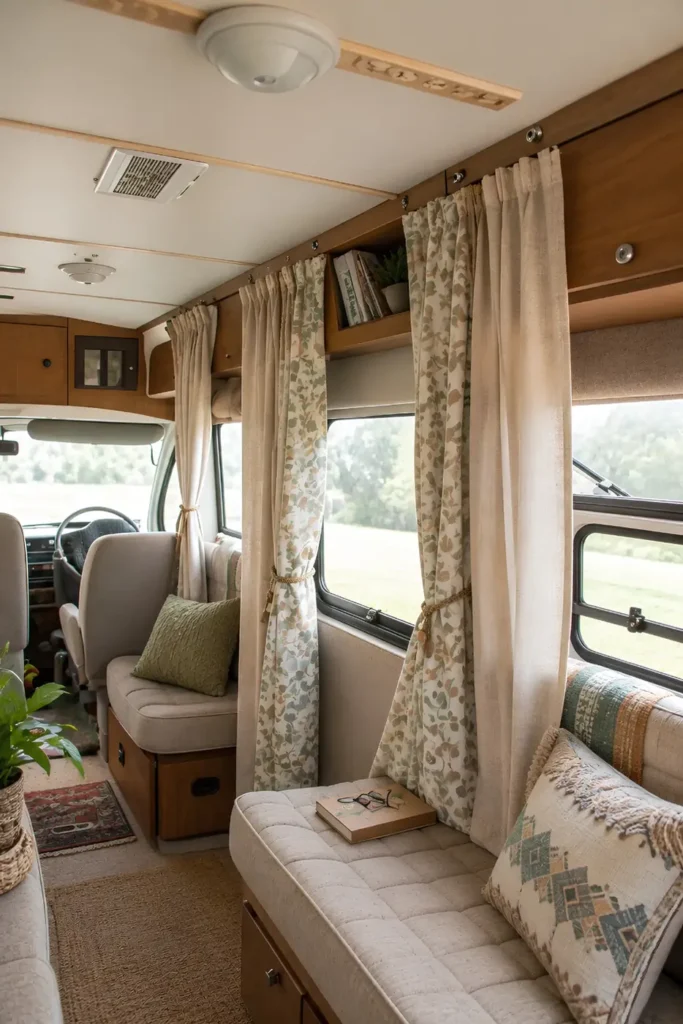
Every window along this wall gets a different curtain, but not randomly. Solid oatmeal linen and a small botanical print trade off one after another down the length of the couch.
Rope tie-backs pull each panel to the same side at the same height, so even though no two windows match exactly, the rhythm down the wall feels planned rather than mismatched.
Watch out: an irregular pattern like this only reads as intentional if the tie-back height and rope color stay identical at every single window. One inconsistent knot breaks the illusion fast.
Solid linen panel, quiet and neutral.
Botanical print panel, small scale and soft toned.
Alternate them window to window on the same rope tie-back system.
19. Pom-Pom Trim Adds A Playful Edge
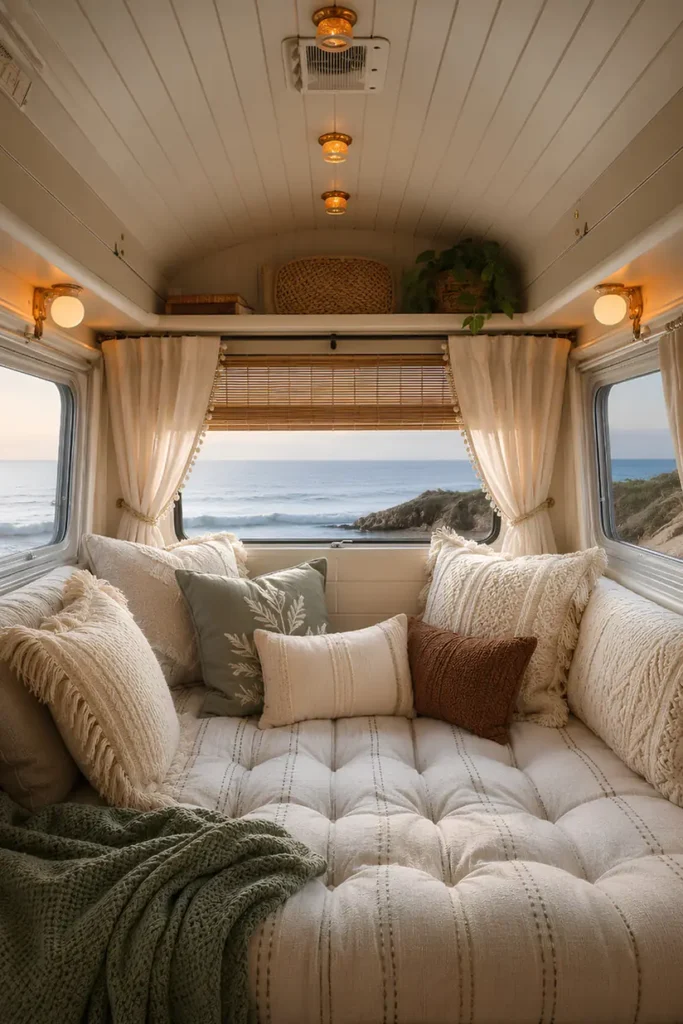
Pom-pom trim along the leading edge of a curtain panel turns a plain neutral drape into something with a little more personality.
- Ball fringe traces the inner edge where the panels meet, visible even when they’re pulled open and tied back
- A woven bamboo shade layers behind for daytime privacy without blocking the ocean view
- Rope tie-backs echo the same natural, textured feel as the shade slats
Cream fringe against cream fabric keeps the detail subtle instead of loud, so it reads as texture first and trim second.
20. Two Treatments, One Room
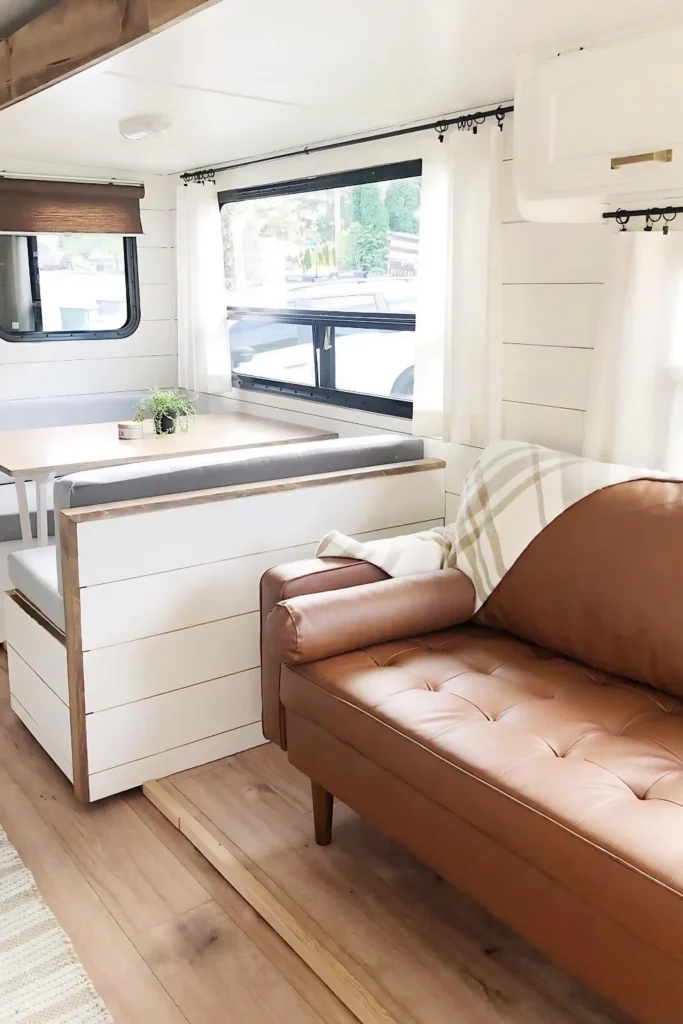
Not every window in an RV needs the same solution. This layout proves it by using two entirely different treatments a few feet apart.
The small side window gets a woven bamboo Roman shade for quick privacy without extra fabric bulk in a tight corner.
The larger picture window nearby gets soft white sheers on a black rod, letting in the most light where the space can afford it.
Matching hardware finishes, black rod and black shade brackets, keep the two different treatments from feeling mismatched.
| Small window | Large window |
|---|---|
| Woven roman shade, quick privacy | Sheer panels, maximum daylight |
| Wall-mounted, no rod needed | Full-width black rod |
Conclusion
Twenty windows, twenty different fixes, and not one factory blind left standing. That’s really the whole point here. There’s no single right curtain for an RV, just the one that matches your window shape, your light, and how much time you want to spend on it this weekend.
Start with whichever idea felt the easiest to picture in your own space. Pin the rest for later. Chances are your next window update won’t be your last.