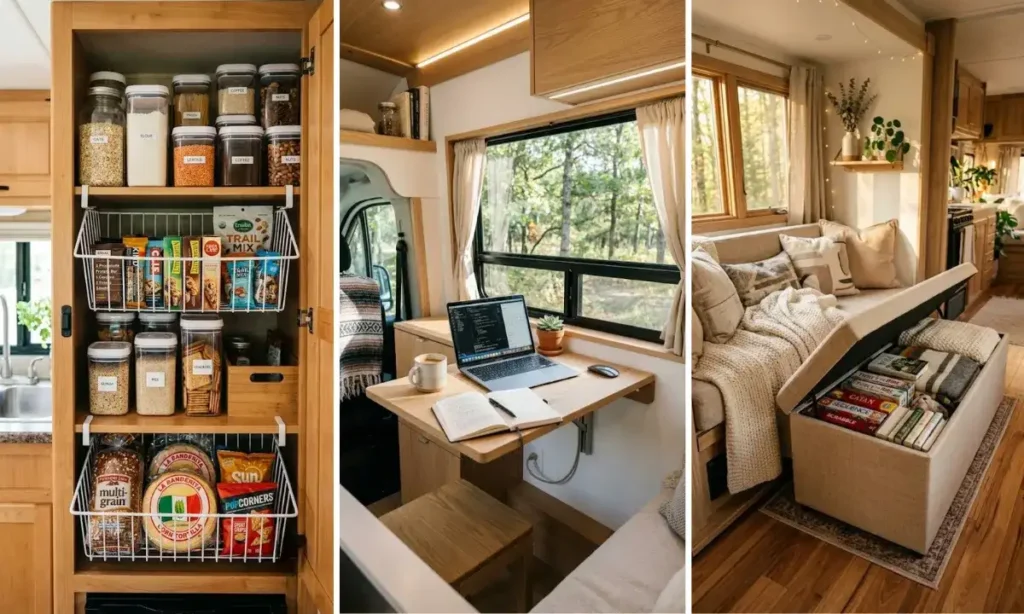
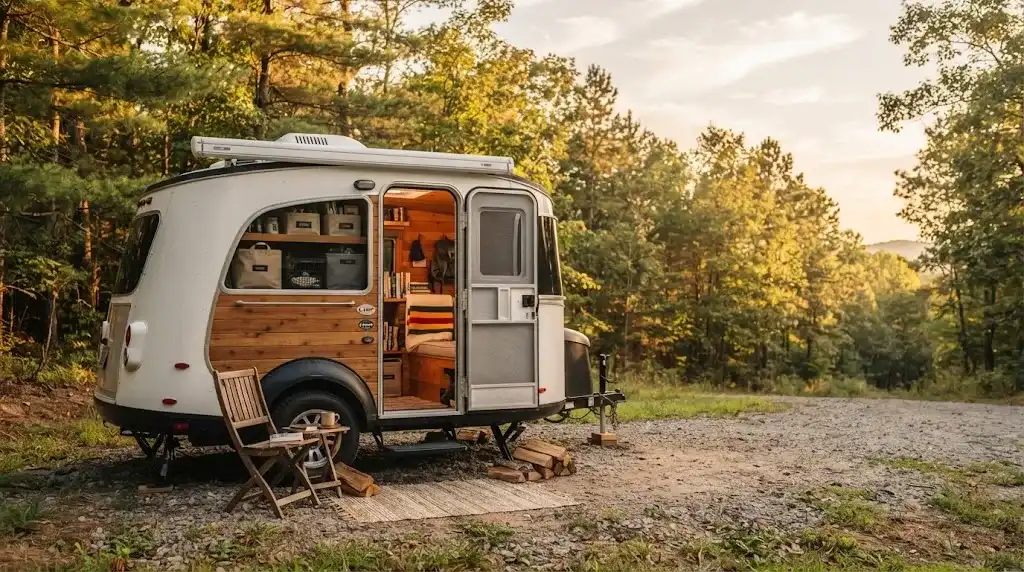
Most people prepare for a month-long RV trip the same way they’d prepare to move into a new house. They pack extra everything: extra shoes, extra dishes, extra just-in-case items that never leave the cabinet.
That instinct makes sense. A month feels long enough to justify it. But an RV doesn’t work like a closet with wheels. Every extra pound changes how the rig handles, and every extra item eats space you’ll want for groceries and gear you actually use.
This guide walks through how to pack an RV for a month-long trip using a system, not a guess. You’ll sort what earns a spot, load it so the rig stays balanced and legal, and still have room to breathe by week three.
None of this needs fancy organizers or a full weekend. Budget about half a day for sorting and loading, done in one push or split across two evenings. The hardest part isn’t the packing. It’s letting go of the “just in case” pile.
- Collapsible storage bins (4-6)
- Packing cubes, 3 sizes
- Non-skid cabinet liner
- Tension rods for closets
- Over-door shoe organizer
- Bathroom or luggage scale
- Painter’s tape and marker
- Notepad or phone checklist app
- Bungee cords (optional)
Sort your belongings into three piles before you touch a single bag

Most over-packing happens before the first bag is even opened.
It starts the moment you guess instead of sort.
Clear a flat surface, a bed or table works, and pull everything you’re considering into one spot.
Then split it into three piles:
- Definitely worn or used in the last two weeks
- Maybe you hesitated on it more than once
- No– it hasn’t been touched in over a month
If something lands in Maybe twice, move it to No. That hesitation is usually the real answer.
Check your RV’s weight rating before you pack anything
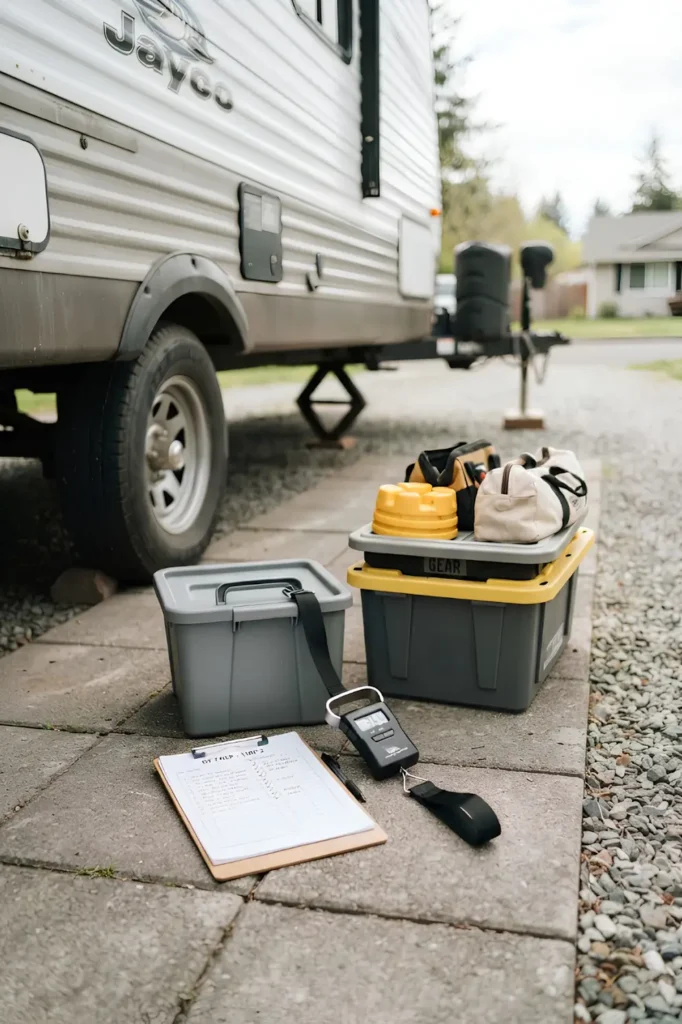
Find your RV’s GVWR (Gross Vehicle Weight Rating). It’s usually on a sticker inside the driver’s door, or in the owner’s manual.
This number is the absolute max your rig can weigh, fuel, water, people, and gear all included.
Go over it, and handling gets unpredictable fast, especially on hills and in wind.
Subtract your RV’s empty weight from the GVWR. What’s left is your Cargo Carrying Capacity, often just 1,000 to 1,500 pounds for travel trailers.
Don’t know your empty weight? Most dealerships and CAT scales will weigh it for a small fee.
Load heavy items low and centered over the axles
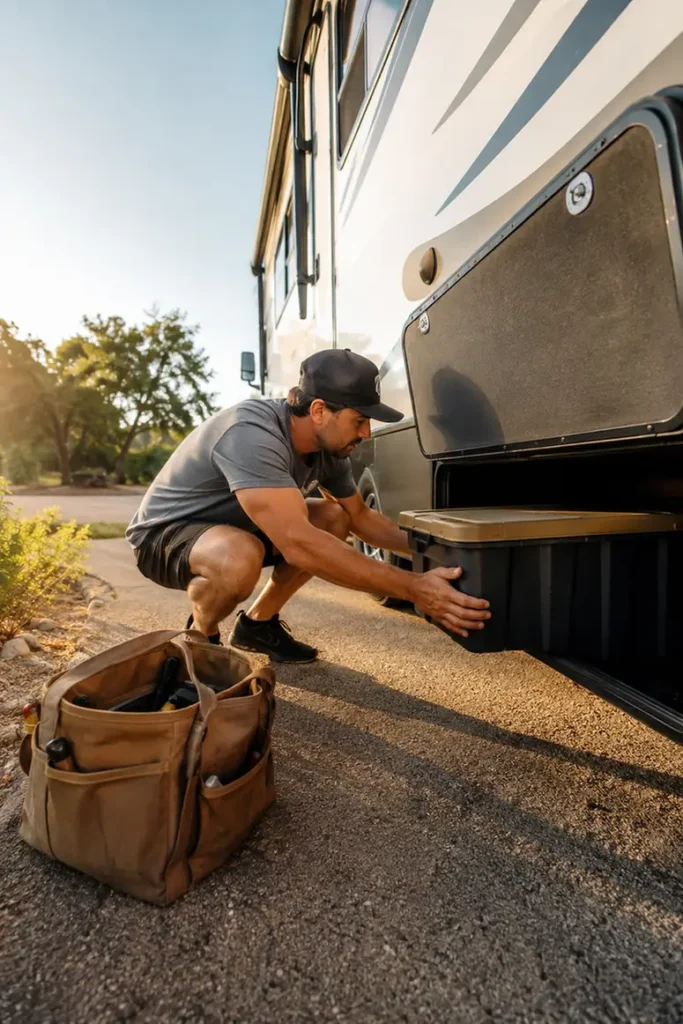
Weight placed high and toward the back turns your RV into a pendulum on the highway.
Store your heaviest items, water jugs, canned food, tools, low and as close to the axle line as you can.
Most people load groceries in the back cargo bay because it’s the easiest reach. That’s exactly the wrong spot for anything heavy.
Aim for roughly 60% of cargo weight in the front half of the rig. This keeps tongue weight in a safe range on travel trailers.
Build a one-month capsule wardrobe that fits two drawers
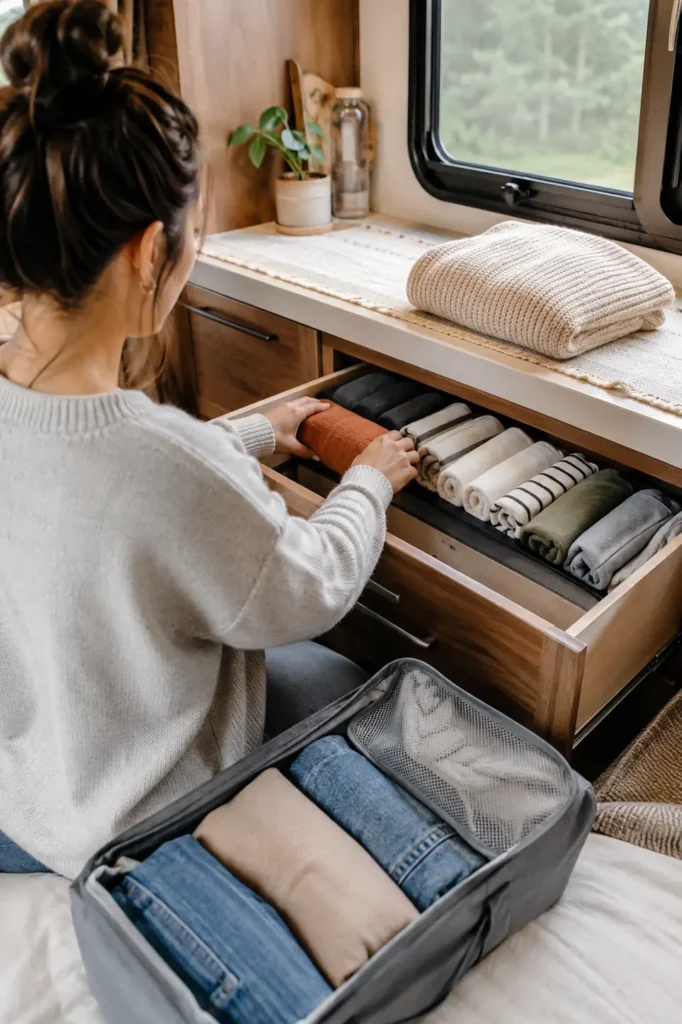
How many outfits does a month on the road actually require? Fewer than you’d guess.
Pick one drawer for tops and one for bottoms. Build around pieces that mix and match at least three ways.
A simple five-category capsule covers it:
- 5-6 tops in colors that pair with everything
- 3 bottoms, plus one dress or layering piece
- 1 warm layer, 1 rain layer
- 7 pairs socks and underwear
- 2 pairs of shoes, plus sandals
If a piece doesn’t pair with at least two others, it hasn’t earned the drawer space.
Stock a compact kitchen with dual-purpose cookware

Choose cookware that pulls double duty before anything single-purpose earns a spot in the cabinet.
A cast iron skillet works stovetop and in the oven. One decent stockpot handles pasta, soup, and steaming vegetables.
You will be tempted to bring the full set from home. Leave it. You’ll use four pieces the entire month, tops.
Collapsible measuring cups and a silicone colander save real cabinet depth, which matters more in an RV than it ever did at home.
Pack a toiletries and health kit that’s easy to refill on the road

A refillable kit beats a stockpile every time. RV storage is small, and grocery stores are everywhere on a month-long route.
Fill travel-size bottles for anything you use daily, shampoo, sunscreen, toothpaste, rather than packing full-size containers you’ll only use once.
Keep these together in one bag:
- A week’s worth of any daily medication, in a labeled organizer
- A basic first aid kit (bandages, antiseptic, pain reliever)
- Any prescriptions, in their original labeled bottles
Refill toiletries at any stop along the way instead of hauling a month’s supply from day one.
Secure loose items and cabinets before departure day
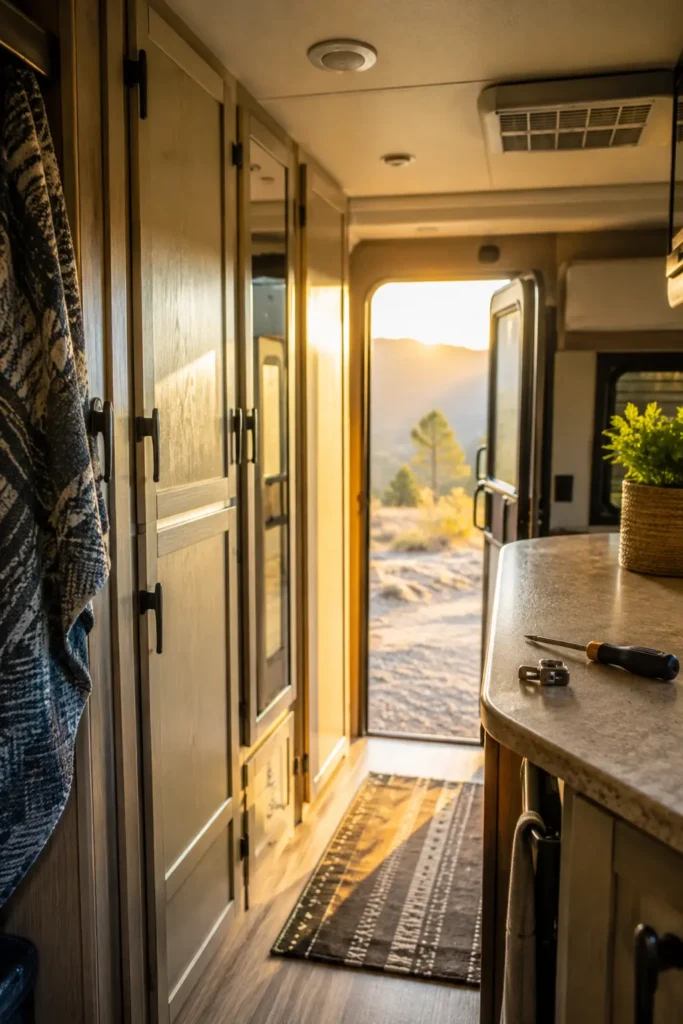
Walk through the RV cabinet by cabinet and test every latch by hand before you pull out of the driveway.
A cabinet that looks closed can still pop open on a sharp turn, sending dishes across the floor.
It usually happens on the first pothole, not the tenth. Most rigs lose at least one item that way on a first trip.
Swap out any weak latch for a cabinet lock now, not after something breaks.
Finish with one exterior walk-around: storage bay doors, entry step, and awning, all locked before you start the engine.
Fix: pick one multi-use version instead of three backups.
Fix: weigh in stages as bins go in, not after everything’s loaded.
Fix: smaller bins, labeled by category, not by size.
Fix: count water at roughly 8.3 lb per gallon before your final load.
- Bins and packing cubes
- Bathroom scale
- Tension rods
- Refillable toiletry bottles
- Sort into 3 piles
- Check GVWR / CCC
- Load heavy items low + centered
- Pack capsule wardrobe
- Stock dual-purpose kitchen
- Pack refillable toiletries
- Secure cabinets + walk-around
You’ve turned a month-long trip into something that actually fits inside the rig, not something you’re wrestling into it. Every drawer has a job now, and the RV still handles the way it should.
Next time you’ll pack faster, because the system stays the same even when the trip changes. Make it yours by swapping the capsule wardrobe for your own climate and route.
Save this now, so it’s waiting in your Pinterest boards the next time you’re staring at an empty cabinet wondering where to start.