
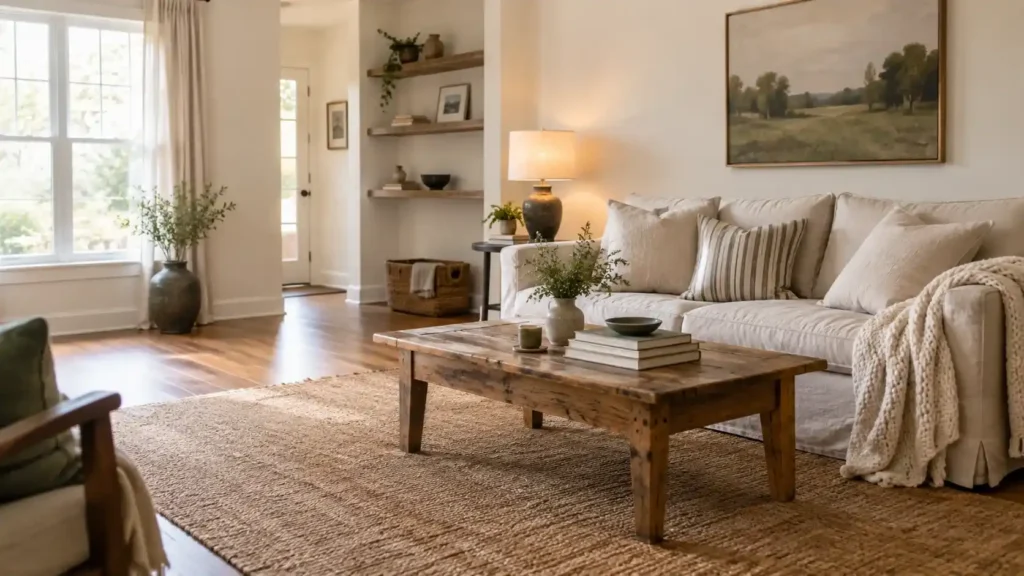
Most people think farmhouse means buying a sign that says “Gather” and a clock with giant numbers. Then they wonder why the room feels like a store display.
Real farmhouse rooms were never bought in one trip. They grew slowly, from things that were useful, worn, and a little mismatched.
This guide shows you how to decorate a farmhouse living room on a budget using that same idea. You will paint, rearrange, thrift one good wood piece, and layer soft textures until the room feels collected instead of staged.
By the end, you will have a warm, lived-in living room that looks like it took years. It will not.
Plan on two weekends. The hands-on work is about 10 to 12 hours, and most of the rest is paint drying.
No special skills needed. If you can use a paint roller and move a sofa, you can do every step here.
Grab a notebook, clear a little floor space, and start with the cheapest tool you own: your eyes.
Paint needs about 4 hours to dry between coats, so plan the wait into your schedule.
Your Shopping & Tool List
Check your garage and closets before buying anything. Items marked optional can wait.
Tools
- Measuring tape (25 ft)
- Paint roller with 3/8-inch nap cover
- Angled brush, 2 inches
- Painter’s tape
- Drop cloth or old bedsheet
- Felt furniture sliders
- Step stool
- Optional: sanding block, 120-grit
Materials
- Warm white wall paint, 1 gallon
- Washable slipcover for your sofa
- One aged wood piece (thrifted)
- Natural-fiber rug, 8×10 ft
- Warm bulbs, 2700K
- Linen or cotton throw pillows
- Chunky knit or wool throw
- Optional: one fixture or lamp
The 10 Steps at a Glance
Clear the room and keep only what you already love
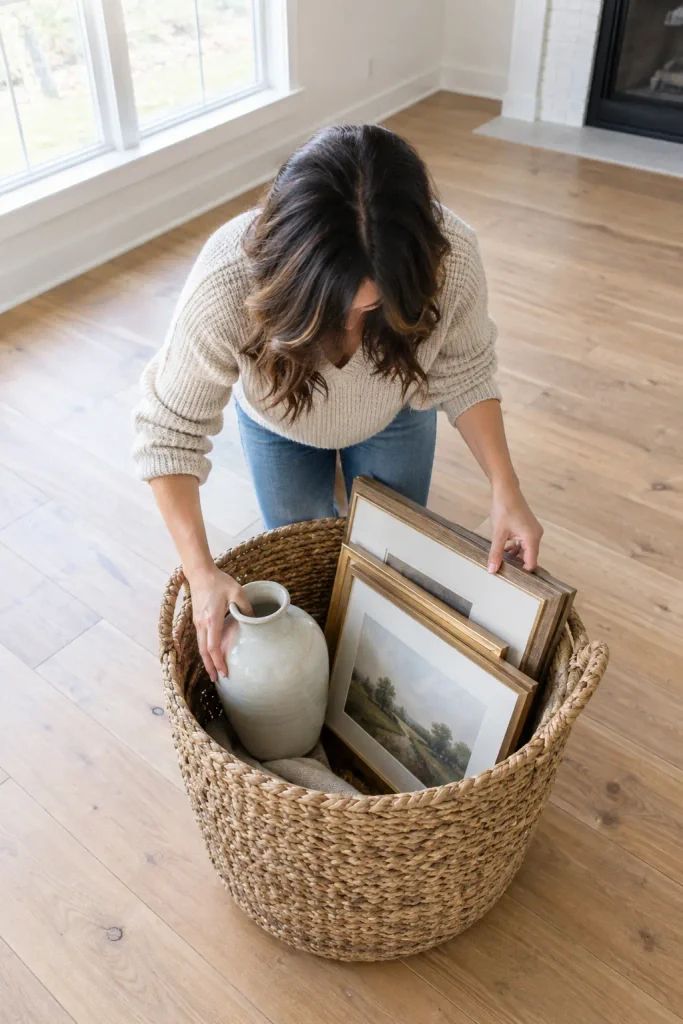
Your budget starts with what you already own. Don’t buy a single thing yet.
Carry everything small out of the room: frames, candles, baskets, throw pillows, vases. Stack them in the hallway or on a bed.
Now bring back only the pieces you would grab in a fire. A room with 8 to 10 keepers beats a room with 30 maybes.
Expect the empty room to feel strange. Echoey, even. Most people want to rush this part. Don’t. The bare walls show you what the room actually needs.
Pick three colors and stick to them
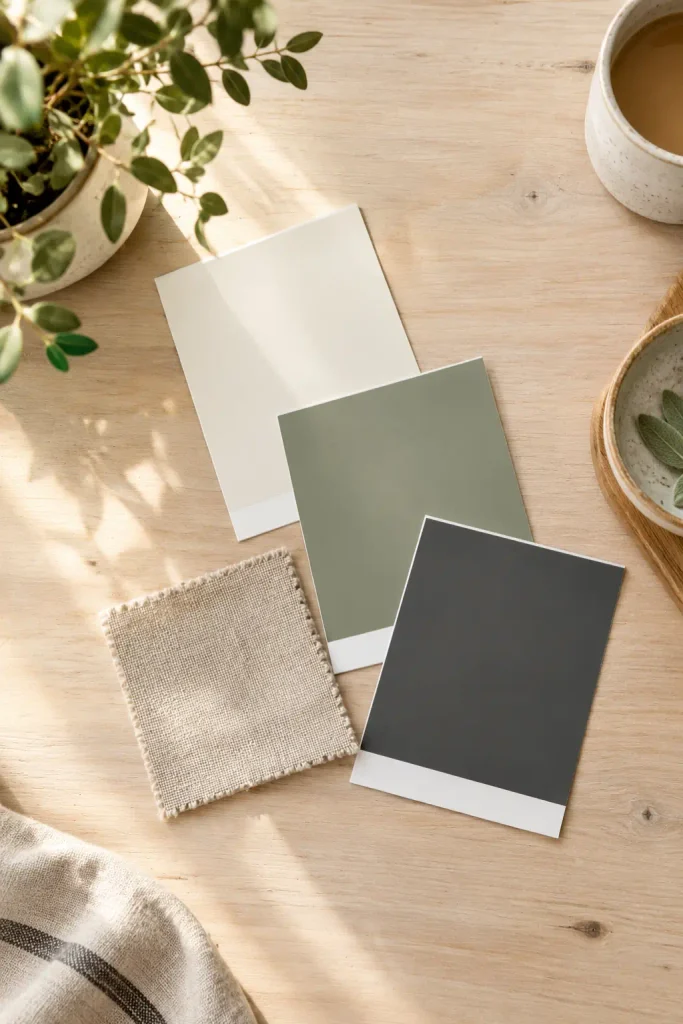
Write down exactly three colors: one light, one mid-tone, one dark. Warm white, sage green, and charcoal are a classic farmhouse set. Cream, tan, and black work too.
Why only three? Farmhouse feels forced when every shelf pulls a different direction. Repeating a few colors is what makes a room look planned instead of bought.
Take a photo of your keepers from Step 1. If a piece fights your three colors, it goes back to storage, or gets a thrift-store life.
Paint the walls a warm white
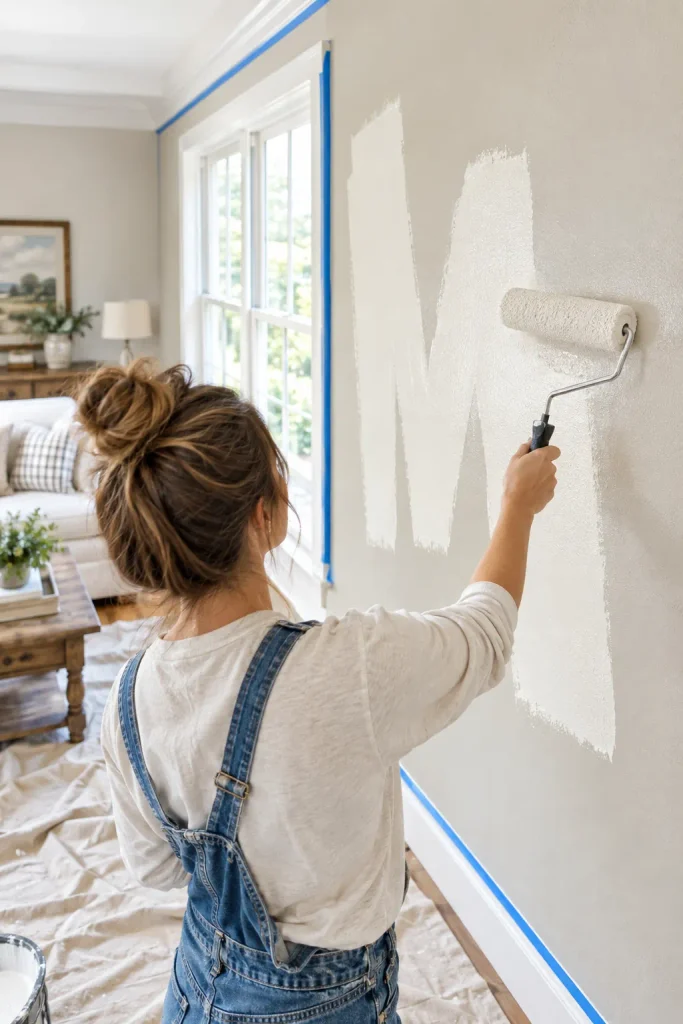
Warm white makes cheap furniture look better. It bounces light around and gives thrifted pieces a clean backdrop.
Choose a white with a creamy, yellow-leaning undertone. Cool, bluish whites feel like a dentist’s office once the sun goes down.
- Tape off the trim with painter’s tape
- Cover the floor with a drop cloth
- Cut in along the edges with a 2-inch angled brush
- Roll the open wall in a “W” pattern
- Wait 4 hours, then add a second coat
Open a window while you work, and don’t judge the first coat. It always looks streaky. The second one fixes it.
Pick an eggshell or matte finish. Glossy paint shows every bump and roller mark on older walls, and a flat finish hides them best.
Float the sofa away from the wall

A sofa pushed flat against the wall makes a living room feel like a waiting room. Pulling it out changes that without spending anything.
Slide it 12 inches off the wall, or 6 inches in a small room. Felt sliders under the legs save your floors and your back.
Seating works best when people sit within 8 feet of each other. Any farther and nobody talks. Test it by sitting down and speaking in a normal voice.
Cover a tired sofa with a washable slipcover
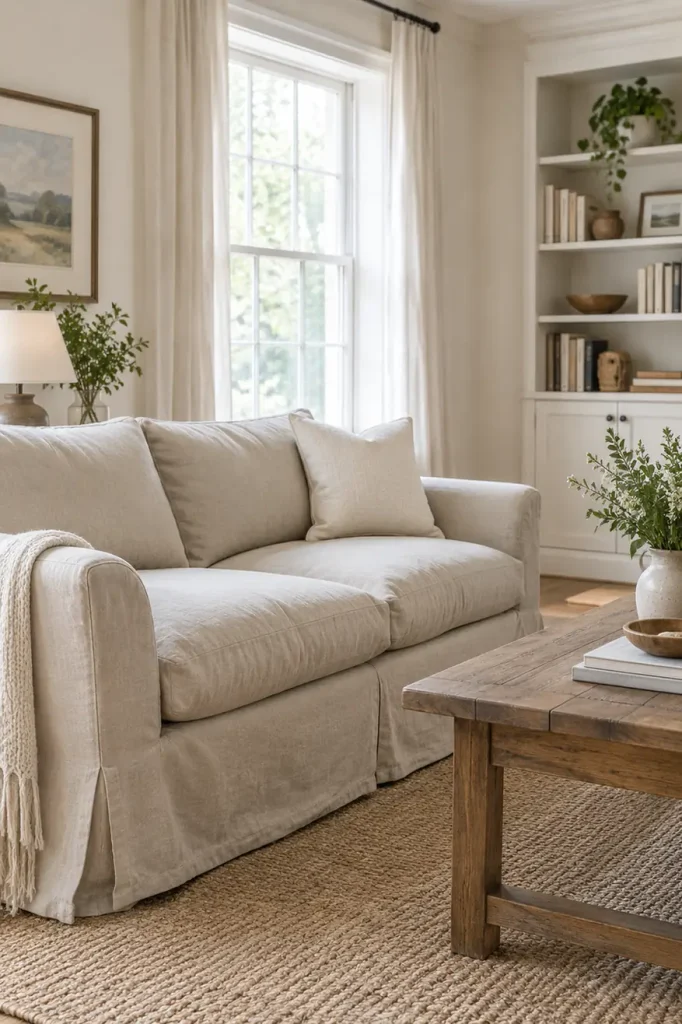
If your sofa is stained, shiny, or a color that fights your three-color palette, don’t replace it. A good slipcover costs roughly $80 to $200, while a new sofa starts near $800.
Choose cotton, linen blend, or heavy canvas in warm white or oatmeal. Those fabrics wrinkle softly, and in a farmhouse room that wrinkling reads as character.
Put it on, then tuck the extra fabric deep into the gaps around the seat cushions. At first it will look rumpled and sloppy. That is normal. Give it a day of sitting.
The risk: A slipcover sized for the wrong sofa sags and slides, and no amount of tucking will hide it.
The tell: Fabric bunches up at the arms and pulls loose at the back after one evening of sitting.
The fix: Measure arm to arm at the widest point and match that number to the product listing. Between two sizes, choose the larger.
Hunt for one aged wood piece at a thrift store
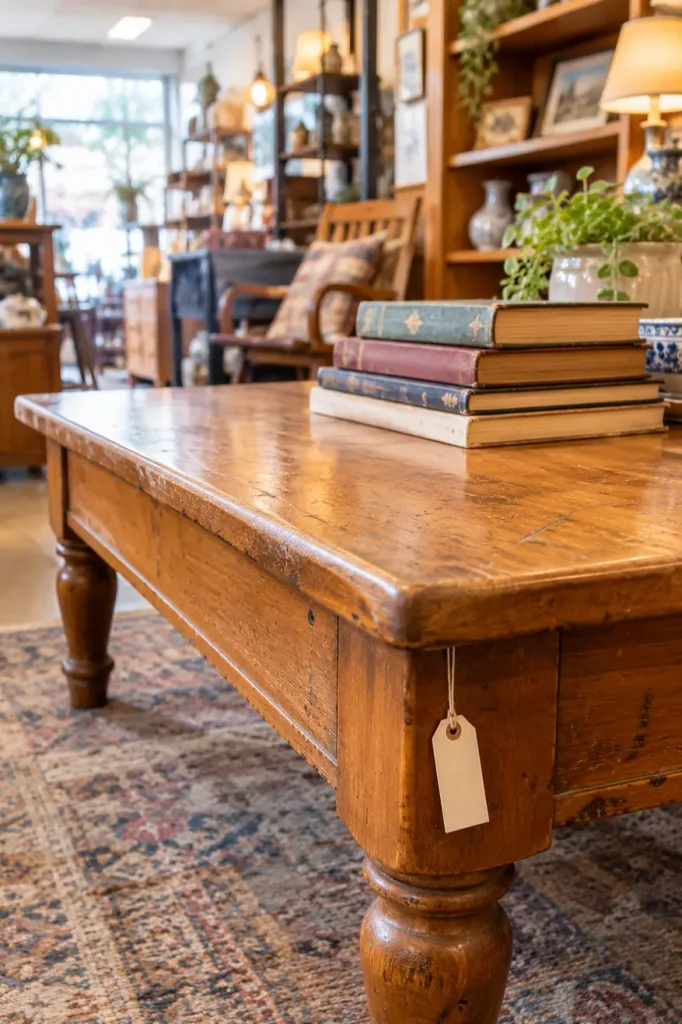
Every thrift store has one table that everyone walks past because it is scratched. That is exactly the table you want.
Look for a coffee table, console, or small bench in solid wood with real wear. Budget $40 to $120. Habitat ReStore, estate sales, and local marketplace listings usually beat regular stores on price.
If nothing turns up on the first trip, don’t settle for particleboard. Check again next weekend. Good pieces move fast, and patience is cheaper than regret.
Flip it over before you pay. Solid wood feels heavy for its size.
Pull a drawer out. Interlocking, finger-shaped joints at the corners mean real craftsmanship. Staples or plain glue mean skip it.
A small coffee table under 15 pounds is probably veneer over particleboard. Real wood pulls your arms down.
Layer a large natural-fiber rug under the seating
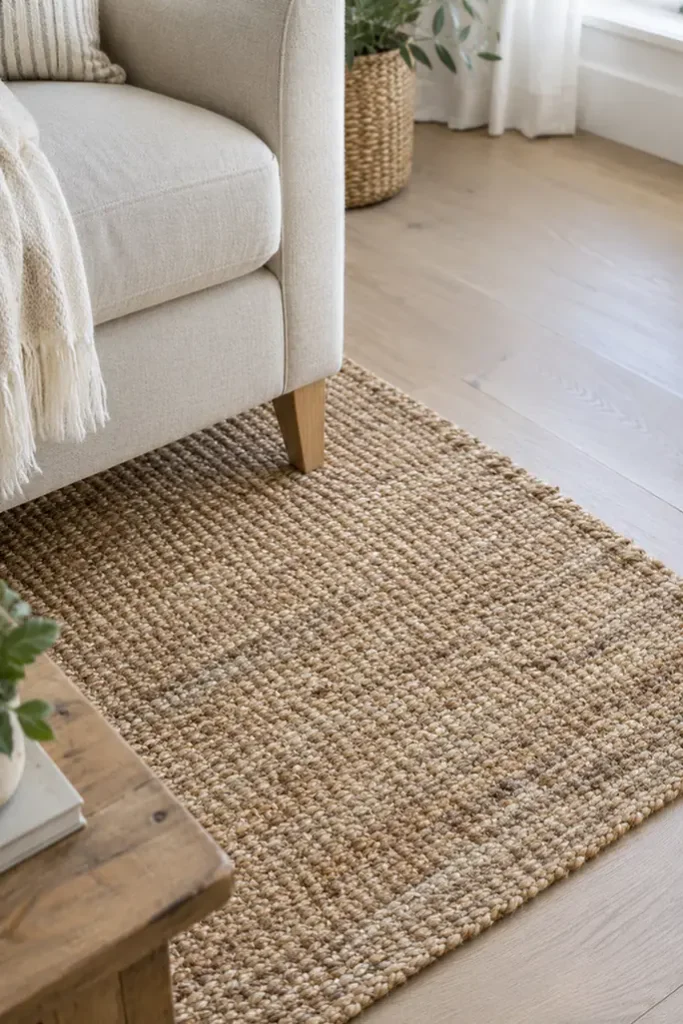
If your rug is smaller than 8×10 feet, the whole seating area looks like it is floating on a postage stamp.
Pull it into place so the front legs of the sofa and chairs rest on it. Leave 6 to 8 inches of bare floor showing around the edges. Jute and sisal run about $100 to $200 and carry the farmhouse look on their own.
Jute sheds for the first week and feels rough on bare feet. Slide a rug pad underneath, or lay a soft washable runner on top.
Fix the lighting with warm bulbs and a lamp

Why does a room look cheaper at night than at noon? Usually it is one harsh ceiling light doing all the work.
Swap every bulb for 2700K warm white at about 800 lumens. Then add light at three different heights:
- A floor lamp beside the sofa
- A table lamp on your thrifted wood piece
- One small lamp or candle low on a shelf
A secondhand lamp with a linen shade costs around $10 to $25. Skip a new fixture unless the old one is truly ugly.
⚠ Heads Up: Forced vs. Lived-In
Check your room against both sides before you add one more thing.
- Every pillow matches exactly
- Words printed on three separate objects
- Everything is brand new and shiny
- Shelves styled in perfect pairs
- Pillows that nearly match but not quite
- At most one piece with words on it
- One scratched, worn, or faded surface
- Groups of odd numbers, never perfectly lined up
Decorate your farmhouse living room on a budget with three-texture layering

Pillows look bought when they match. They look collected when they almost match.
Gather one chunky knit or wool throw, two linen or cotton pillows in your palette, and one pillow with ticking stripes or a soft plaid. That is three textures and one pattern, which is enough.
Drape the throw over one arm of the sofa, loosely, never folded into a perfect square. Most people move the pillows two or three times before it feels right. That is completely normal.
Edit the room by removing one-third of the decor
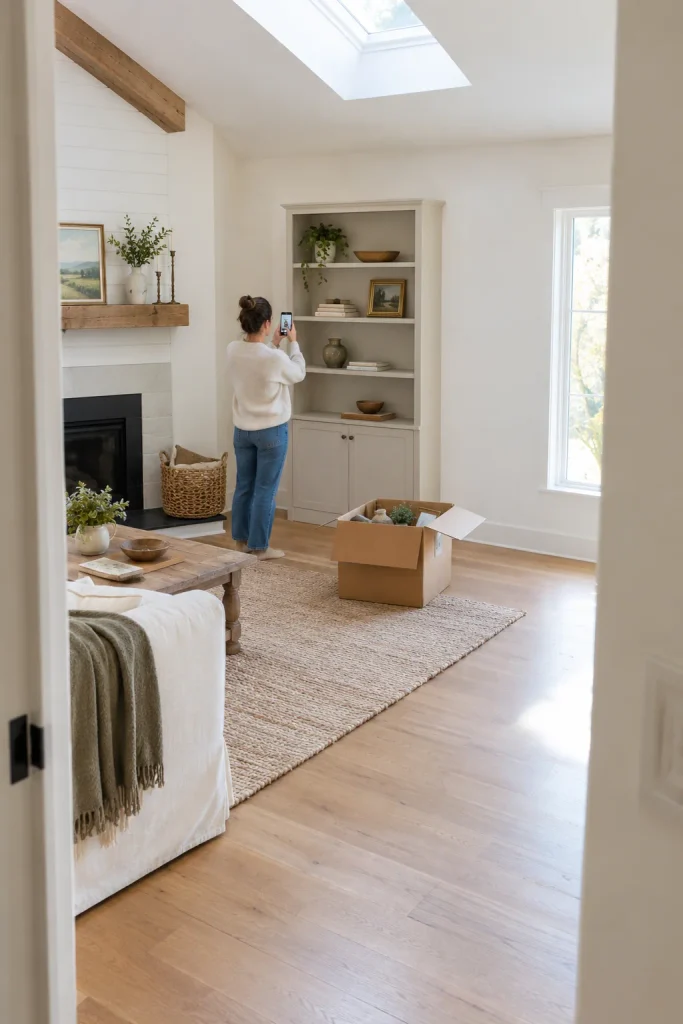
Stand in the doorway with your phone and take a photo. Cameras are blunter than eyes, and the photo will show you the clutter in about two seconds.
Count what is on your shelves and tables, then take away one-third of it. Pull the one that looks like it is trying hardest.
Leave a few bare spots on purpose. Empty space on a shelf, or 4 to 6 inches of clear tabletop, is what makes the pieces you kept look chosen.
Put the removed items in a box. Live with the room for a week, and only bring something back if you truly miss it. Most people never open the box.
That is the last step of the build. The room is done.
Common Mistakes (and How to Fix Them)
Most of these show up halfway through the project, when the room looks almost right, and something still feels off.
4 Mistakes That Make a Farmhouse Room Look Off
Buying a matching furniture set
Result: The room looks like a showroom floor.
Fix: Pair one painted piece with one raw-wood piece, and keep the wood tones within one shade of each other.
Hanging art too high
Result: Frames drift away from the furniture and the wall feels empty.
Fix: Put the center of each frame at 57 inches from the floor, and hang art 6 to 8 inches above the sofa back.
Painting over dusty walls
Result: The paint peels in patches, mostly near the kitchen and the doorway.
Fix: Wipe the walls with a damp cloth and a drop of dish soap, then let them dry for 1 hour before taping.
Buying small decor first
Result: Cute vases pile up, and none of them fit the finished room.
Fix: Buy in the order of this guide. Large pieces first, accessories last, once you can see what the room is missing.
Frequently Asked Questions
Beginner Questions, Answered
The five things readers ask most.
Quick Reference Card
Budget Farmhouse Living Room
Gather
- Warm white paint, 1 gal
- Roller, brush, tape, drop cloth
- Felt sliders
- Washable slipcover
- Thrifted solid wood piece
- Jute rug, 8×10 ft
- Bulbs, 2700K
- Lamp with linen shade
- Throw + 3 pillows
Do
- Clear the room
- Pick 3 colors
- Paint walls
- Float the sofa
- Slipcover it
- Thrift wood
- Layer the rug
- Warm the lighting
- Layer 3 textures
- Remove 1/3
Screenshot this card before you head to the store.
Conclusion
You now know how to decorate a farmhouse living room on a budget, and you did it with paint, thrifted wood, and a few soft layers.
The room will keep improving on its own. A scratch here, a faded cushion there, and it only looks more like home.
Next, try the same approach on a bedroom or an entryway, starting again with paint.
Save this guide to your Pinterest board so it’s ready the next time you walk into a thrift store.