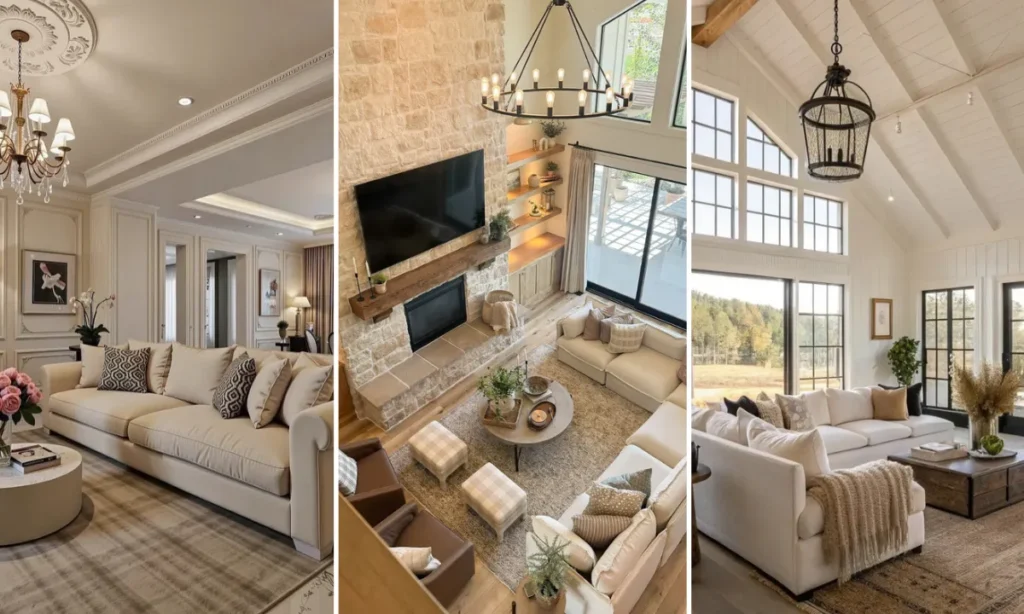
Farmhouse living rooms look easy until you try one. Then the walls feel flat, the sofa looks lost, and nothing quite matches.
The best Farmhouse Living Room Ideas aren’t about buying more. They’re about how the room hangs together.
These ideas focus on whole-room moves. Color that repeats across zones. Light that comes from lamps, not ceilings. Dark pieces balanced by pale surroundings. Old wood, soft linen, and one rough edge to keep it honest.
Some tackle a tall room that feels empty. Others take the chill off an all-white space, or tie an open plan together so the kitchen and sofa read as one.
Pick the moves that suit your room and skip the rest. A farmhouse feels lived in because it was built slowly.
Save the ones you like, then scroll on.
1. The Warm Neutral Great Room
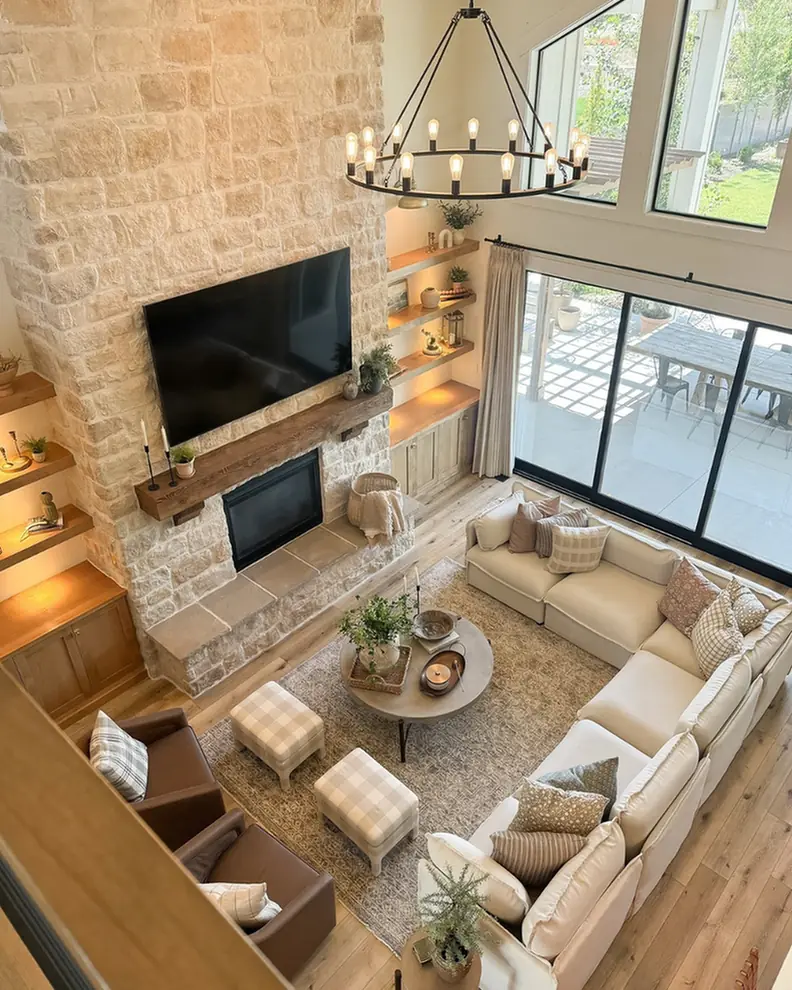
Nothing in this room fights for attention, and that’s the trick. Cream, honey wood, and black steel repeat from ceiling to floor:
- Cream in the stone, sofa, and curtains
- Wood in the beam, shelves, and flooring
- Black in the window frames and chandelier
Because the palette stays small, the room can hold a lot without looking busy.
Lock in your three tones before you shop, then refuse anything outside them for your next few purchases.
Start with the largest surface in the room. Let furniture and decor follow its color, not the other way around.
2. White Rooms Need Black
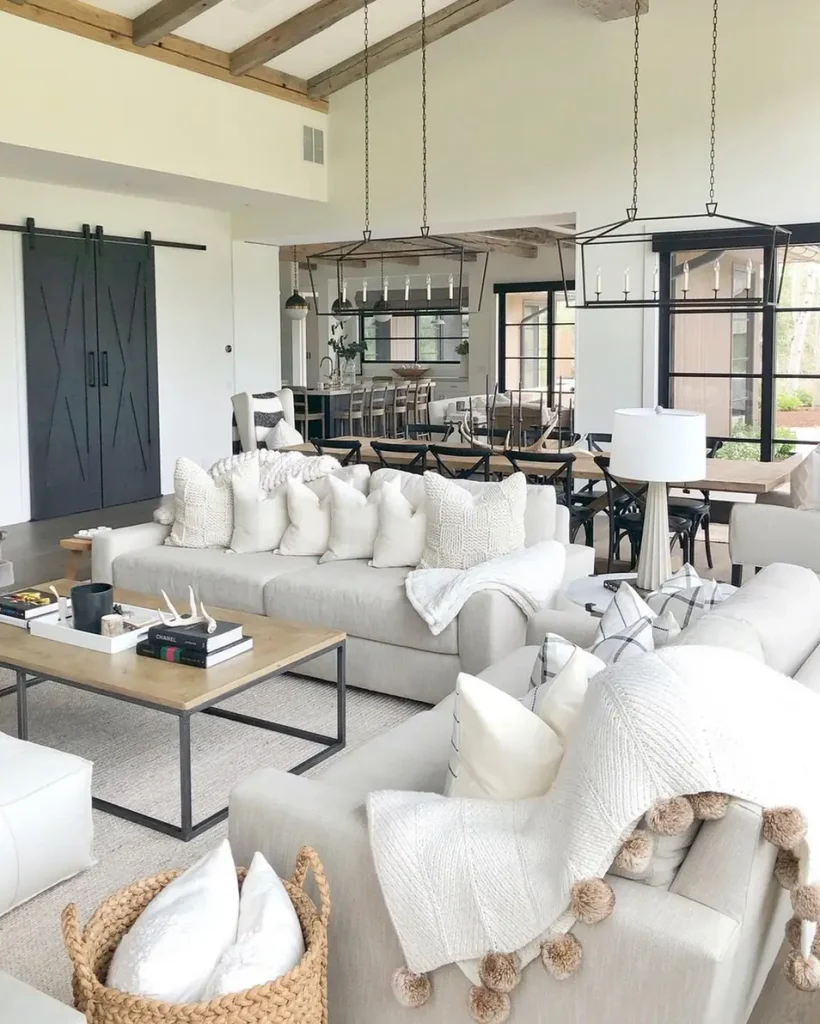
Most people go all white and end up with a showroom.
Here, thin black steel holds the room down. It shows up in the sliding barn doors, the lantern lights, the window frames, and the metal legs under the coffee table.
Knit throws and a big woven basket do the rest. The pom-pom edge spilling off the sofa arm is the detail that says someone actually sits here.
Pale sofas show every spill, so washable covers are worth a look before you commit.
soft white and oatmeal
weathered wood tones
black, kept thin and small
Here are entries 3, 4, and 5 again, in the order you sent the images. Each one is about the overall room theme, not individual pieces.
3. Dark Weight, Light Surroundings
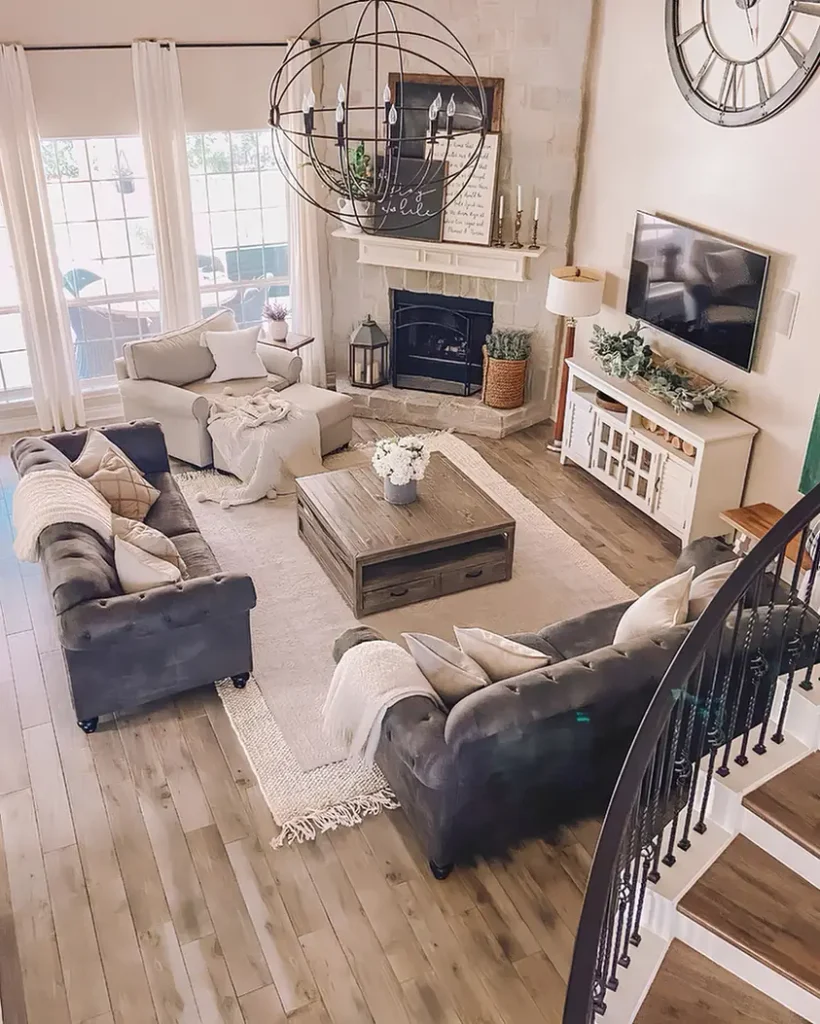
Heavy furniture doesn’t have to make a room heavy. It depends on what you put around it.
In this room, the dark pieces sit on a pale rug, under sheer drapes, beside light stone. The eye keeps finding somewhere bright to rest.
Most people go all dark or all pale. Mixing both works when light wraps the dark.
4. Borrow Colors From Outside
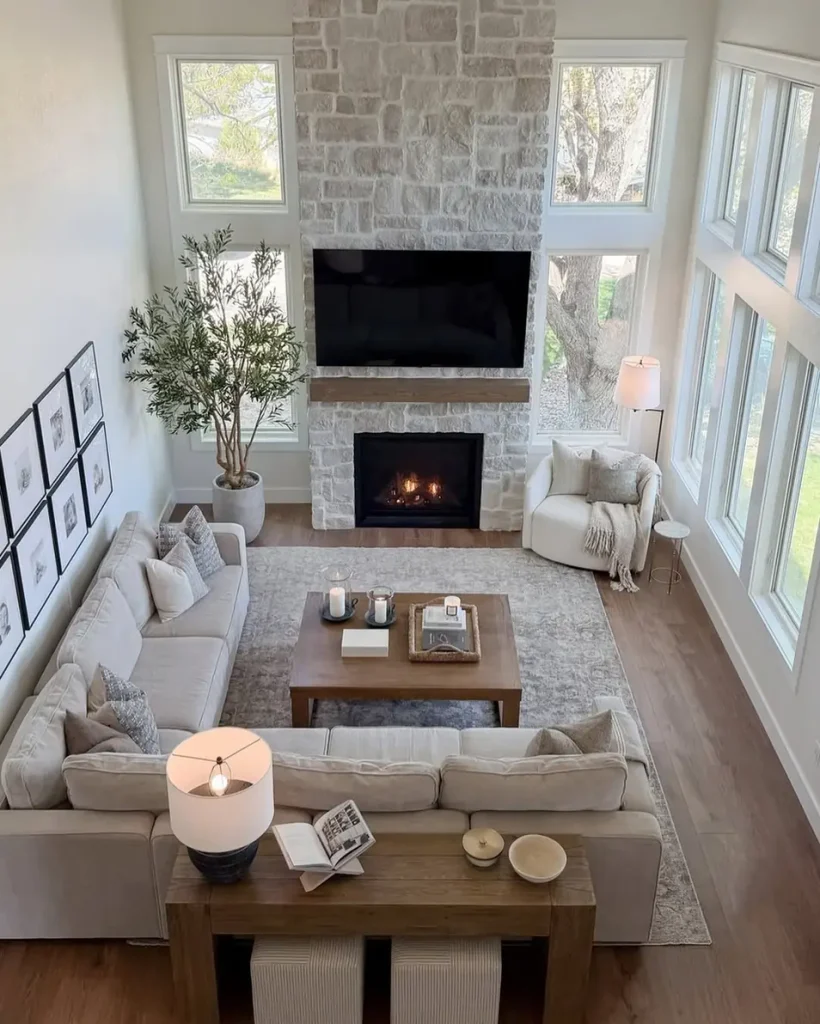
Big windows hand you a free color palette. Use it, and the room stops feeling cut off from the yard.
Take cues from what you can actually see:
- Leafy greens from trees and plants
- Bark and soil browns in the wood
- Pale sky grey in the stone and rugs
Keep window coverings thin so the light does the rest.
5. Symmetry Calms Big Rooms
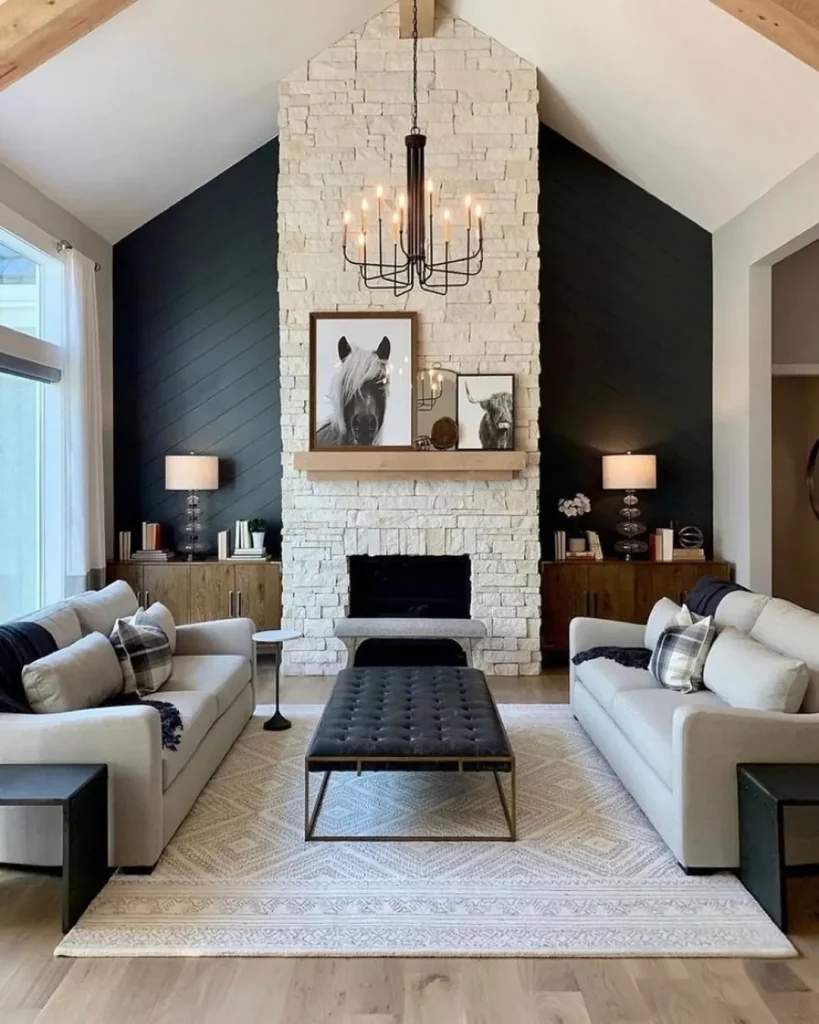
Tall rooms can feel like they’re drifting. Symmetry gives them a spine.
Here, everything on the left has a twin on the right. That’s why the dark walls feel steady, not heavy-handed.
Match the big moves and loosen the small ones. A slightly different pillow on each side keeps it from reading like a catalog page.
6. One Palette Across Zones
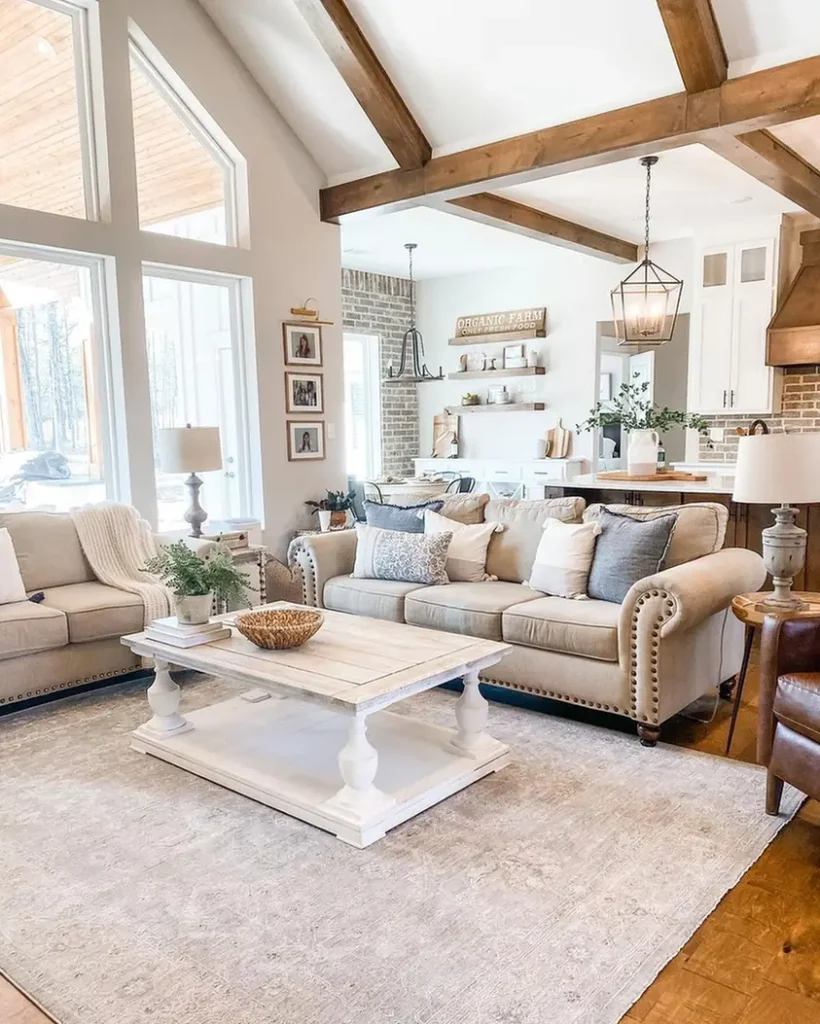
Open plans fall apart when each zone picks its own colors. The fix is simple, and it works.
Build one shared set and repeat it:
- Pull two or three tones from the biggest surfaces, like beams, floors, and walls.
- Echo each tone at least once in every zone.
- Let one finish travel from area to area.
Now the living area and kitchen read as one story.
| Zone | Borrows | Keeps for itself |
|---|---|---|
| Seating | Honey wood from overhead | Deep, plush comfort |
| Kitchen | Cream from the sofas | Brick and metal contrast |
| Dining | Wood tones and whitewash | Open display of everyday pieces |
7. Dress Farmhouse Up Gently
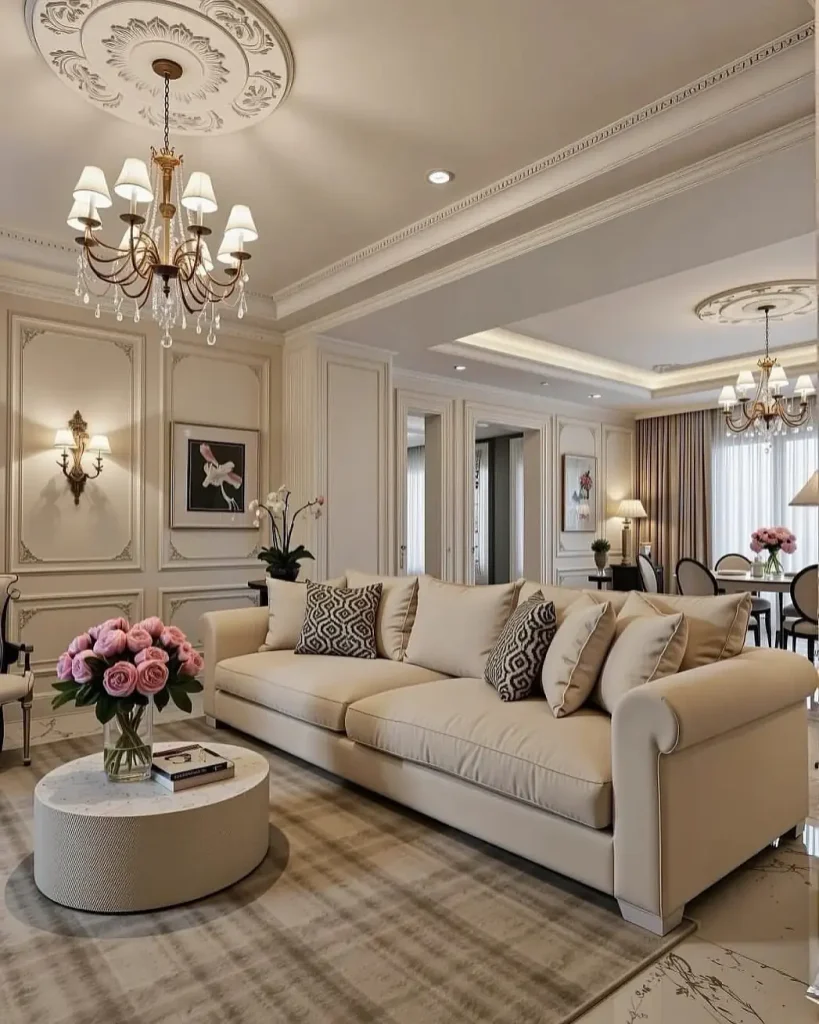
Can a farmhouse room feel polished and still relaxed? Yes, and tone does most of the work.
Stay inside one family of creams, then let trim, shapes, and lighting carry the detail. Nothing shouts, so everything gets noticed.
To keep it farmhouse, add one honest, rough-edged piece. It stops the polish from going stiff.
Many shades of one color, side by side. Detail shows up as depth instead of contrast.
Use it like this: walls one shade deeper than the sofa, a rug one shade deeper than the walls.
8. Old Bones, One Bold Move
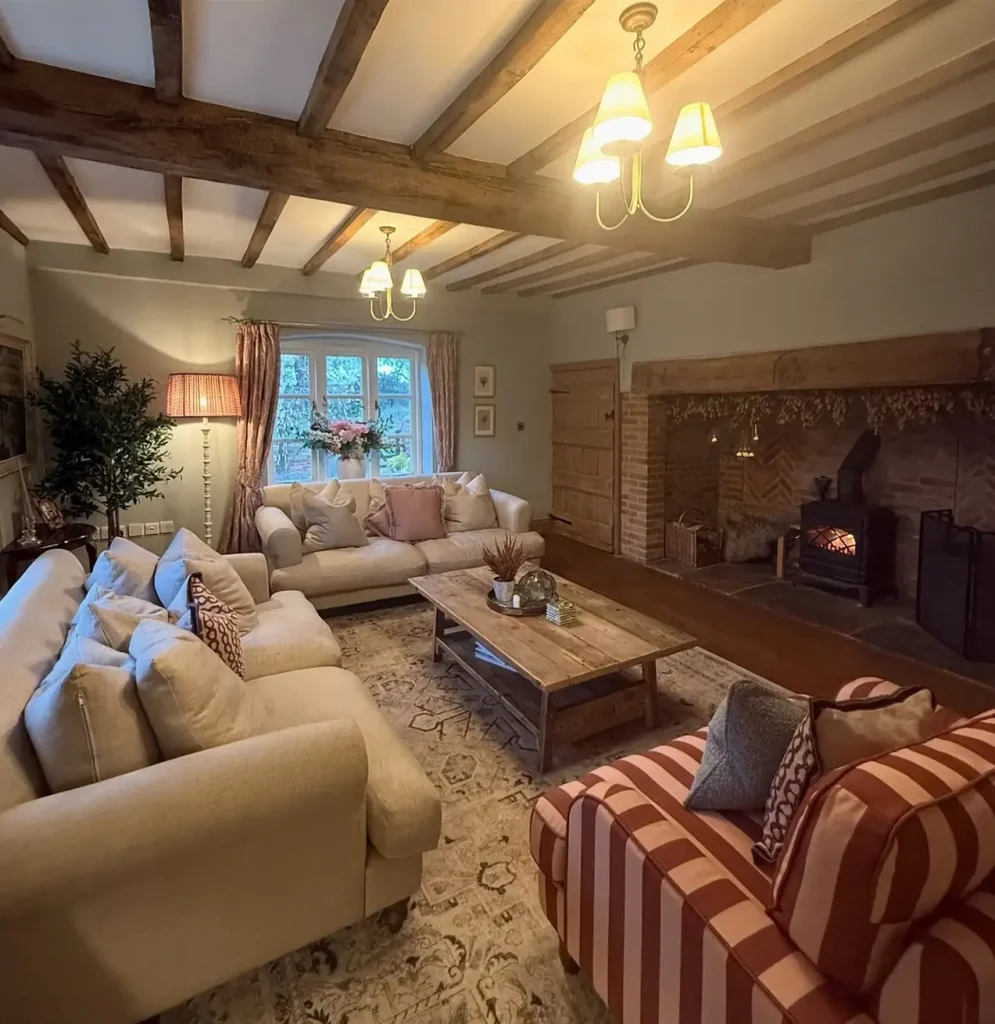
Don’t hide an old room’s character. Build around it.
Three things lead here:
- Low timber beams overhead
- A deep brick hearth
- Aged wood underfoot
Then the room saves its one loud move for a single pattern and keeps everything else quiet.
9. Curves Soften Heavy Beams
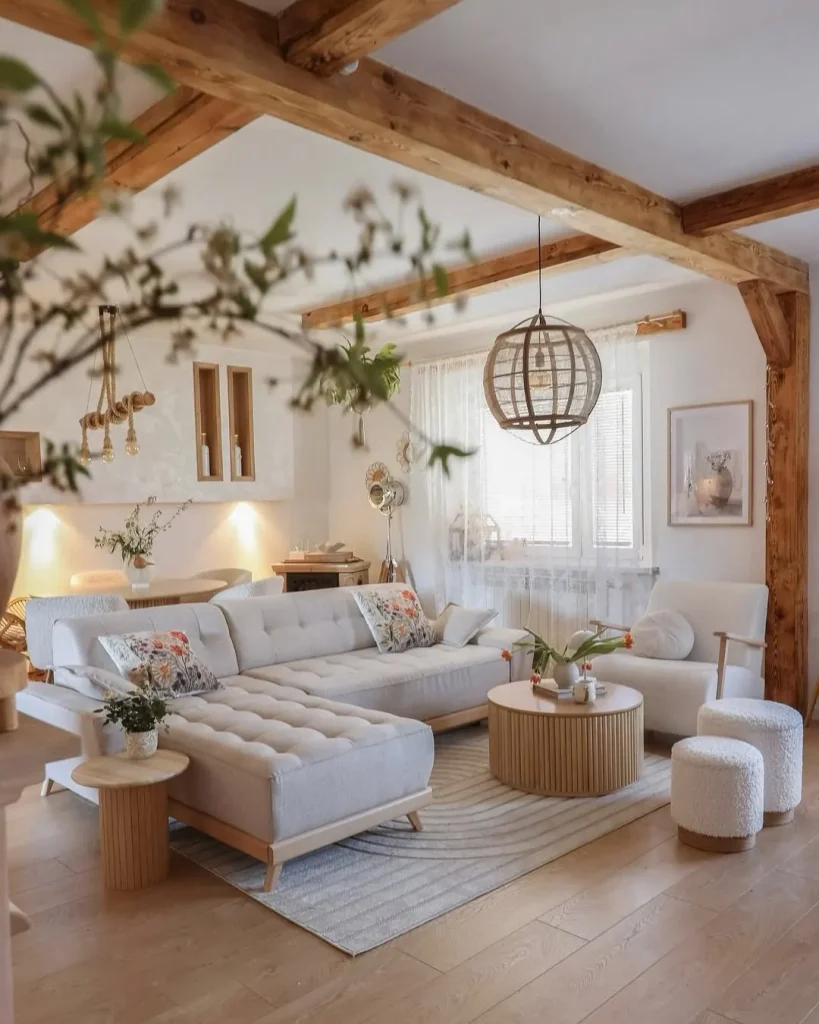
Timber overhead is all straight lines and weight. Left alone, it can press down on a room.
So the furniture answers back with rounds. Curved edges and arched patterns break up the rigid lines above.
Pets and kids cut through a lot of living rooms, and rounded forms are kinder to hips and shins in tight walkways.
Hard angles stacking up from ceiling to floor.
Echo the beams once, then change direction with something round.
The eye travels in loops instead of stopping at corners.
10. Mismatched Wood, Collected Look
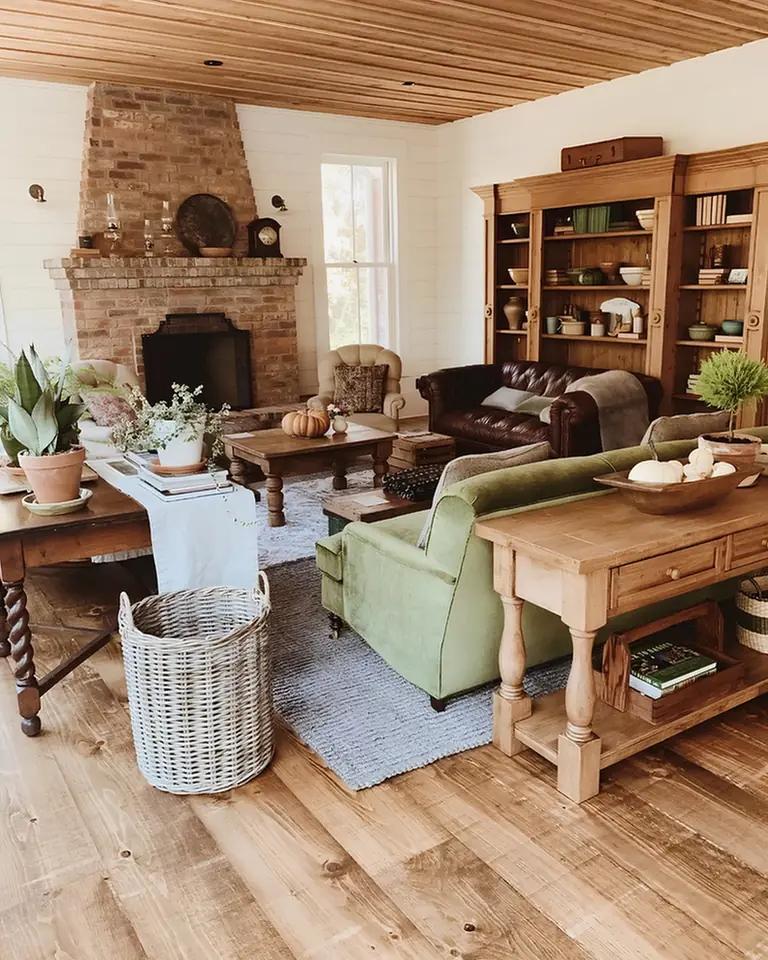
Matching wood looks tidy and a little flat.
Here, pale, honey, and dark woods sit side by side and nobody minds. Green and leather join in, which keeps the eye busy.
Pick one wood to lead, then let the others show up in smaller doses.
Real collections build over years, so resist buying it all at once.
Hold two samples together in daylight. If both lean warm or both lean cool, they’ll get along.
11. Dusty Blue Calms Neutrals
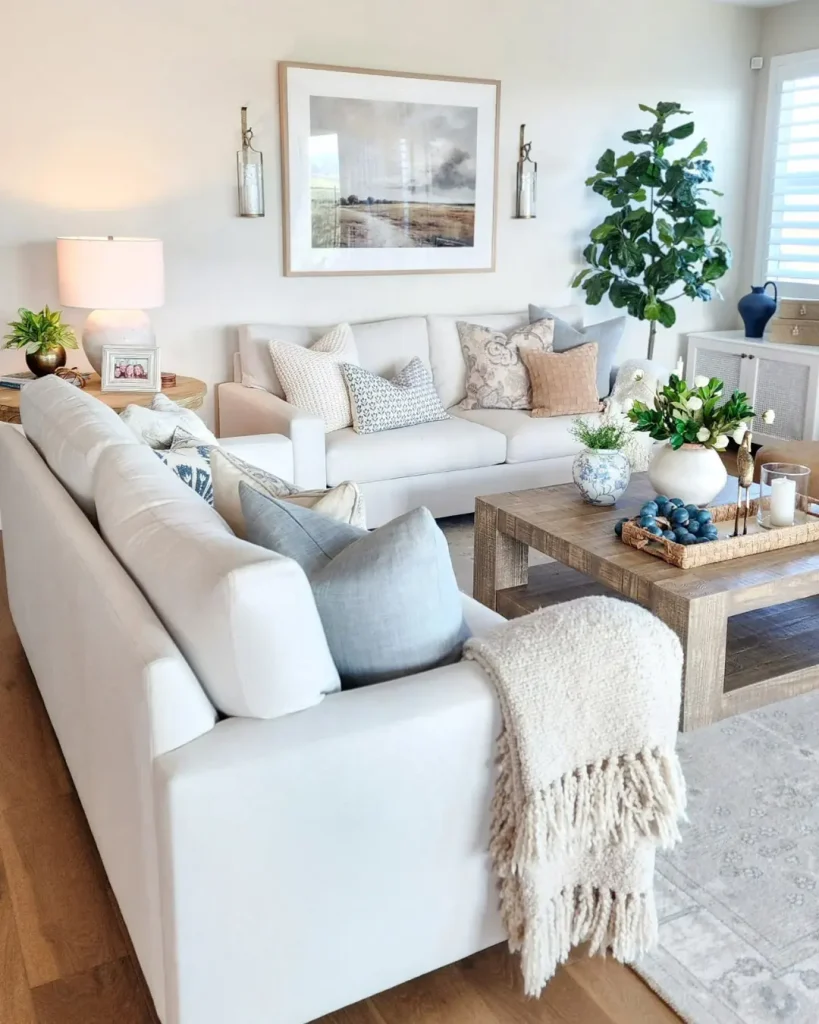
Cream on cream can read a little sleepy. One cool tone wakes it up without a fuss.
Here it shows up in pillows, ceramics, and a small tray. Tiny doses, scattered around the room.
The calm stays. The eye just gets somewhere new to land.
Pull your accent shade from the biggest piece of art.
It already matches your room, so nothing clashes.
12. Heirloom Wood, Deep Walls
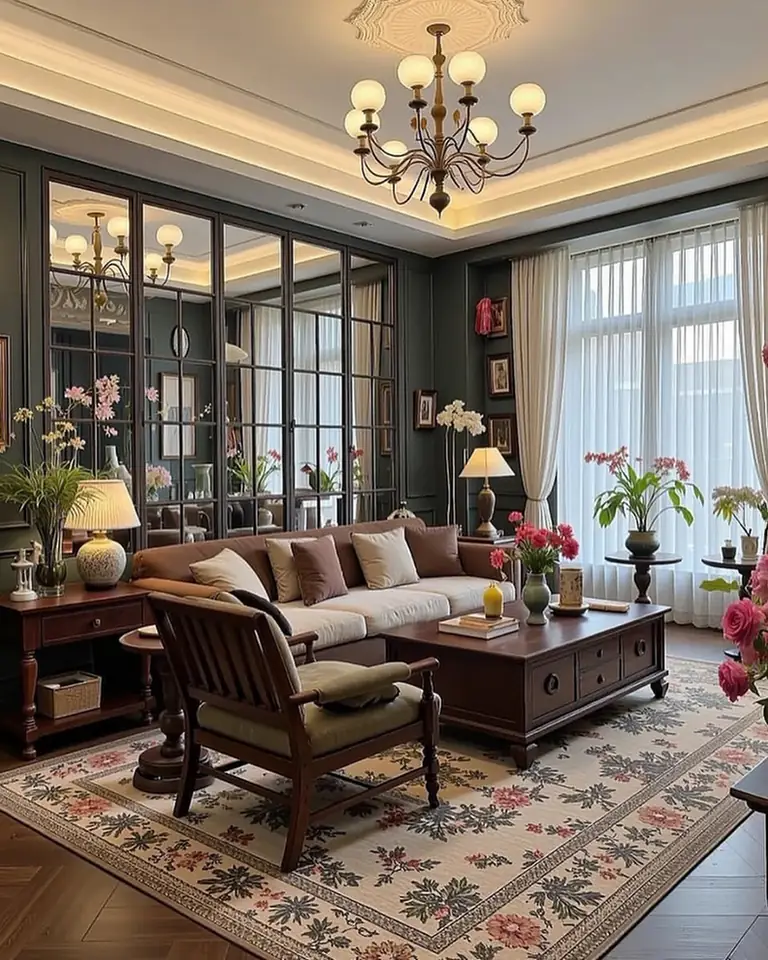
Deep walls and old wood make a farmhouse feel inherited, not bought.
Three moves get you there:
- Paint the walls a muted green or charcoal.
- Choose wood in reddish, aged tones.
- Anchor it all with a floral rug.
Keep the curtains sheer so daylight still wins.
Whatever gets handled every day. Solid wood ages well and shrugs off wear.
Whatever mostly gets looked at. Nobody checks the price of a vase.
13. Mix Patterns, Limit Colors
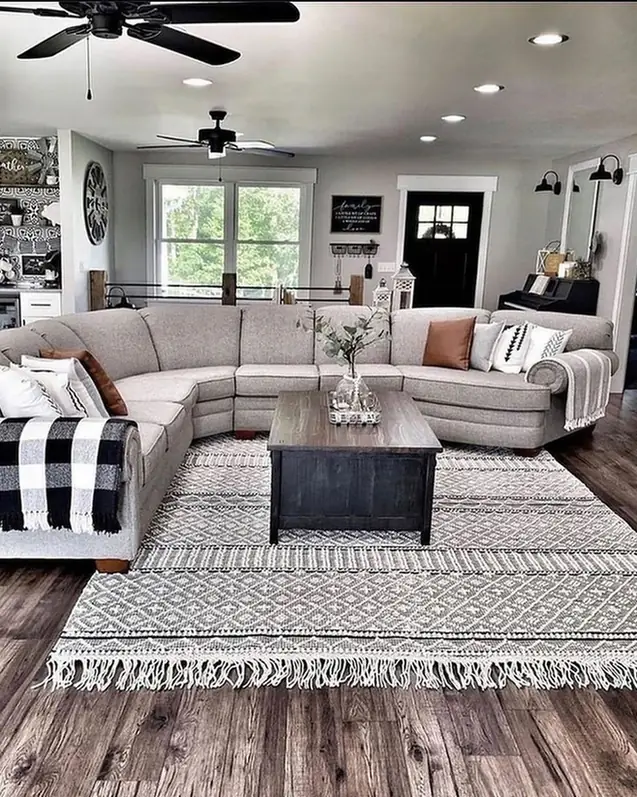
Plaid, geometric, and stripe can share one room if they share a palette.
Here, every pattern sticks to:
- Black
- White
- Warm grey
Different shapes, same colors. That’s what keeps it from looking busy.
One pattern covers the widest area
A second pattern, drawn smaller
Tight prints that fill the gaps
14. Swap Seasons, Keep The Base
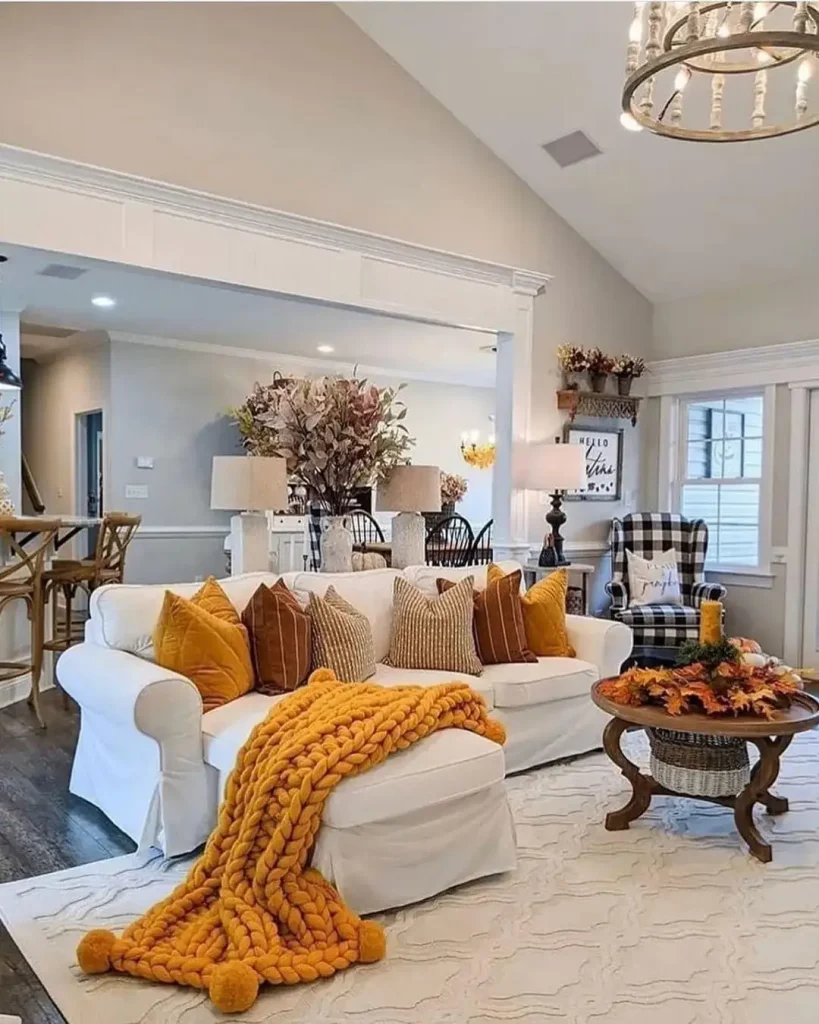
A calm base makes seasonal decorating almost too easy. Nothing gets repainted or replaced.
Here, the base stays white and wood. Fall arrives as rusty gold and a check pattern.
Change the loud things. Leave the quiet ones alone.
15. Let Windows Do The Decorating
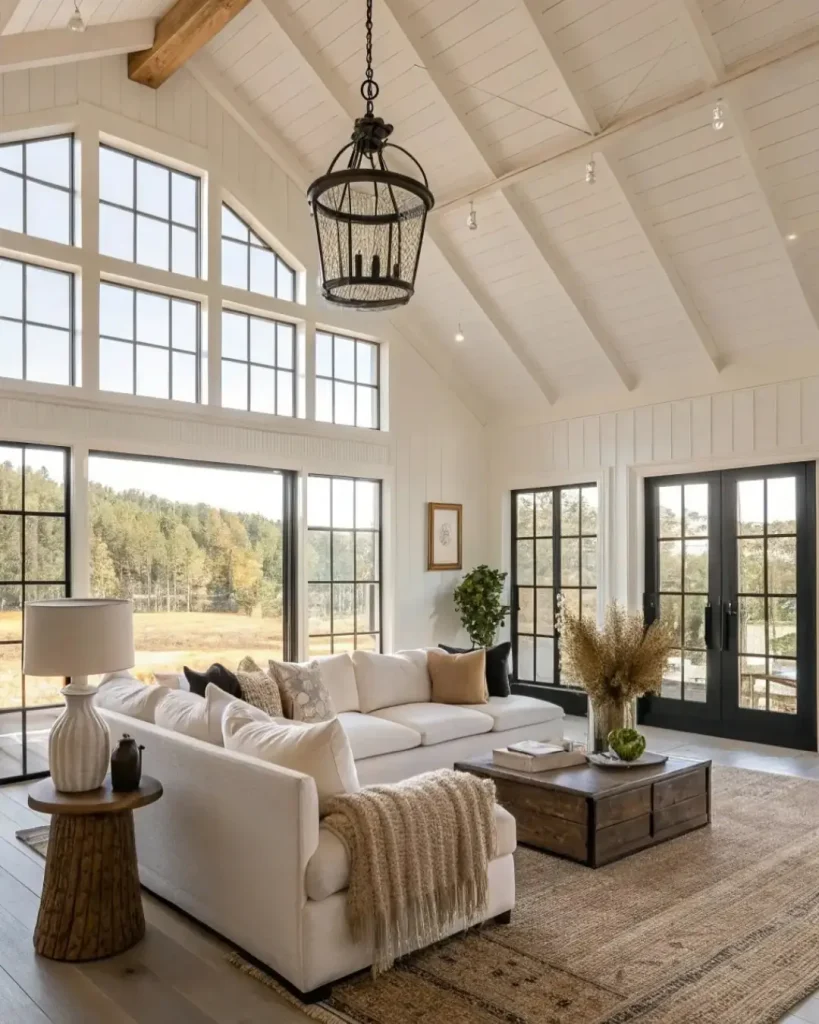
When the windows are this big, the view becomes the art. Everything inside just needs to stay out of its way.
That’s why the walls are pale, the sofa is plain, and the rug is woven in earthy tones.
But there’s a catch. A view like this needs shades or sheers for glare, or the room gets squinty by noon.
Rooms facing trees, fields, or open sky.
Tall ceilings that need quiet walls.
Windows facing a close neighbor.
Street-level rooms that need privacy.
16. Lamps Beat Ceiling Lights
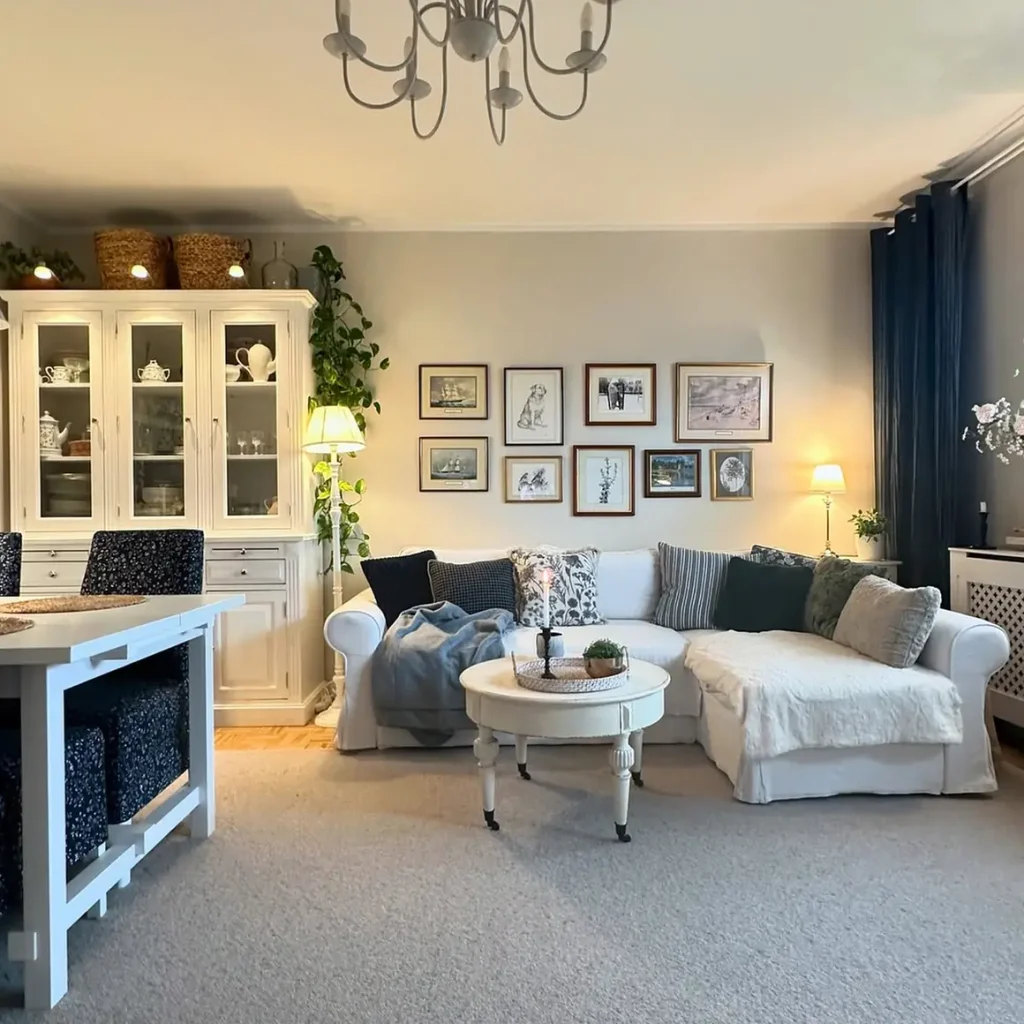
Overhead light flattens a room. Lamps at different heights do the opposite.
This one leans on low glow from every direction, so walls and art pick up gold instead of glare.
Put the main fixture on a dimmer, or leave it off after dinner.
Daylight does the work. Nothing needs switching on yet.
Light the table lamps first, starting with the ones near seating.
Add one floor lamp or candle. Stop before it feels bright.
17. Aged Details, Bright White
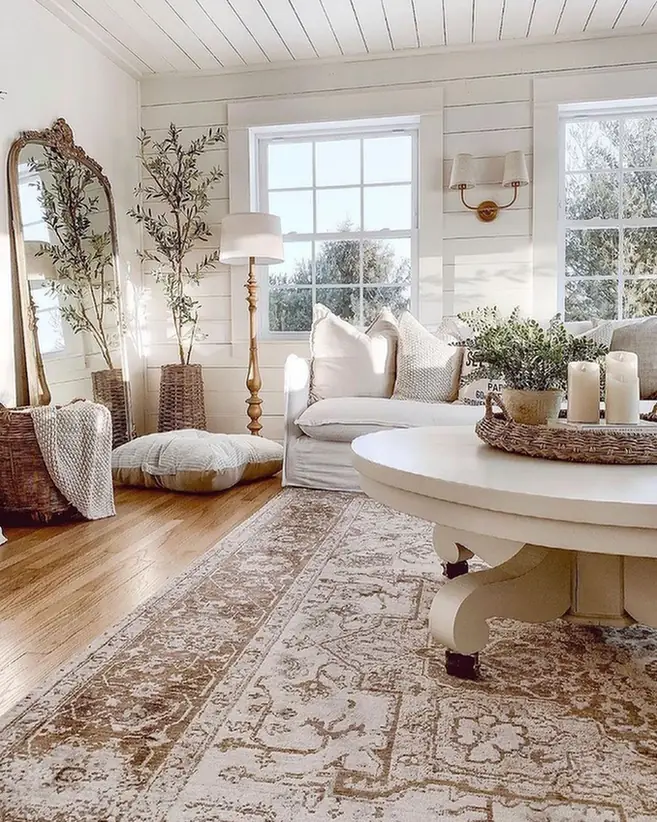
All white can turn cold fast. A little age fixes that.
Three things take the chill off:
- A worn, faded rug
- Real wood showing through
- A few brass or gold touches
Bright and slightly tired beats bright and flawless.
18. Seating That Doesn’t Match
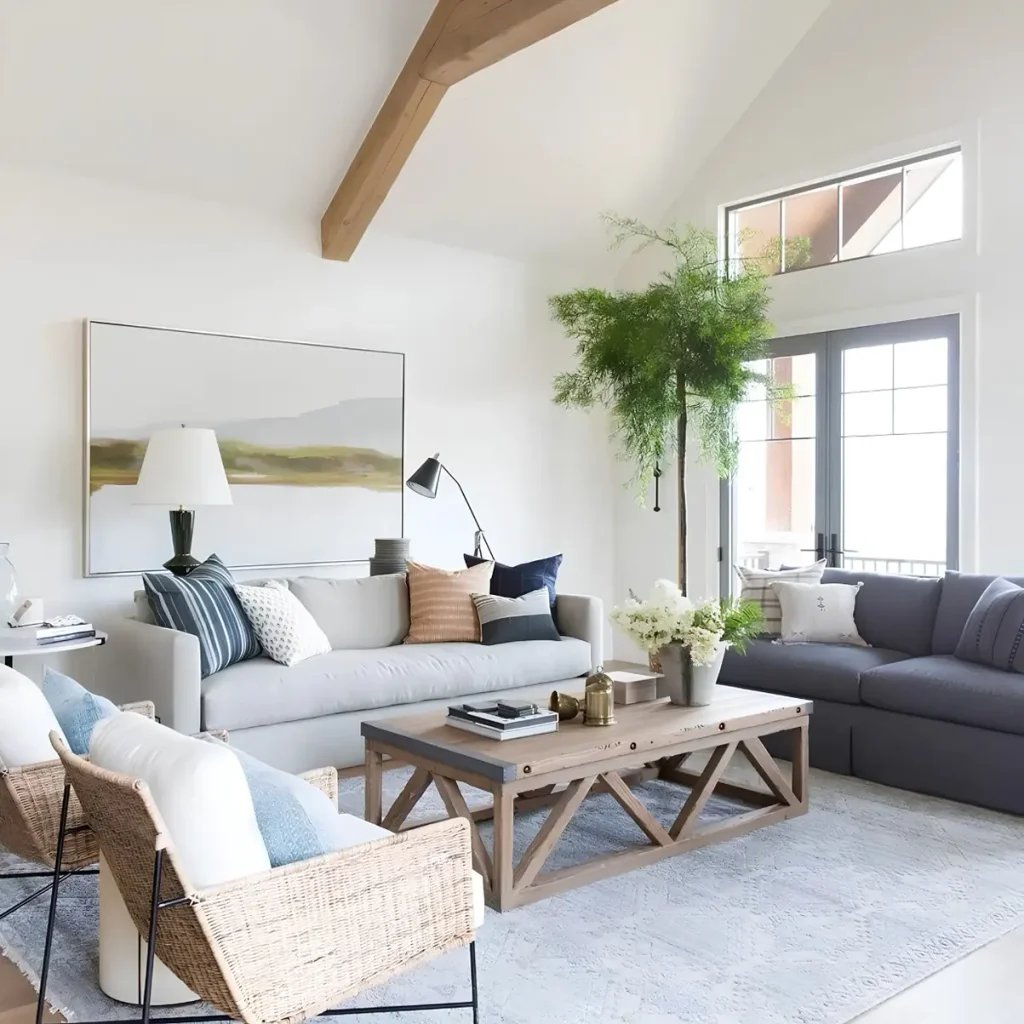
A matched set looks bought in one trip. A farmhouse room should look gathered.
Make two seats relatives, not twins:
- Same depth and height
- Different color, one shade apart
- Each echoed by a pillow across the room
Natural woven chairs add breathing room around them.
19. Storage That Looks Like Decor
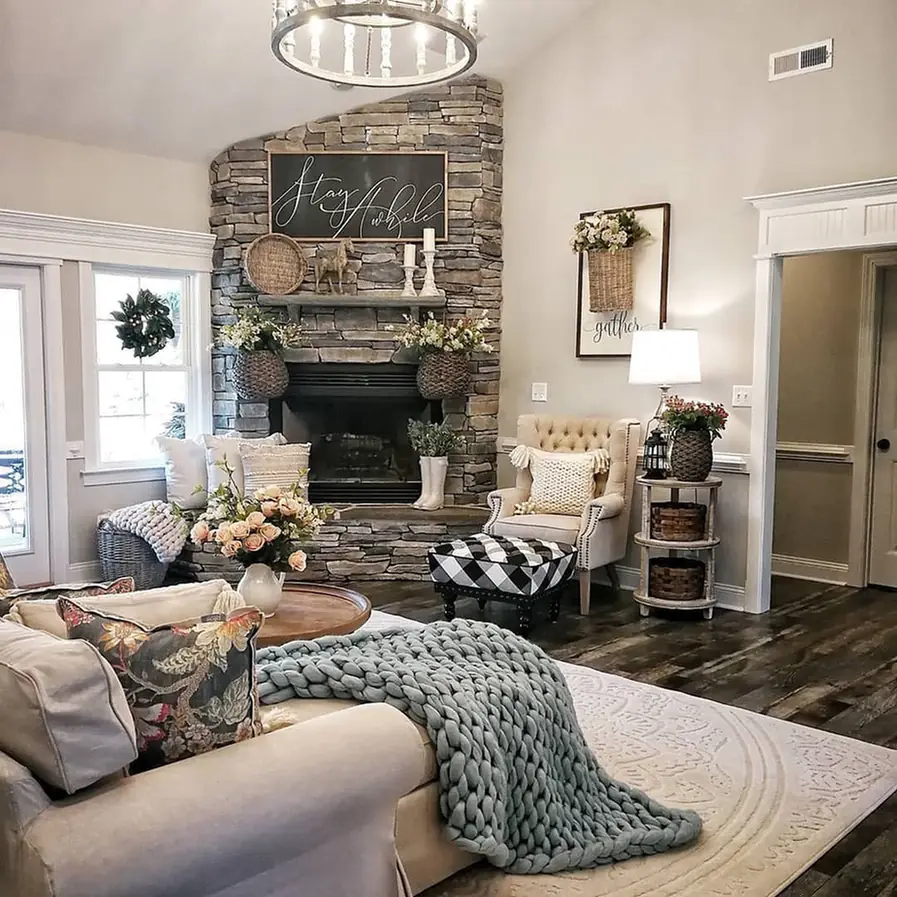
Throws, magazines, and cold-weather gear need somewhere to land. Piles of them aren’t decor.
Here, woven pieces hold the clutter in plain view and read as part of the plan.
Keep them low and near the hearth, where things naturally end up.
If it hides a chore and still earns its spot on the floor, keep it.
20. Vintage Finds Feel Lived In
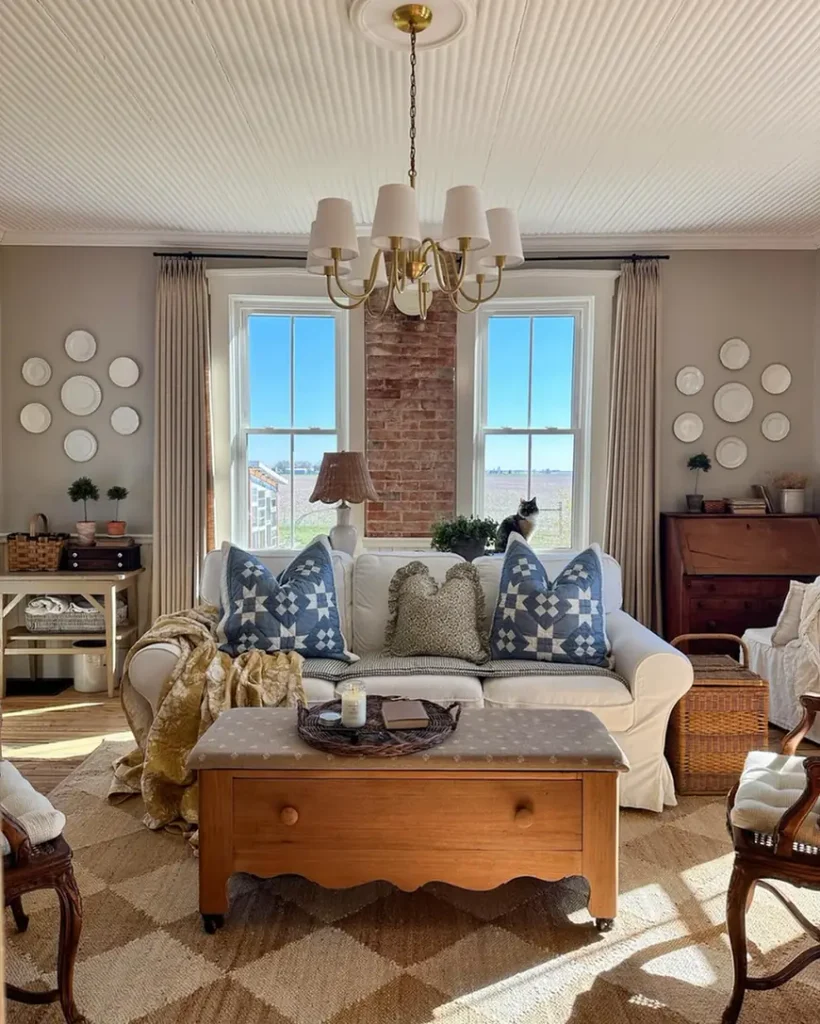
A farmhouse living room isn’t finished on delivery day. It collects.
Old pieces bring wear marks and stories new ones can’t fake, and that’s the point. Blue and cream patterns tie mismatched finds together.
One catch: older wood can wobble or hide damage, so test it before you buy.
Quilted textiles and sturdy older tables
Small dishes and family-owned wood pieces
One anchor piece with real age
21. Repeat One Soft Stripe
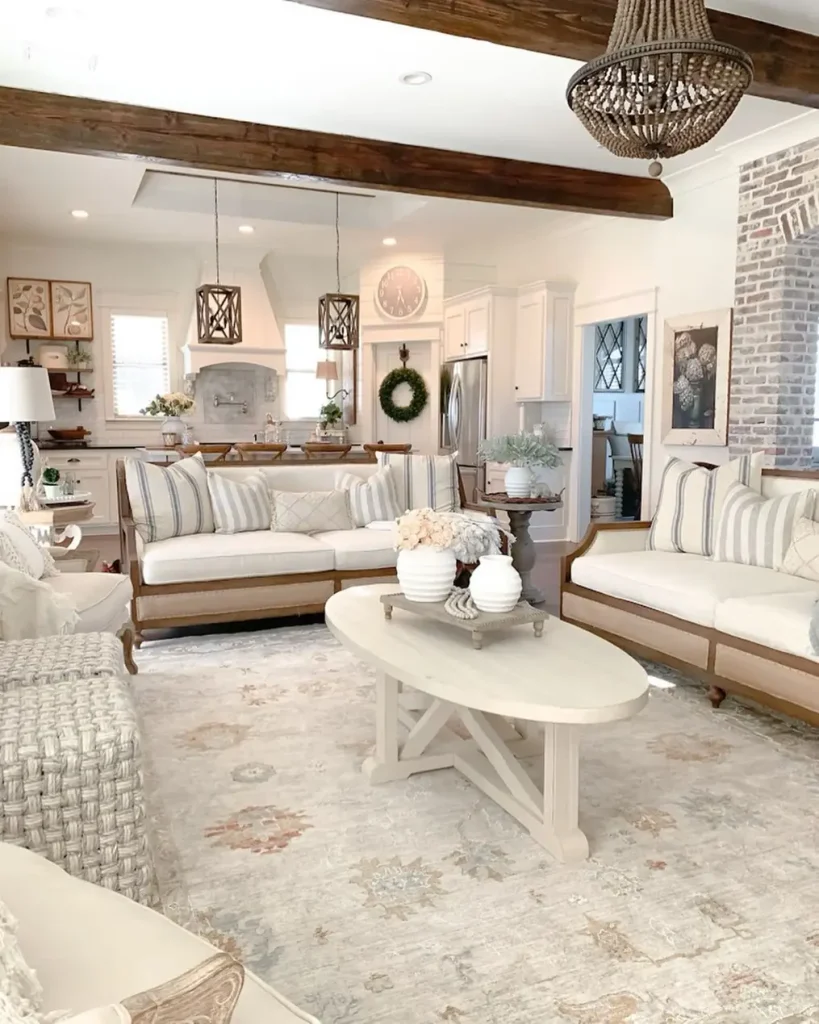
Stripes can calm a room instead of stirring it. The trick is to keep them soft and repeat them.
Here, one muted blue-grey stripe shows up on both sofas, never matching exactly. Wider on one cushion, narrower on the next.
Your eye reads that as rhythm, not noise.
22. Paint The Dated Feature White
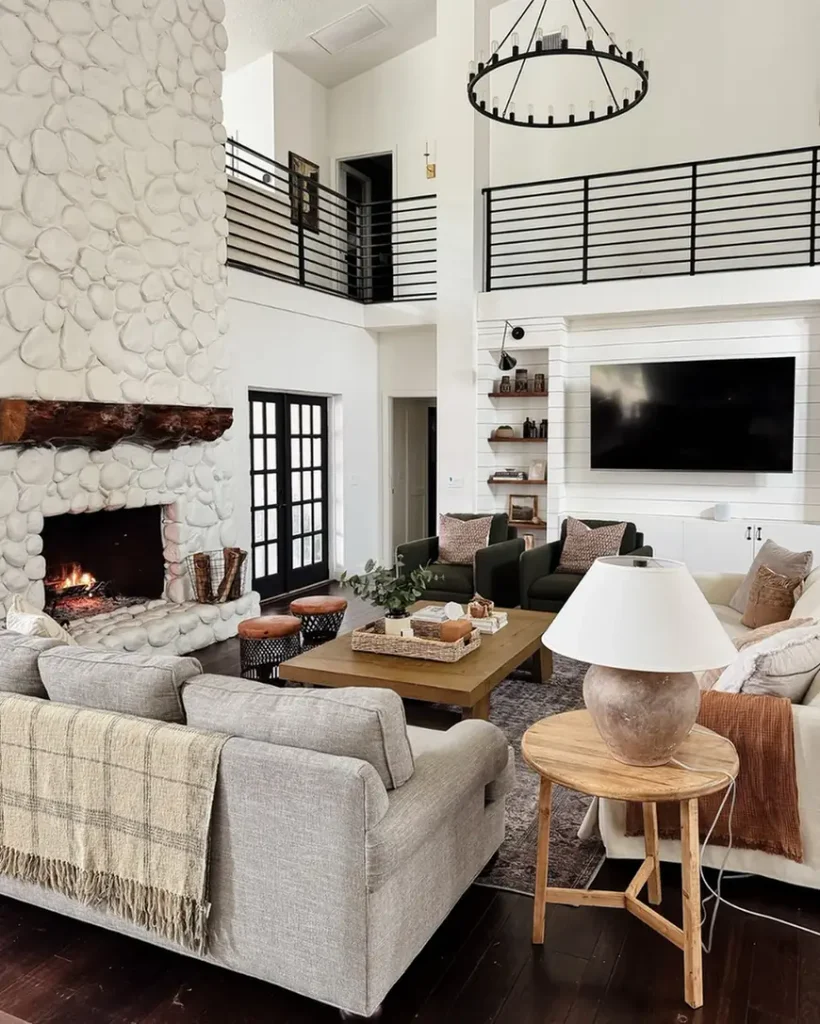
Not every farmhouse living room starts pretty. Some come with a lumpy feature nobody loves.
This one got the white treatment. The stone now reads as sculpture, and the dark wood above it has something to push against.
If you’re tempted:
- Test a small hidden patch first, since paint on stone is hard to undo.
- Leave any old wood on top alone.
- Repeat the dark metal somewhere else in the room.
Heavy, busy, and fighting the furniture for attention.
A soft, textured backdrop that lets the seating lead.
23. Black And White Memories
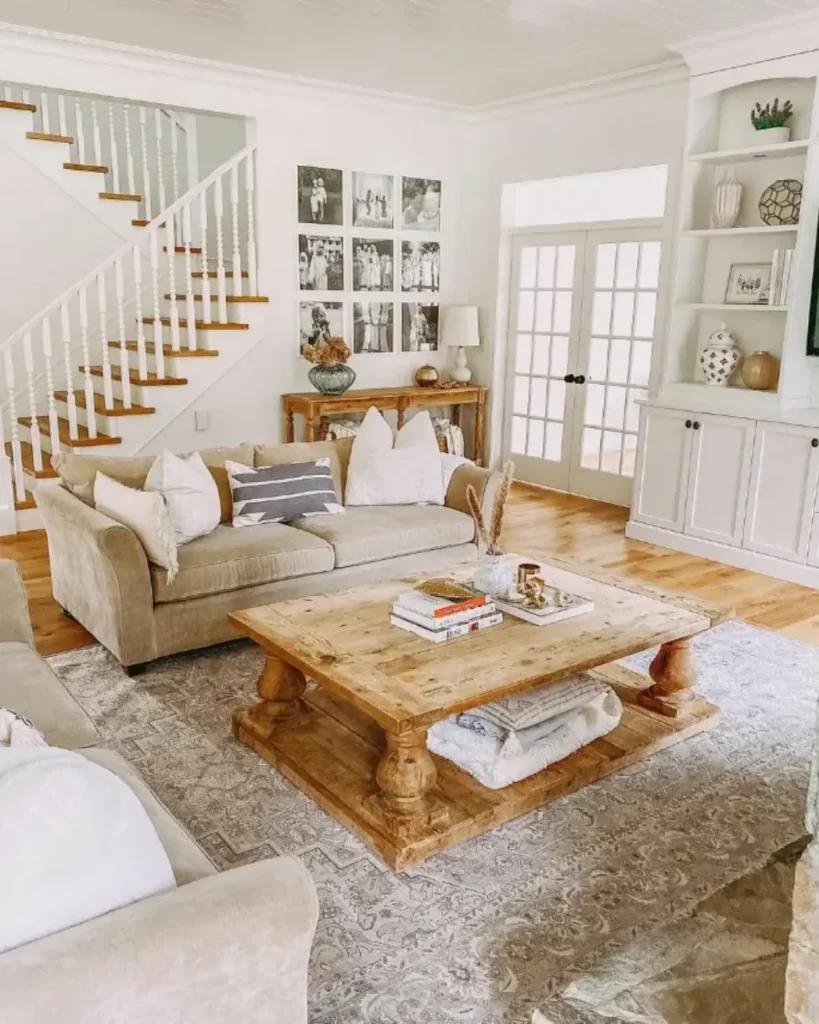
Family photos can be the art. A white room just needs them to behave.
Turn every picture black and white, use one frame style, and hang them in a tight grid. Mismatched snapshots start to look like one collection.
It reads as art first, memory second.
▸ Cut paper templates and tape them up.
▸ Mark eye level for the middle row.
▸ Step back across the room before you hammer.
24. Raw Edges Soften Clean Lines
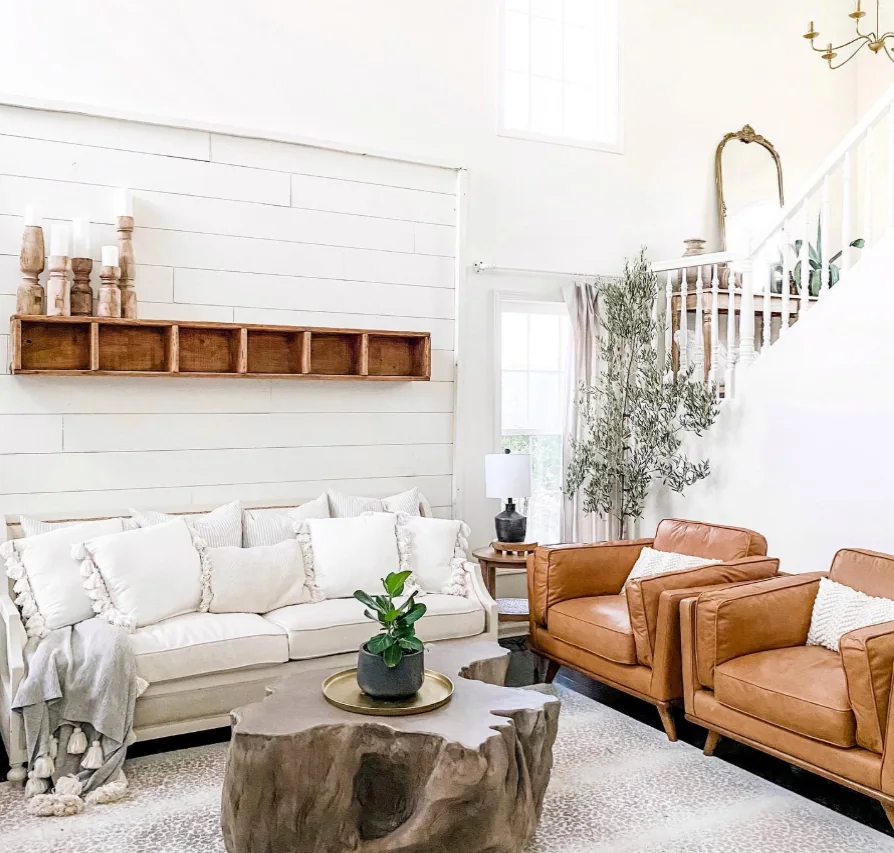
Clean white walls need something with a little bite. A few raw things do the job.
Look for:
- A table with a rough, uneven top
- Leather that creases and darkens
- A leafy branch that leans a bit
Nothing here is symmetrical, and that’s the point.
The soft wear that leather and wood pick up with years of use. It reads as age, not damage.
Use it like this: wipe with a damp cloth and skip the heavy sanding.
25. Mirrors Multiply Light
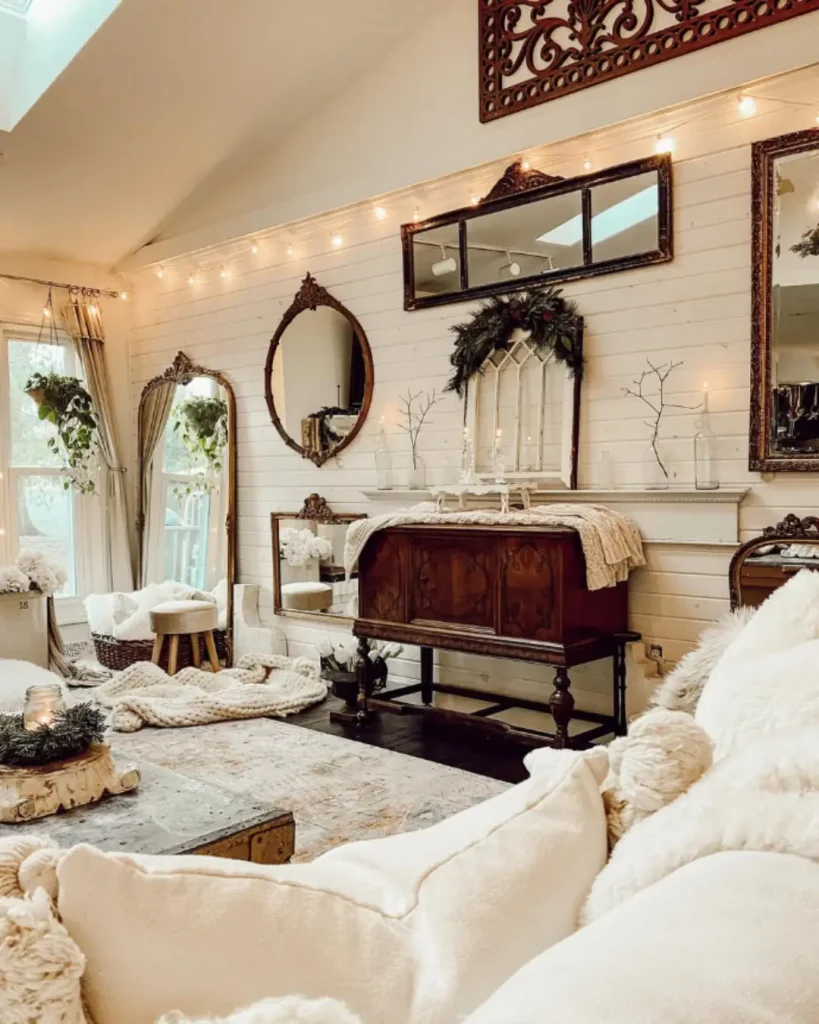
Nothing brightens a room cheaper than old glass. Hang one across from a window and daylight bounces back in.
Here, mixed shapes and frames share a similar dark wood tone, so the wall looks collected instead of chaotic.
Keep clutter out of the reflection, or you just double the mess.
Lean a tall one on the floor for a relaxed look.
Wipe the glass before evening, when lamps catch every smudge.
Tuck small string lights above the frame, not across the glass.
26. Scale Up For Tall Ceilings
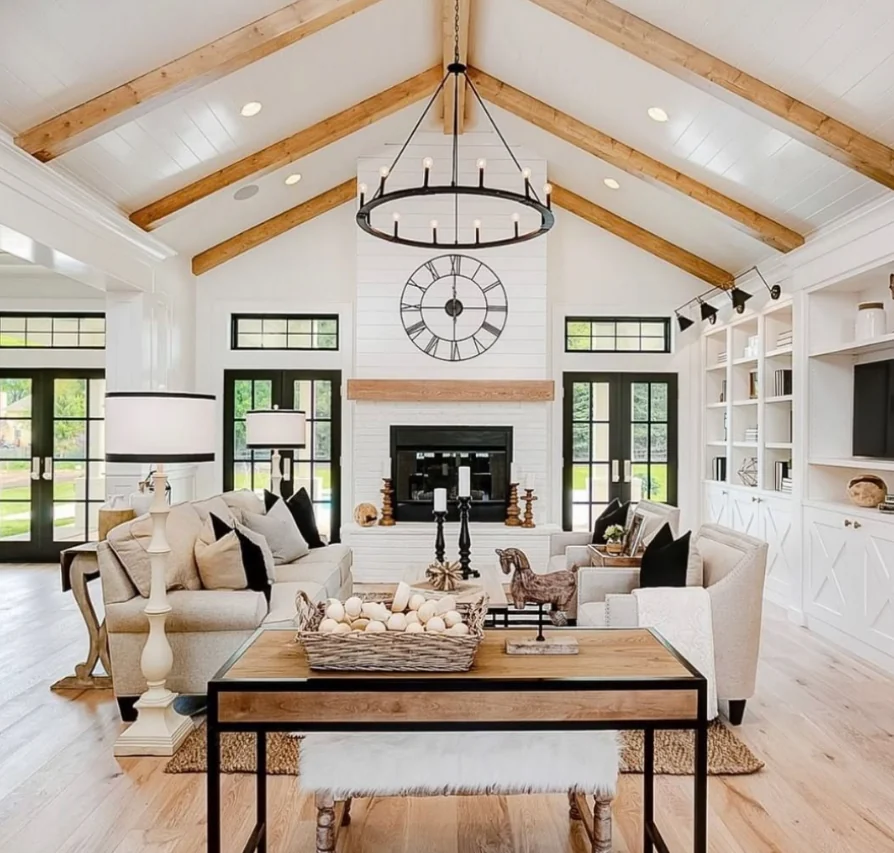
Tall rooms swallow small things. A skinny fixture or a tiny clock just disappears up there.
Go bigger than feels sensible. Oversized lighting and a wall piece with real width keep the height from feeling empty.
The exception is down low. Keep seating plain so the big stuff overhead gets all the credit.
Let the roof pitch draw the eye upward
One long, dark horizontal line to rest on
Texture you can actually touch
27. Pale Beams Brighten Everything
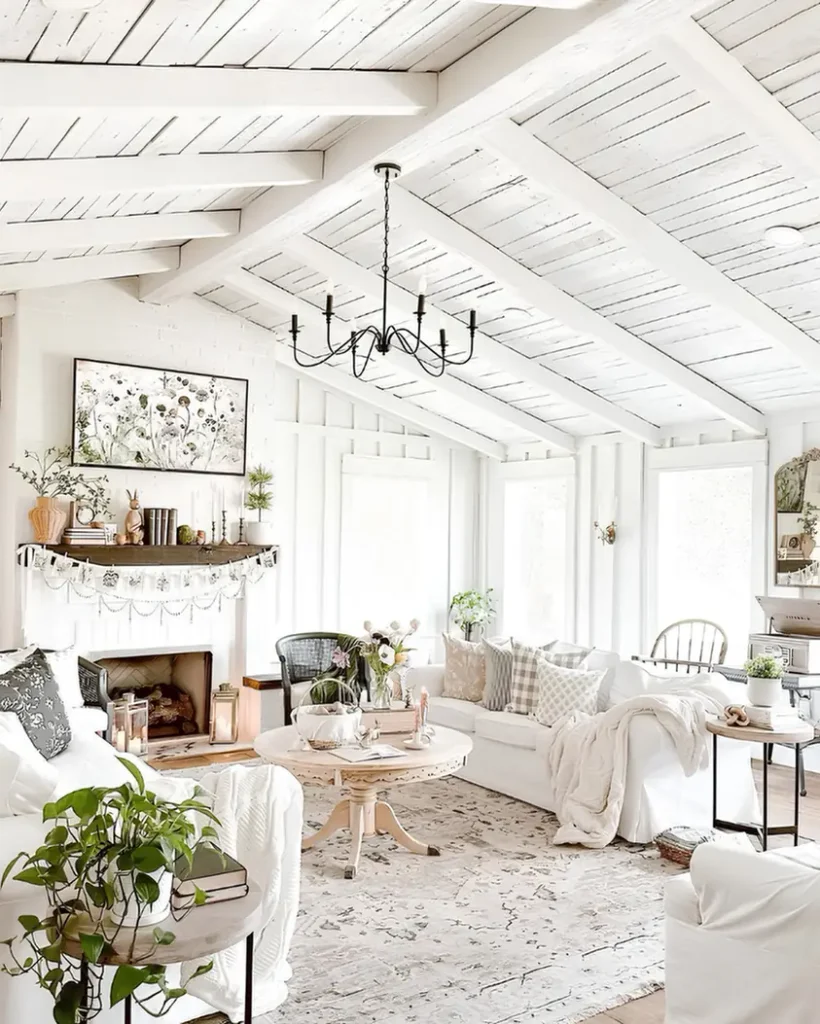
Dark timber is gorgeous, but it can shrink a room. Whitewash it, and the ceiling starts working like a reflector.
What changes:
- Daylight bounces further into the room
- The grain still shows through
- Everything below feels taller
Painted wood is tough to undo, so test one hidden spot first.
28. Echo One Holiday Motif
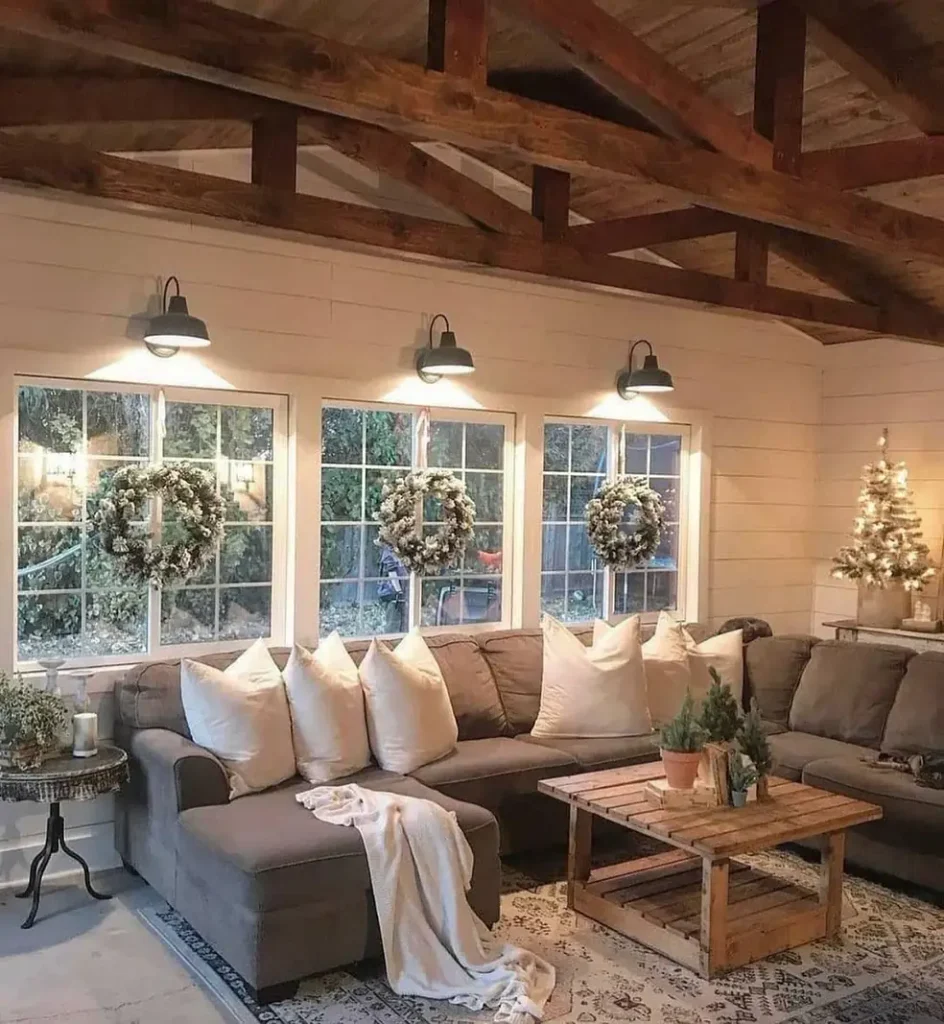
A row of identical wreaths does more than a mantel full of ornaments.
Pick one shape, hang each at the same height, and let the glass frame them. The whole wall reads as one decision.
Then let the rest of the room stay everyday. One small tree off to the side is plenty.
Stick to one finish, either frosted or plain greens.
Dry-fit spacing with tape before you hang anything.
Mixing sizes inside a single row.
Adding a second motif right beside the first.
Conclusion
A farmhouse living room doesn’t need to be finished by Sunday. It earns its character over time, one good swap at a time.
Start with the move that solves your biggest annoyance. Maybe that’s a dark corner, a bare wall, or a sofa floating in the middle of nowhere.
Then live in the room a few weeks before adding anything else. You’ll know what it’s missing.
If one idea sparked something, save it to your living room board on Pinterest so it’s waiting when you’re ready.