That flat stretch under an RV mattress is easy to overlook. It’s dark, it’s low, and it’s usually stuffed with whatever got shoved in last, which means most of it goes unused.
The RVs in this roundup treat that space differently. Some lift the whole platform on gas struts. Others split it into labeled bins, molded trays, or drawers that match the cabinetry around them. A few solve one specific headache, like a pet nook or a strapped luggage tray, rather than trying to hold everything at once.
None of these ideas require gutting the bed frame. Most start with what’s already there, whether that’s a raised leg base, a lift-top platform, or an open cavity waiting for the right bins.
Sixteen real setups follow, pulled from actual RVs, each one built to make that hidden space actually work for daily life on the road.
You’re right, that’s my error — this is entry 1, not 4. Fixed below.
1. Divided Pull-Out Under-Bed Drawers
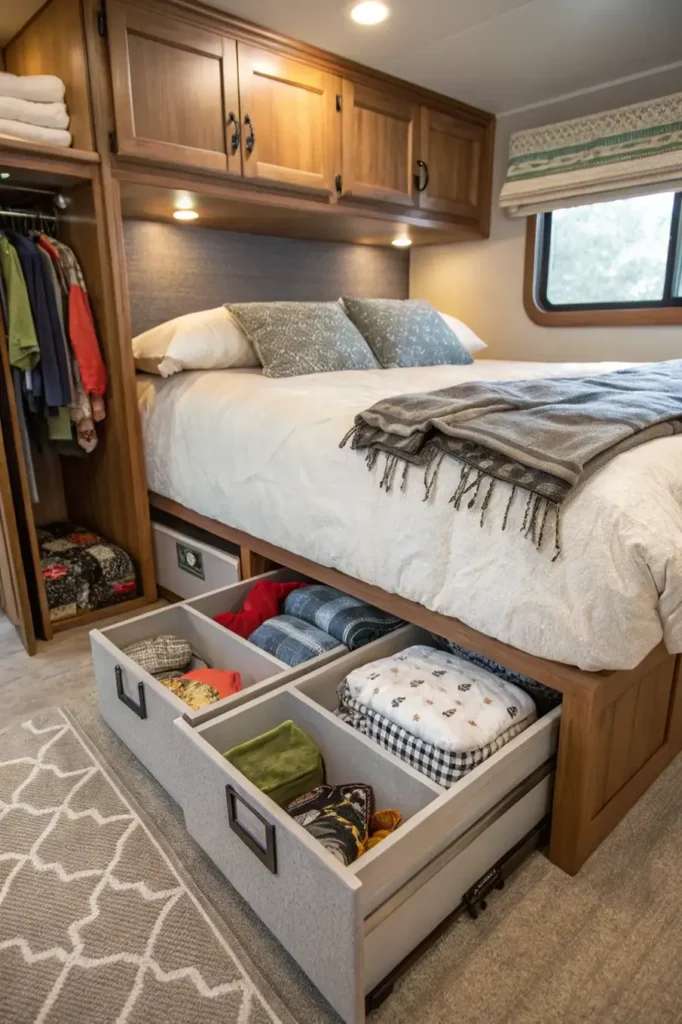
That flat space under an RV mattress holds more than anyone expects, once it stops being one open cavity.
- One section for folded sweaters and pants, kept flat instead of stuffed into a bin.
- A second section just for bedding, so a spare quilt is never buried under laundry.
- A narrow front slot for shoes, caps, and accessories that usually end up on the floor.
Look for a metal glide rated for real weight, not plastic runners. Gravel roads shake loose anything that isn’t built for it.
2. Gas-Strut Lift Bed Over Dresser
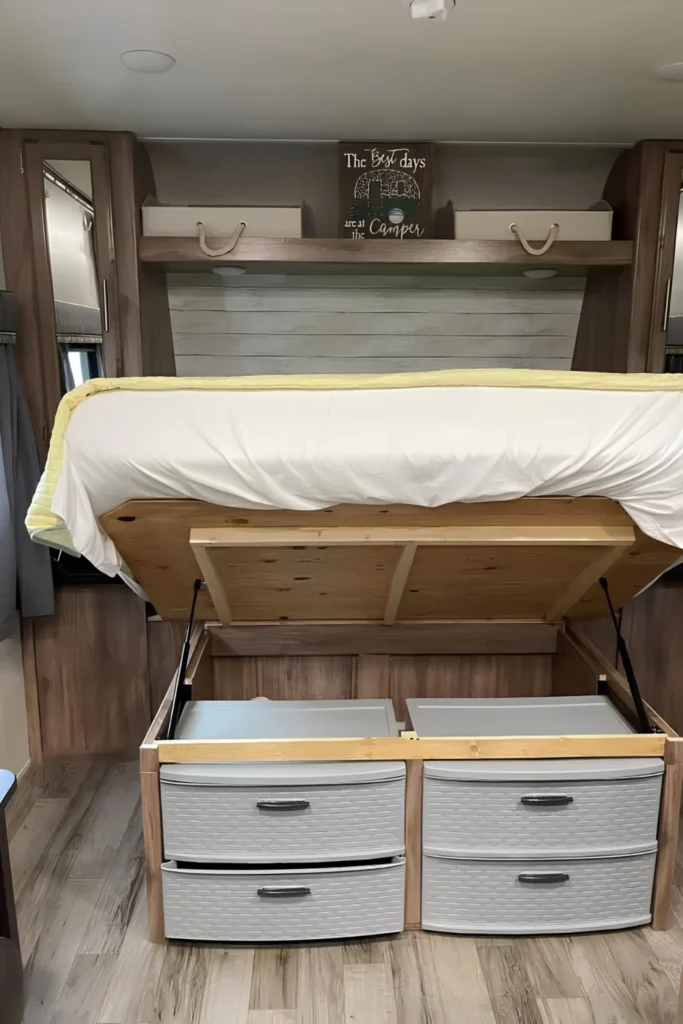
This RV skips the drawer-in-the-frame approach entirely. The whole mattress platform lifts on gas struts, and underneath sits a real freestanding dresser, four drawers deep.
Two struts hold the platform open on their own, no one has to prop it with a stick or a stray shoe. That matters when you’re digging for something at 6am before the coffee is even on.
The dresser itself isn’t custom-built into the RV frame. It’s a standard stacked drawer unit set on the floor and boxed in with a plain wood surround, which means a worn drawer can be swapped out without touching the bed structure at all.
A single storage cavity forces every category of item into one messy pile.
Lift the mattress on gas struts and drop a real dresser underneath instead of loose bins.
Each drawer holds one category, and the unit is replaceable without rebuilding the bed.
3. Zoned Drawers For Kitchen And Gear
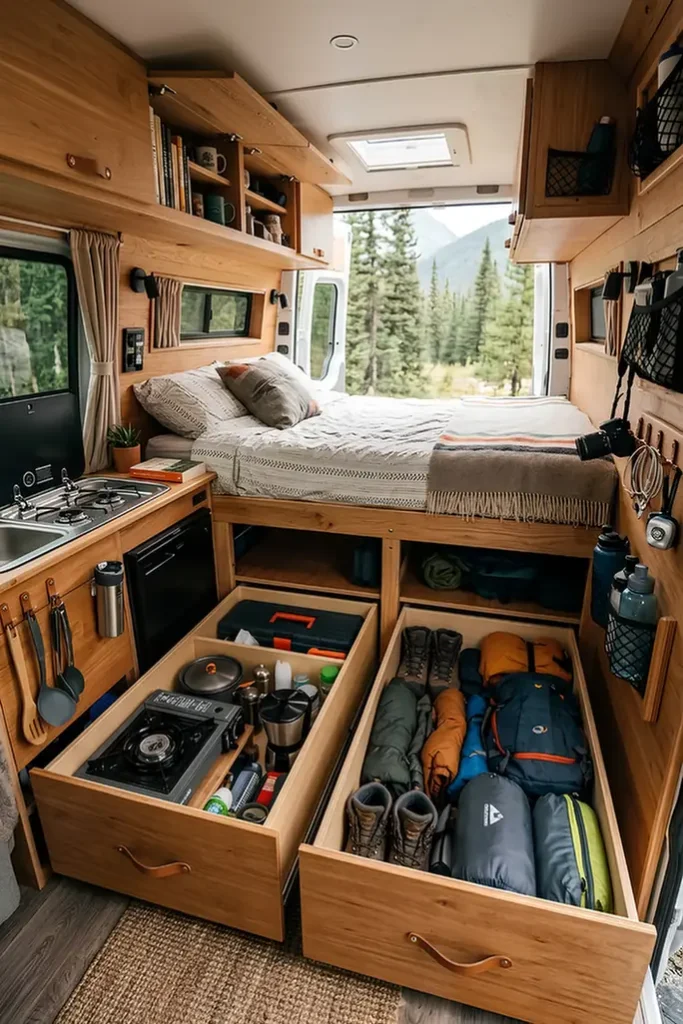
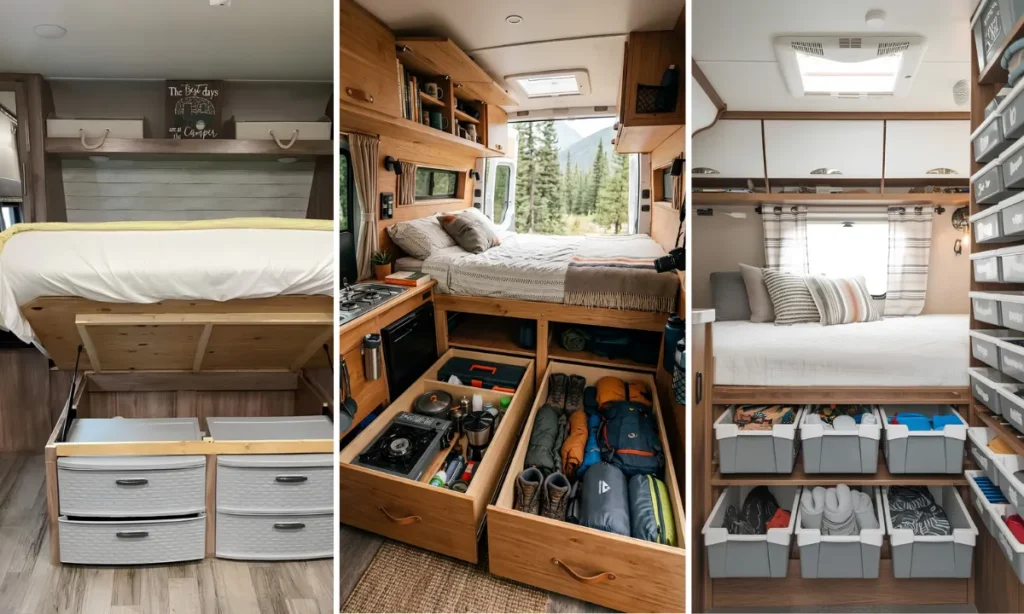
Not every RV under-bed space needs to hold clothes. Here, the whole cavity turns into a gear closet split by function.
One drawer holds cooking gear: a portable stove, cookware, and a French press, all zipped in reach of the kitchenette a few feet away.
The other drawer holds outdoor gear entirely. Boots, sleeping bags, packs, all the bulky stuff that never fits in a closet.
An open shelf above both drawers holds a toolbox on standby, so it’s grabbed without opening anything.
This only works with full-extension slides. A drawer that only opens halfway hides half the gear at the back.
Everything needed to make a meal outside the rig, kept as one grab-and-go unit.
Boots, layers, and bags stored flat so they stay dry and don’t crush each other.
4. Open Cubbies With Fabric Storage Bins
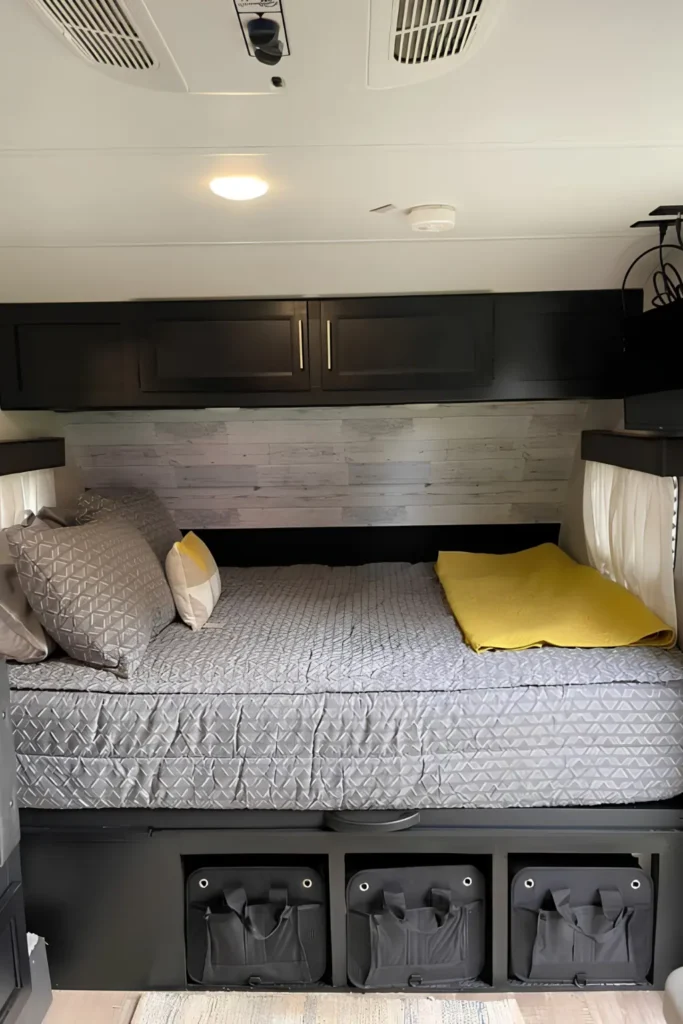
The simplest version of this whole idea lives in one platform bed with three matching bins slid into open cubbies, no drawer hardware at all.
Collapsible bins with side handles pull straight out like a basket, then fold flat if the space gets used for something else on a trip. No slides to grease, nothing to break off in transit.
Three identical bins split naturally into three categories: shoes in one, off-season layers in another, extra bedding in the third. Keeping every bin the same size means nothing gets crammed sideways to make it fit.
5. Lift-Top Bed Over Bin Bench
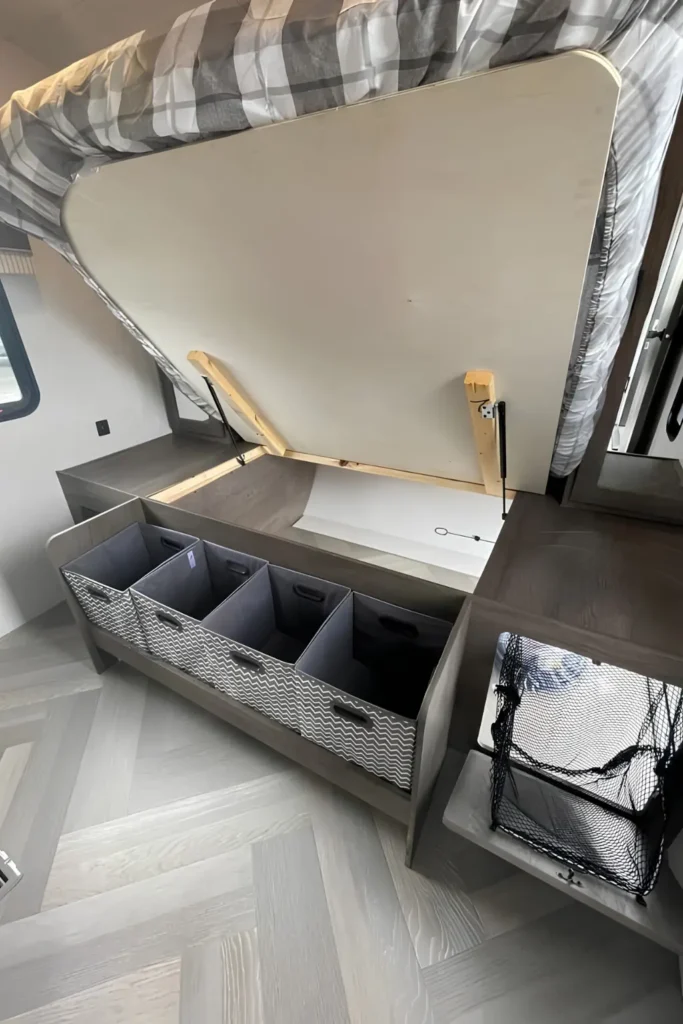
This bed frame does double duty. Lift the whole platform up on its gas strut, and the entire cavity underneath opens as one deep box for bulky, seasonal stuff nobody needs daily.
Down at floor level, a separate low bench holds four fabric bins side by side for the everyday items: socks, chargers, small tools.
A mesh net pocket on the side wall catches anything too small or oddly shaped for a bin. Sunglasses, a phone charger, a hat that never sits flat anywhere else.
Splitting storage by how often something gets touched, not just by category, means the deep cavity stays closed most of the trip.
| Zone | Job | Anchor piece |
|---|---|---|
| Deep cavity | holds seasonal, rarely touched items | gas strut lift lid |
| Bench bins | holds daily grab items | four fabric bins |
| Side wall | catches odd small items | mesh net pocket |
6. Open Cubby Shelf Under Raised Frame
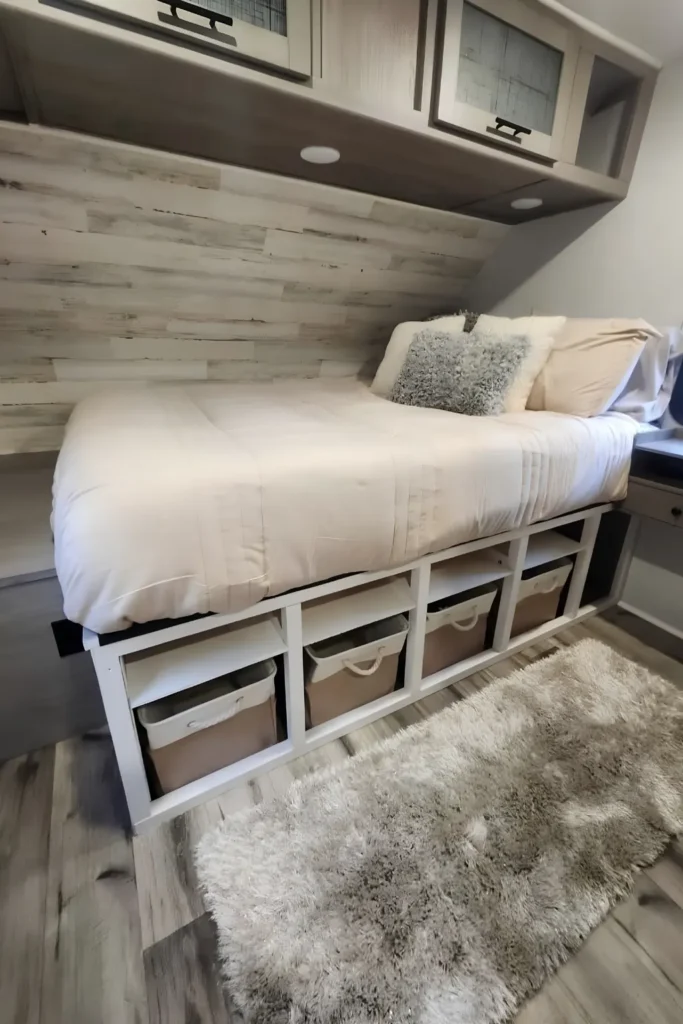
This bed sits up on a simple leg frame, and the whole space underneath is left completely open, no drawer to slide, no lid to lift. Four matching bins with rope handles just slide in and out of a shelf unit that looks more like a bookshelf than a bed base.
Nothing here is hidden. A quick glance tells you which bin has what, since each one sits in plain view instead of behind a closed front.
The raised leg design also adds a few extra inches of headroom under the mattress compared to a boxed platform bed, which is worth checking against your own ceiling height before copying this one.
If you use it weekly, keep it visible.
Open shelving skips the search, since nothing sits behind a closed panel.
7. Twelve Labeled Bins, Two Storage Systems
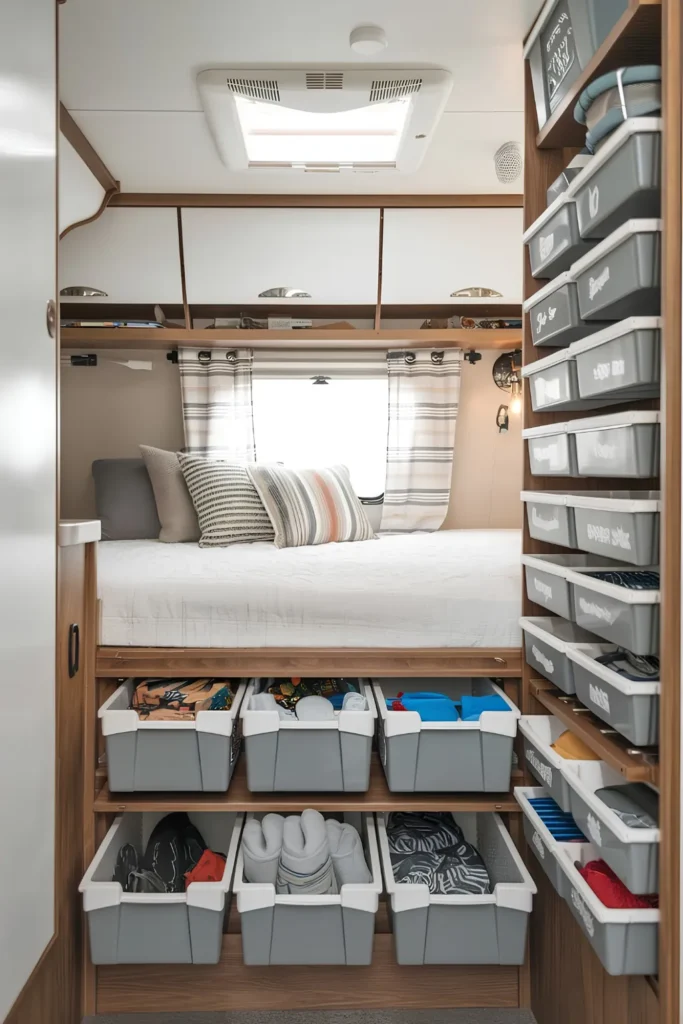
Most RV closets max out at four or five bins before things start doubling up.
This one runs two systems side by side. A tall vertical tower holds eight slim bins along the closet wall, each one labeled by hand.
Down below, six wider bins sit in open shelving under the mattress, split into two rows of three.
Labels are the real trick here. Without them, twelve bins turns into twelve guessing games every single morning.
8. Color-Matched Bins In A Metal Grid
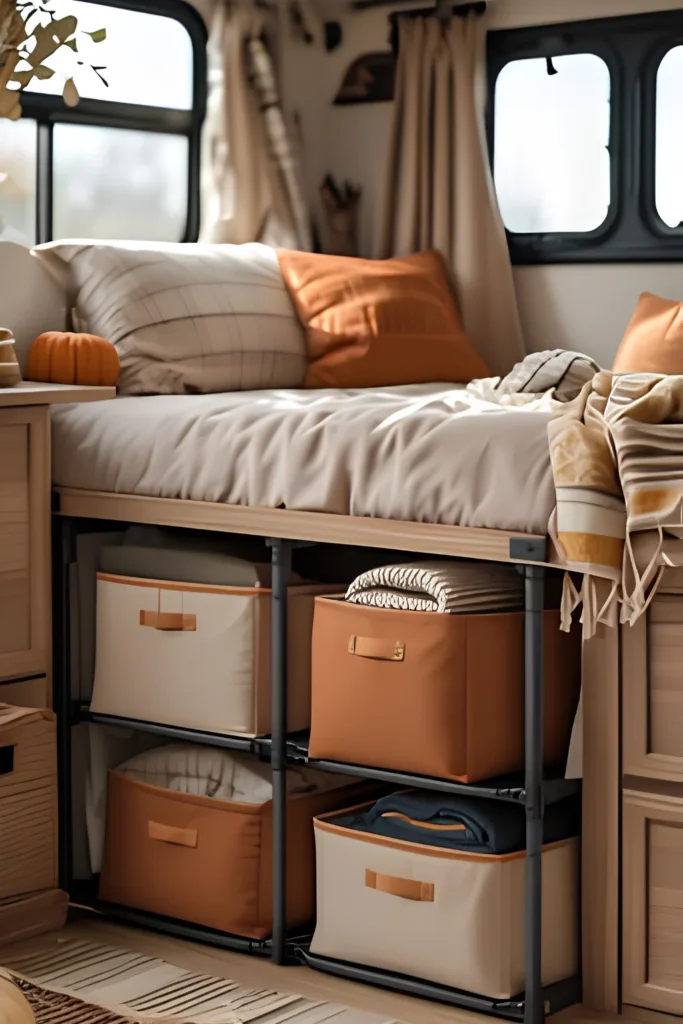
Four bins slot into an open metal grid frame here, two over two, and every bin was picked to match the blanket and pillows on the bed above it.
That’s the real trick. Storage doesn’t have to look like storage. Pick bins in the same rust and cream tones already in the room, and the whole setup reads as furniture instead of an afterthought.
The metal frame itself skips wood entirely, so it holds up better around a shower door or damp boots than a wood cubby would.
One thing to watch: metal grid frames flex more than wood if they’re not bolted to the floor, so check for wobble before loading them heavy.
Bins pull the same tones as the bedding, so the eye reads one palette, not two zones.
A metal cube grid skips wood swelling issues near damp gear.
9. Two-Tier Mixed Storage Wall
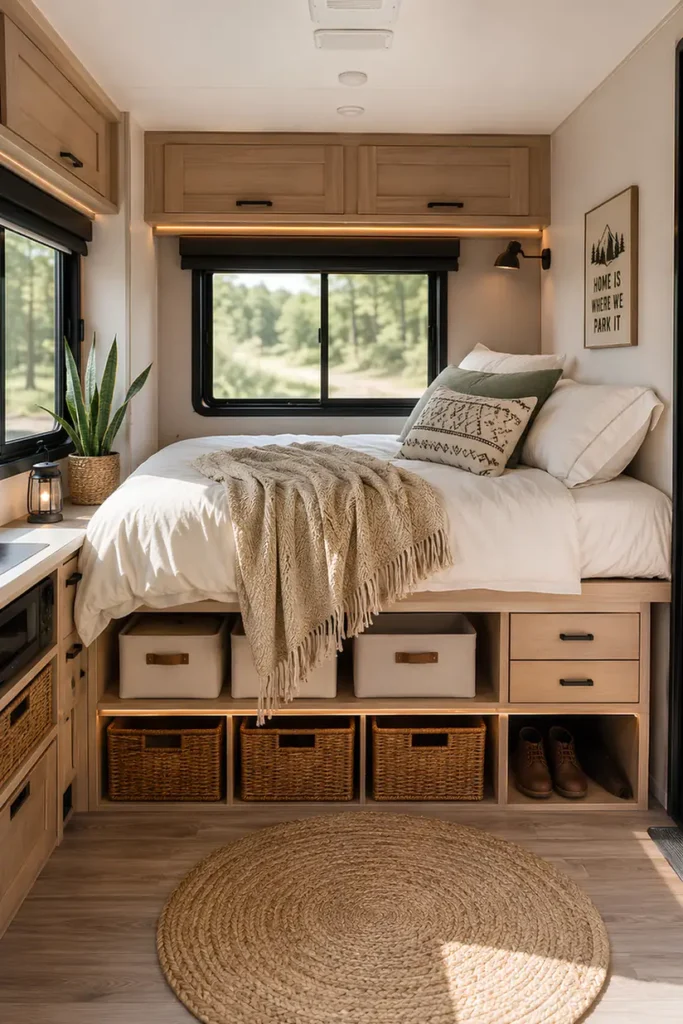
This bed splits its underside into two full rows, and each row uses a different material on purpose.
The top row holds three linen bins with leather handles for soft items, next to a pair of real drawers for anything that needs to stay flat.
Below that, three woven baskets sit side by side, with one open cubby left bare just for boots.
Warm LED strip lighting runs under the platform edge, so nothing below gets dug through in the dark.
| Row | Material | Best for |
|---|---|---|
| Top row | linen bins + wood drawers | soft items, flat items |
| Bottom row | woven baskets + open cubby | bulk items, boots |
10. Split Lift Panels Over Divided Trays
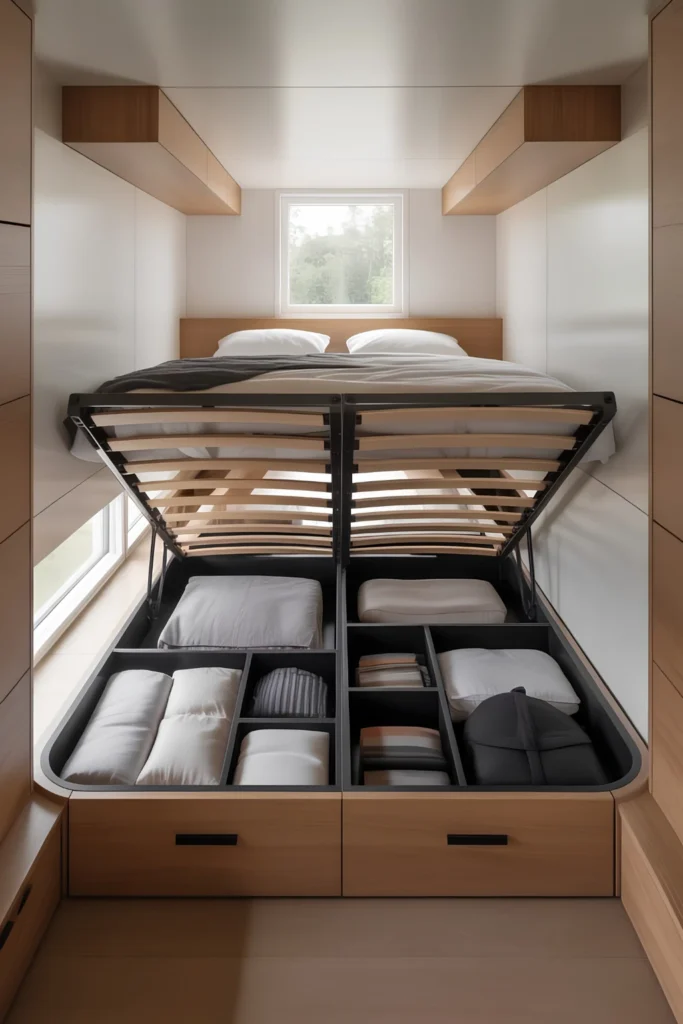
The mattress base here splits into two separate lift panels instead of one, so only half the bed needs to move to reach either side.
Underneath sits a molded tray with built-in dividers, not loose bins. Pillows and folded linens drop into fixed compartments that hold their shape, so nothing slides into a jumbled pile when the RV hits a bump.
A second tier of drawers sits below the tray at floor level, out of sight until you crouch down for it. That third layer is where the bulkiest, least-used items go.
- Split panels mean less weight to lift at once.
- Molded dividers keep folded items from shifting in transit.
- Floor-level drawers hold overflow without crowding the main tray.
Split lift panels on gas struts
Molded tray with fixed dividers
Floor-level drawers for overflow
11. Eight-Bin Grid Spanning The Full Bed Width
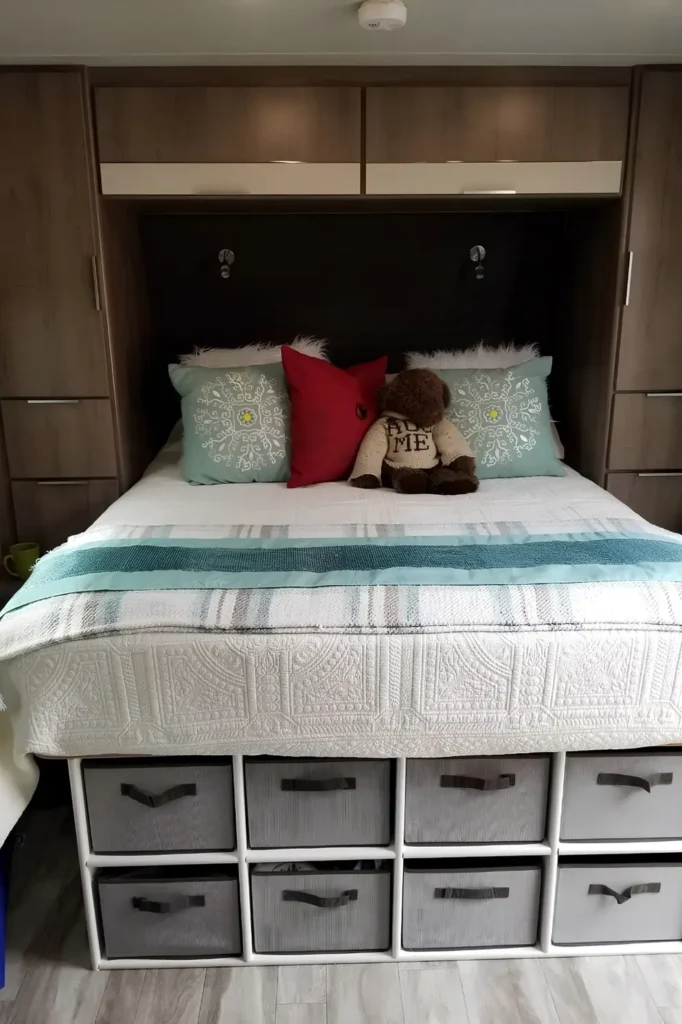
Eight matching fabric bins fill this frame edge to edge, four across and two rows deep, so nothing on the whole underside gets left as dead space.
Each bin has a flat ribbon pull instead of a hard handle, which keeps snagging fabric or blankets to a minimum when one gets tugged out fast.
Uniform white cube framing does the visual work here. When every bin is identical, the eye reads one clean grid instead of eight separate boxes competing for attention.
For a bed this wide, measure twice before ordering. Off-the-shelf bin sizes rarely divide evenly across a full mattress width without a custom frame.
Ribbon pulls instead of rigid handles.
Uniform bin size reads as one grid.
Custom frame needed for full width fit.
12. Rolling Clear Bins On Raw Wood Legs
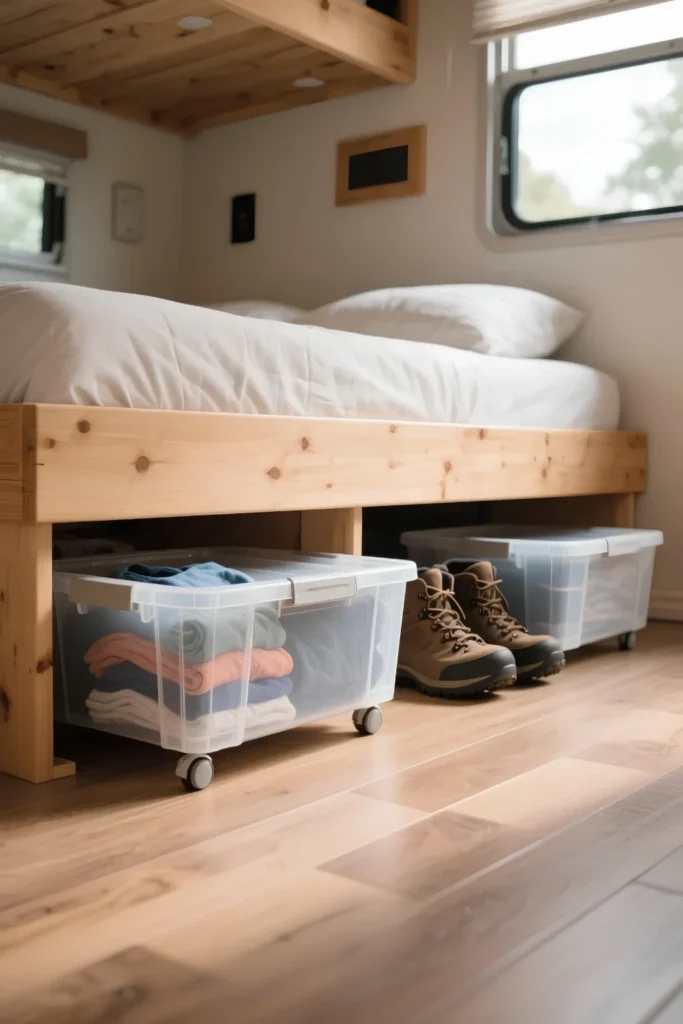
Skip the built-in cabinetry entirely. This bed frame is just raw lumber on legs, tall enough to slide two clear bins on wheels straight underneath.
See-through plastic means no labels, no guessing. A glance down tells you exactly which bin has the sweaters and which one’s still empty for boots.
Locking casters turn the whole bin into something you roll out to pack, then roll back when you’re done, instead of crouching and reaching into a fixed cubby.
Plain lumber like this costs a fraction of custom cabinetry, though it won’t hide the bins the way a paneled base does.
You want it done this weekend.
Rolling bins are ready off the shelf.
You already have spare lumber.
A raised frame takes one afternoon.
13. Three Bins Labeled By Written Tags
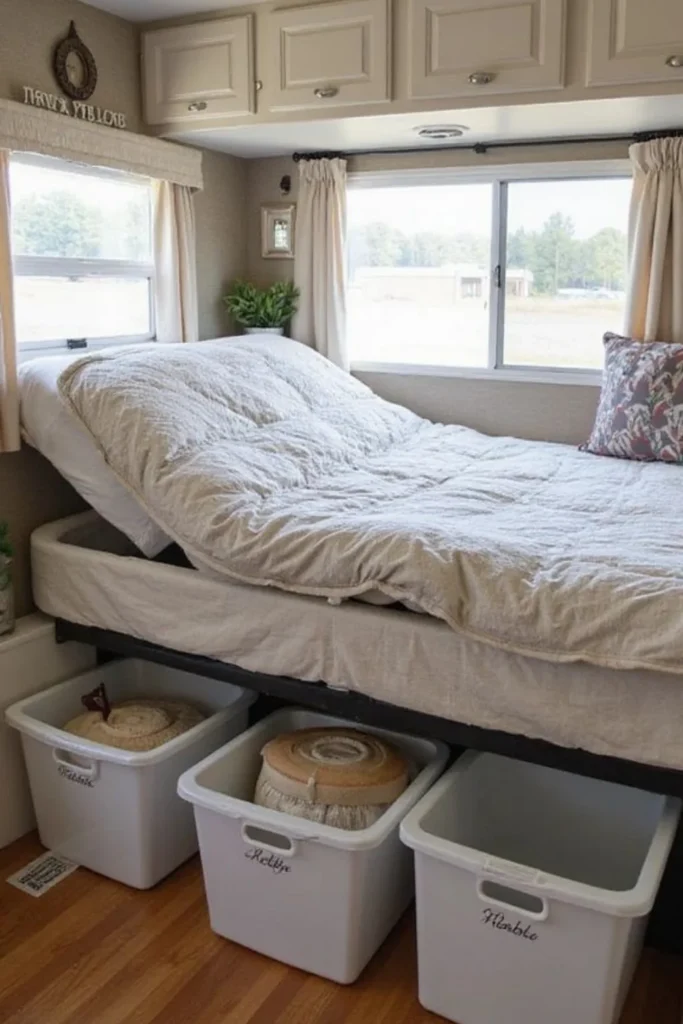
Nothing fancy holds this system together, just three matching plastic bins slid under a raised bed frame, each one marked with a handwritten paper tag taped to the front.
Inside, folded throws and a woven basket lid sit visible above the rim, so a glance tells you which bin still has room before you even open it.
The frame itself sits high enough off the floor that the bins clear the base easily, no digging into a tight cavity required to pull one free.
Paper tags fade and peel fast in a humid climate, so this setup works best paired with a laminated tag or a grease pencil marked straight on the plastic.
14. Four-Drawer Cabinet With Nightstand Match
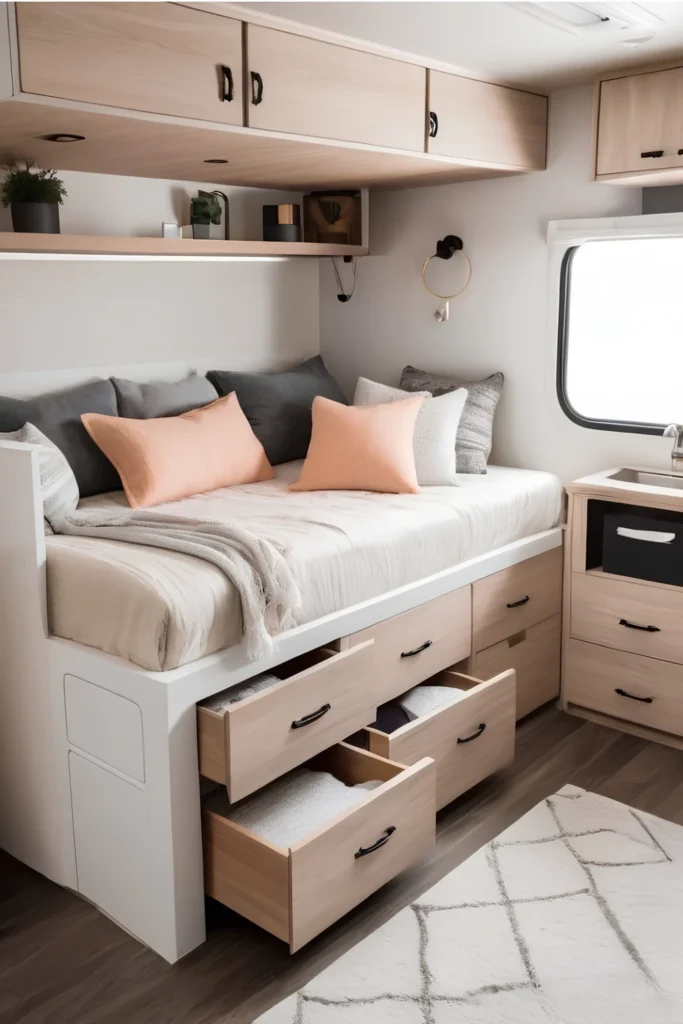
This platform bed carries four full drawers of graduated depth, stacked two by two, finished in the same light oak as the nightstand cabinet standing right beside it.
Because the drawer fronts match the surrounding furniture exactly, down to the same black bar pulls, the whole storage wall reads as one built piece instead of a bed with add-ons.
Top drawers run shallow for folded shirts and socks. Bottom drawers run deep, holding bulkier layers that would crowd a shallow slot.
One drawer left mid-open on a bump-heavy road can jam against the one below it, so a soft-close mechanism is worth the extra cost on a stack this tall.
15. Hydraulic Lift Bed Cargo Grid
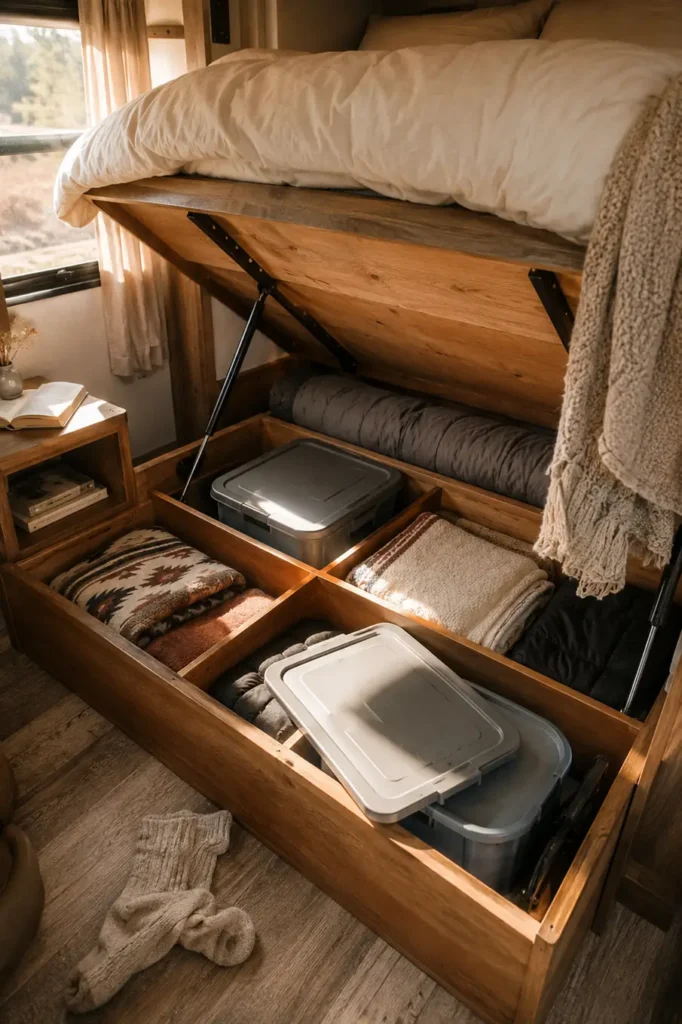
Most people bolt a lift bed straight onto bare plywood and call the space underneath storage.
This one goes further. A paired strut system raises the whole platform, and underneath sits a built wooden grid instead of one open box.
Each slot has a job: one deep bay for bulky totes, two shallow ones for folded layers, and a narrow back channel for boards or poles that never fit anywhere else.
The struts matter more than the wood. An undersized rating strains fast, and the lid gets heavier to lift every season it’s used.
The weight a gas strut can safely hold open before it sags or stops lifting the platform cleanly.
Use it like this: match the rating to a fully loaded platform, not an empty one.
16. Slide-Out Pet Cave And Nook
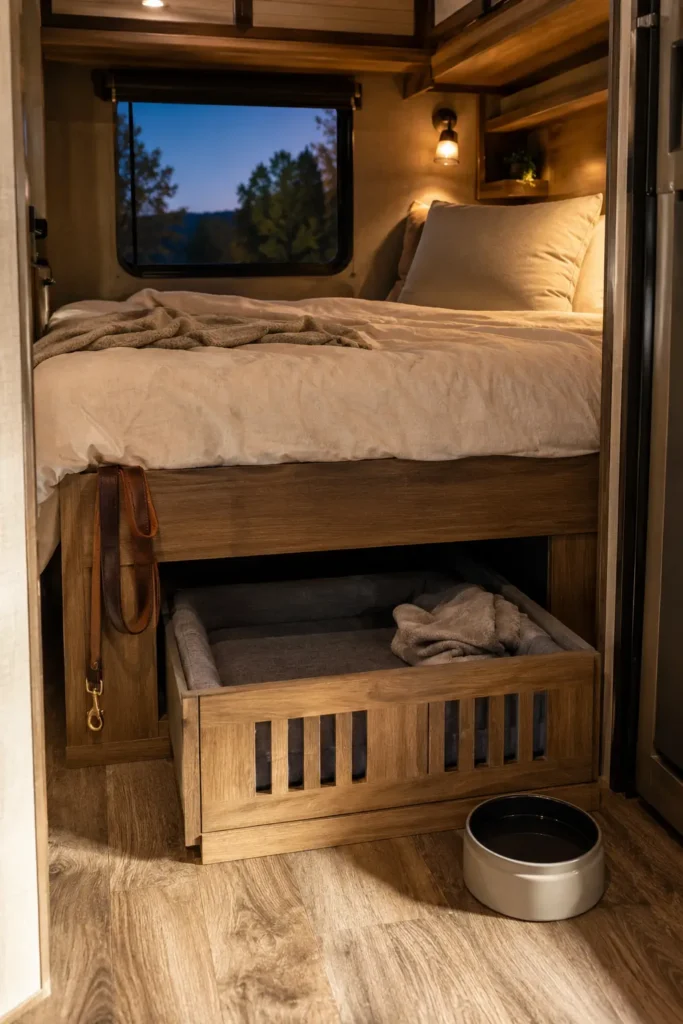
Small dogs and cats need their own sleeping spot, and in most RVs there’s nowhere to put one.
The fix here is a slide-out nook framed straight into the under-bed cavity, sized for a crate pad, riding on a soft-close rail so it glides out without waking anyone.
At night, the pet gets an enclosed, low spot of its own. By morning, the whole thing tucks back under the platform, and the floor is clear again.
One thing worth checking: a solid drawer front traps heat fast, so the nook needs a mesh or slatted panel for airflow.
Small dogs and cats who like an enclosed sleeping spot.
RVs with no floor space to spare for a bed.
Larger breeds who need standing headroom.
Pets prone to chewing rail hardware.
Conclusion
That space under the bed is one of the few spots in an RV that hasn’t already been claimed by a cabinet, a slide-out, or a fixed shelf, which makes it worth the effort to get right.
Start with whichever setup matches how the space is already built. A raised leg frame suits open bins. A lift-top platform suits a divided tray. There’s no need to rebuild the whole base just to borrow one good idea.
Save this one before your next trip, so the packing list has somewhere real to go.