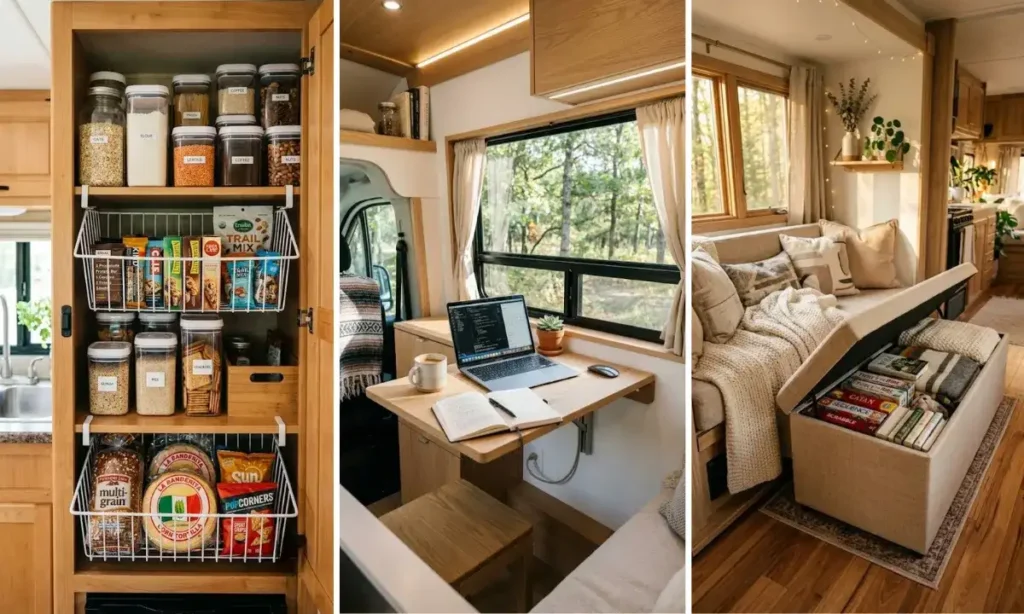
A single RV cabinet has to hold what a full kitchen pantry does at home, and most of it ends up in a pile that shifts every time the rig turns a corner.
These RV pantry organization ideas fix that without adding square footage you don’t have. Some come from real RV kitchens that already solved the problem: pull-out bins, tension rods, corner shelving split by weight. Others are habits, like loading new groceries to the back so nothing quietly expires up front.
None of it requires a renovation. Most of these ideas use a door, a drawer, or a shelf you already have, just organized on purpose instead of by accident.
1. Modular Pull-Out Bin System
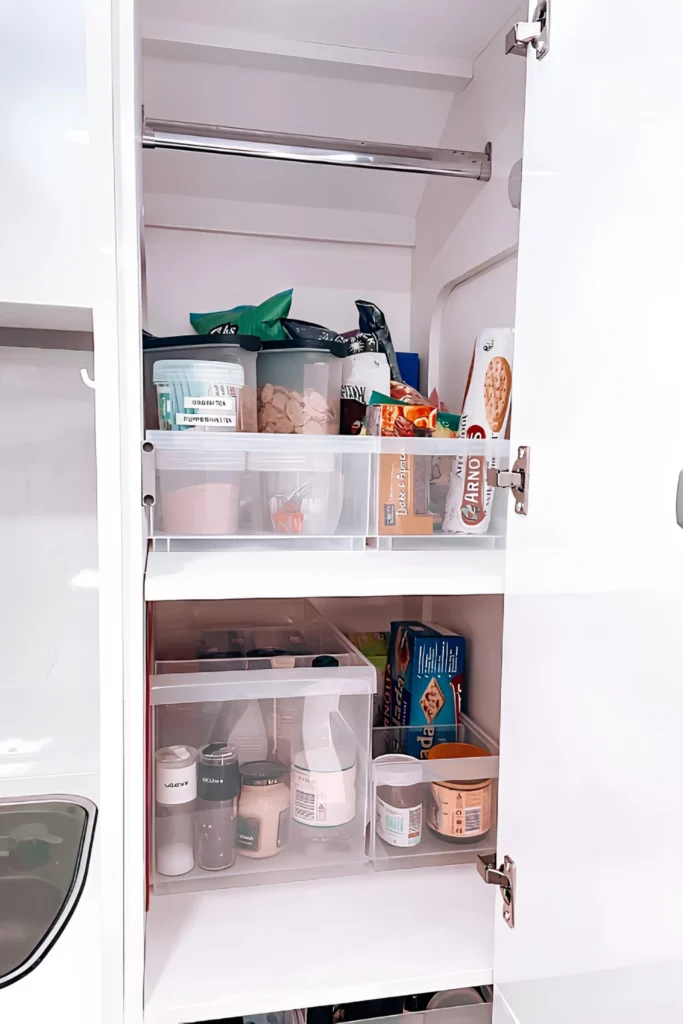
Clear bins turn one narrow cabinet into a set of pull-out drawers. Each one slides forward like a tray, so nothing at the back gets forgotten or lost behind taller boxes.
Stacking them by category means snacks stay separate from spice jars and cleaning sprays, and a quick glance tells you what’s running low.
The see-through plastic does double duty on the road. Contents stay visible, and the low sides keep jars from sliding into each other on bumpy stretches.
- Grouped by type, not by whatever fit last
- Slides out fully for back-row access
- Low enough sides to see over the top row
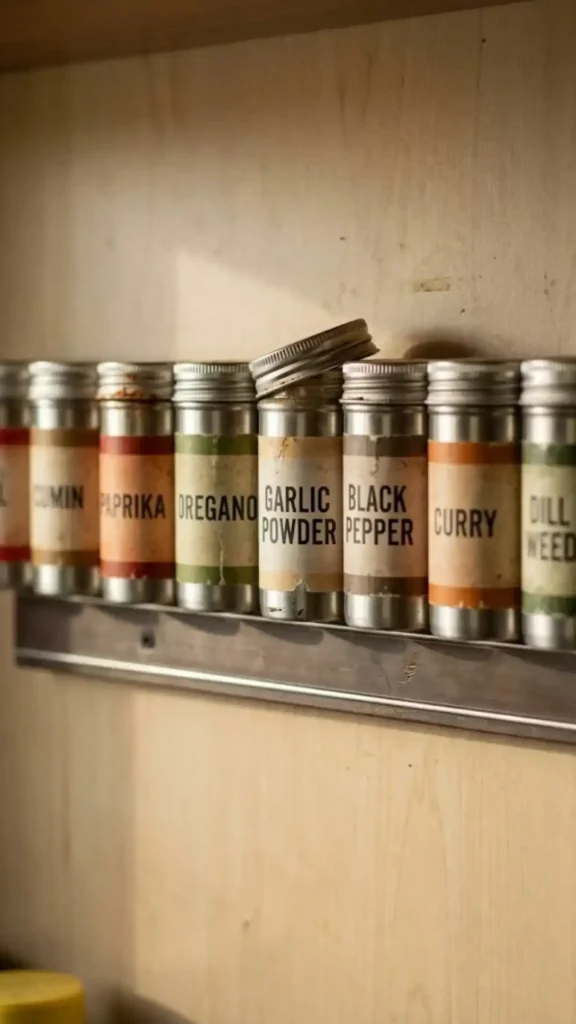
2. Vertical Spice Rack On Door
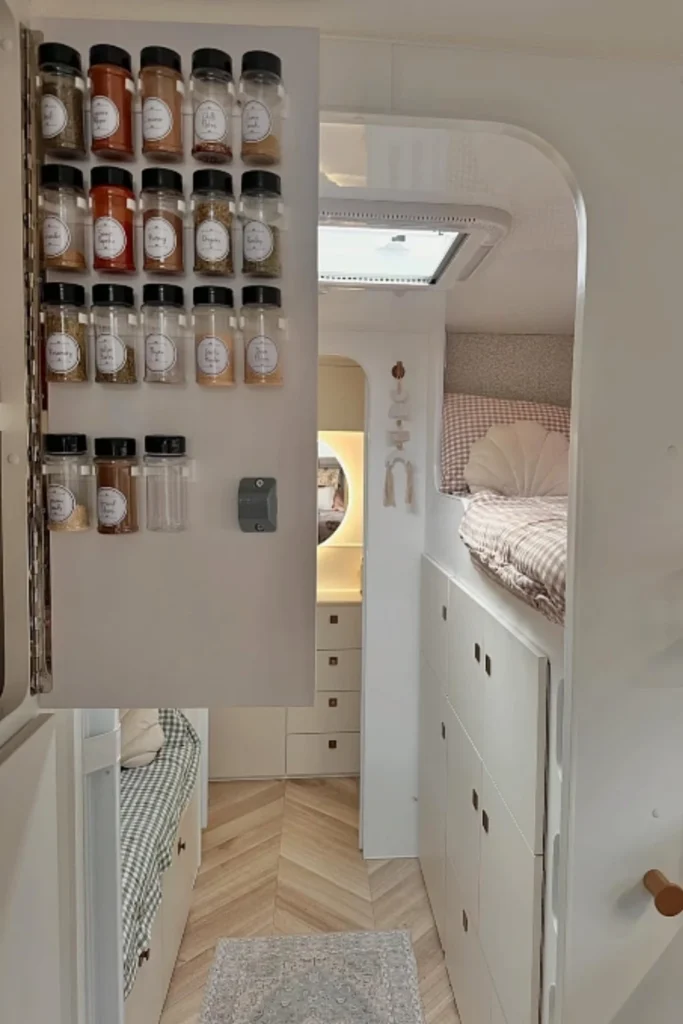
Most RVers store spices in a drawer, where jars roll around, and the smallest ones sink to the bottom.
Clipping them to the inside of a cabinet door solves that instead. Every jar sits upright, label facing out, sorted in tidy rows instead of a jumbled pile.
It also frees up real shelf space for bulkier pantry items, since the door was doing nothing before.
Small clip mounts hold better than adhesive strips on a moving rig, and the door swing needs enough clearance to fully open without hitting a counter edge.
3. Drawers Labeled By Meal
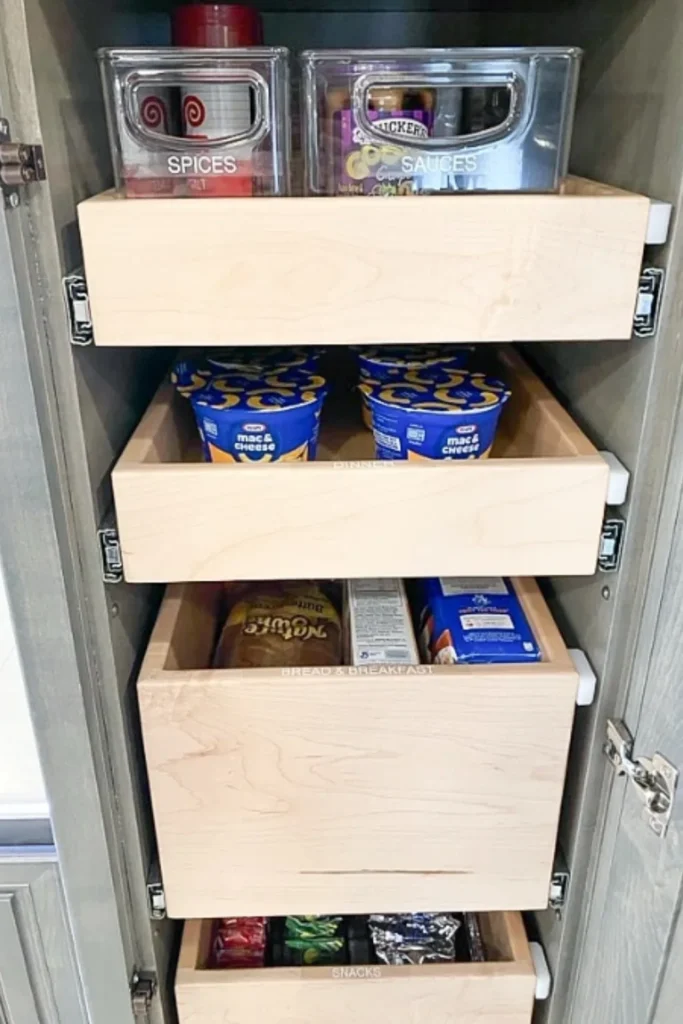
Most RVers stack pantry items by whatever fits, then dig through three shelves just to find dinner.
This setup sorts by meal stage instead. The top drawer holds spices and sauces, the shallowest layer, meant for a quick grab. The middle holds dinner staples. The bottom holds bread and bulkier breakfast items.
Labeling each drawer face means anyone in the rig can find things without asking, and it stops a cook from yanking open every drawer mid-meal.
One catch: shallow drawers need low dividers, or small jars roll to the back on a bumpy road.
Spices and sauces, used every meal
Boxed and cupped meal staples
Bread, cereal, and breakfast boxes
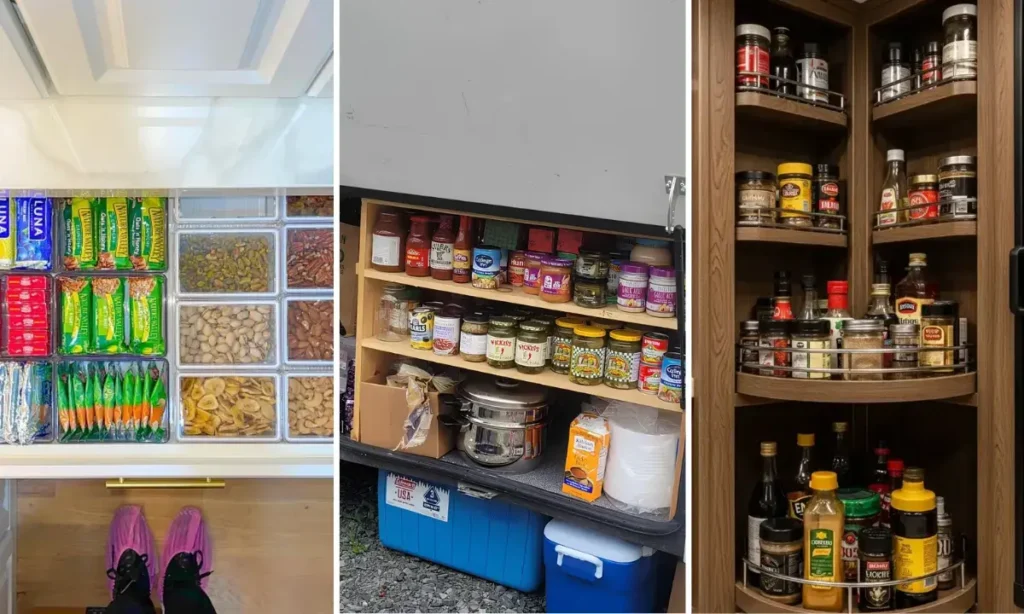
4. Overflow Storage In The Basement
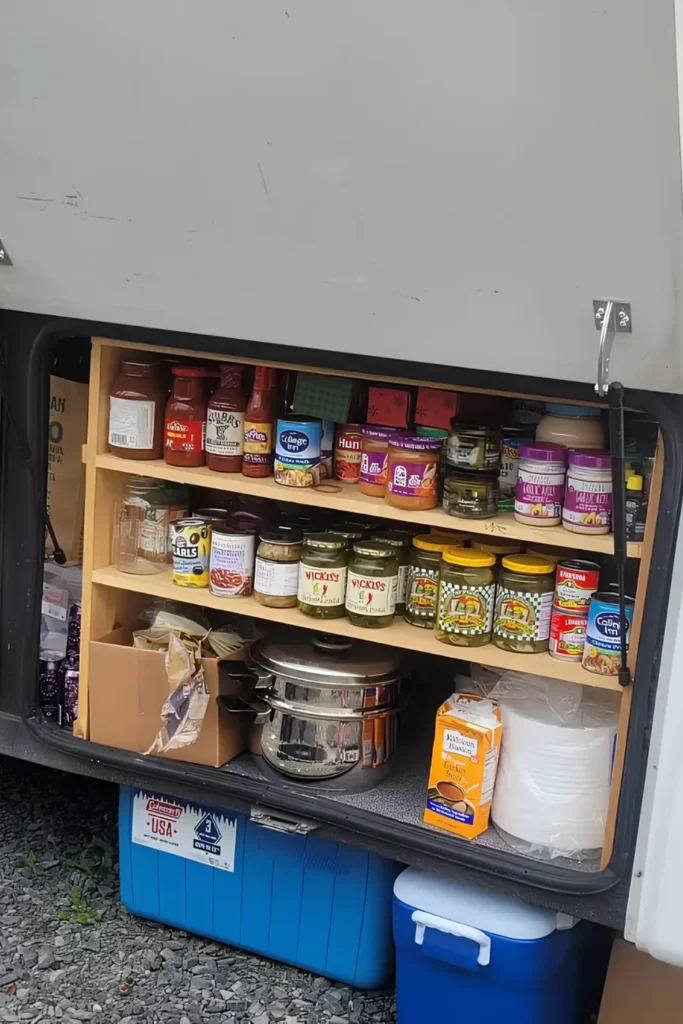
Not every pantry item has to live inside the galley. Canned goods, jars, and paper towels that only get grabbed now and then can move to an exterior pass-through bay, freeing the kitchen shelves for daily staples.
That bay sits outside the insulated cabin, though, so it swings hotter and colder than the galley on a travel day. Stick to shelf-stable cans, jars, and paper goods here, and keep anything oil-based or heat-sensitive back inside.
| Zone | Job | Anchor piece |
|---|---|---|
| Exterior bay | Overflow for shelf-stable goods | Bulk paper towel pack |
| Galley cabinet | Daily-use staples only | Everyday condiments |
5. Matching Canisters Maximize Vertical Space
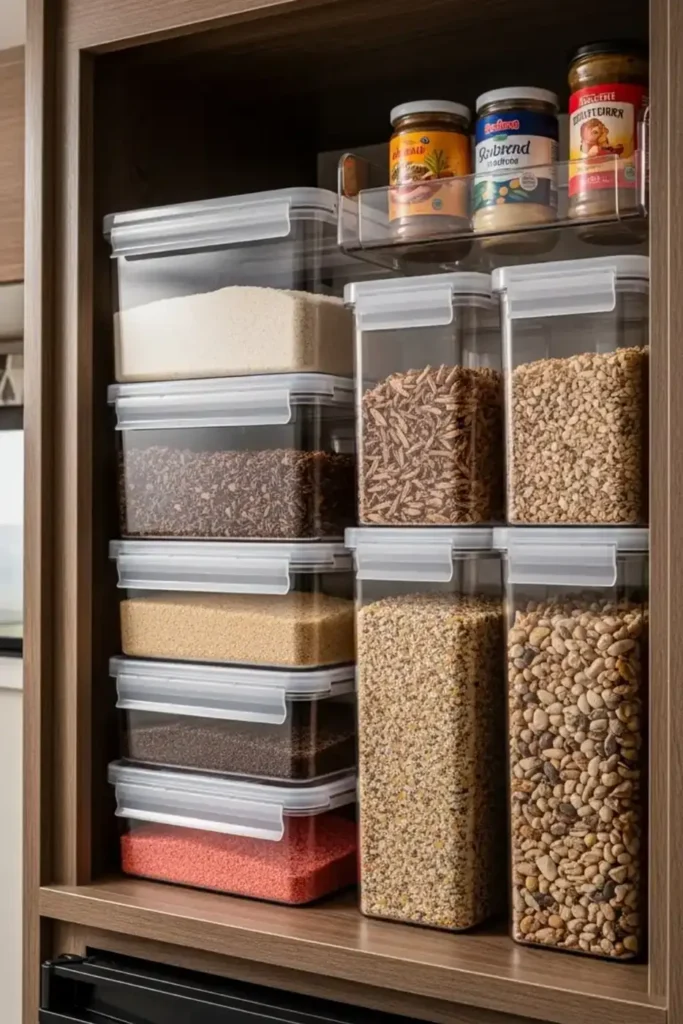
Uniform canisters replace mismatched bags, and matching lids let everything stack clean to the top of the cabinet.
Two shapes cover most needs: a low wide bin for short goods like rice, and taller square jars for pasta or beans.
Buying one size across the board turns a jumble of bags into a tight grid instead of a leaning pile.
- Same lid height across every jar in the stack
- Square shapes nest tighter than round ones
- Hard sides hold up better than bags on rough roads
6. Divided Drawer Sorts Snacks Fast
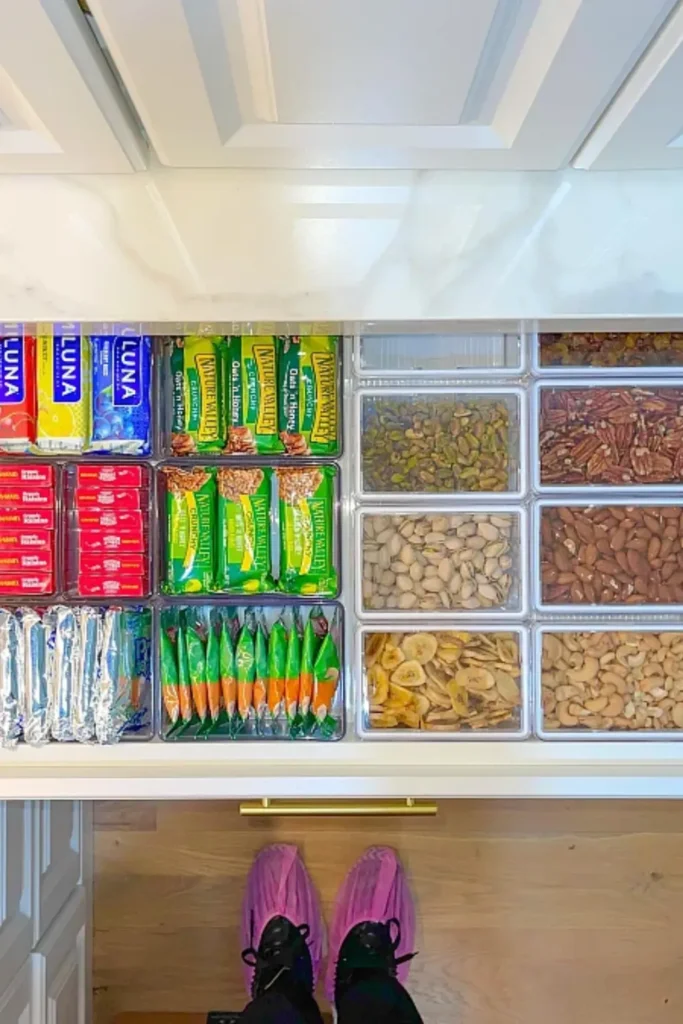
A flat drawer split into small bins turns snack time into a one-glance decision instead of a dig through bags.
Bars sit in one row, nuts in another, dried fruit in a third, so anyone can grab their own without asking.
The dividers also stop loose pieces from migrating into every corner of the drawer once the rig starts moving.
7. Slide-Out Column Fills Dead Space
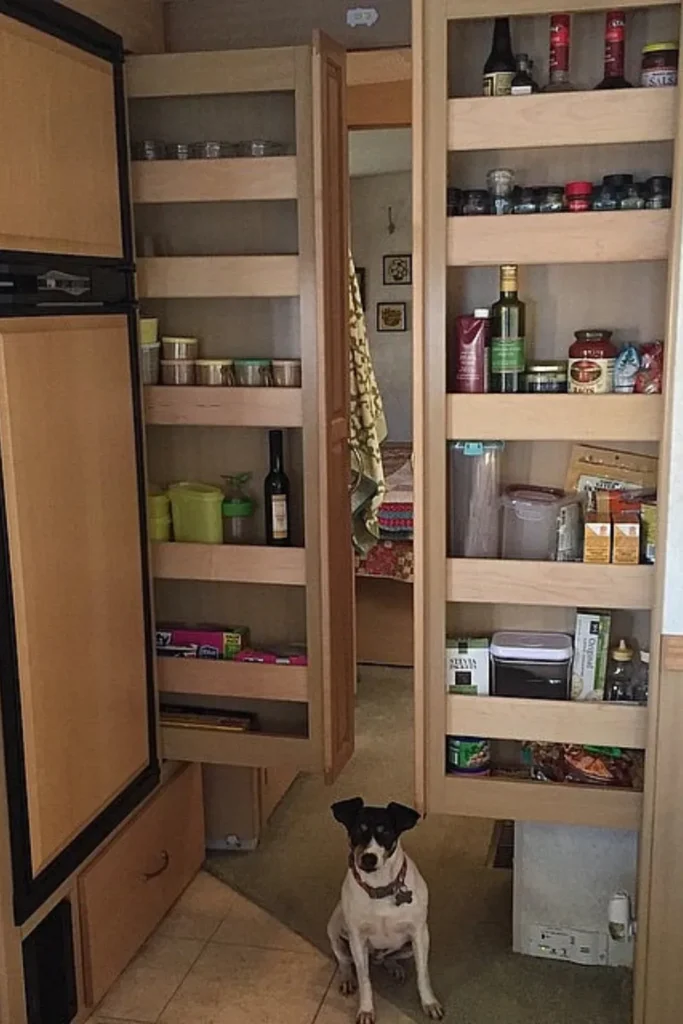
The narrow gap next to a fridge or freezer usually sits empty, just deep enough to collect dust and nothing else.
A slim pull-out column turns that sliver into four or five slotted shelves for cans, oils, and boxes, and it slides fully into the room for easy loading.
Loaded with canned goods, a full column carries real weight on one wall, so it’s worth checking the slide hardware can handle it before filling every shelf.
A sliver of unused space beside an appliance.
Five slotted shelves that pull fully into the room.
8. Corner Turntable Reaches Deep Corners
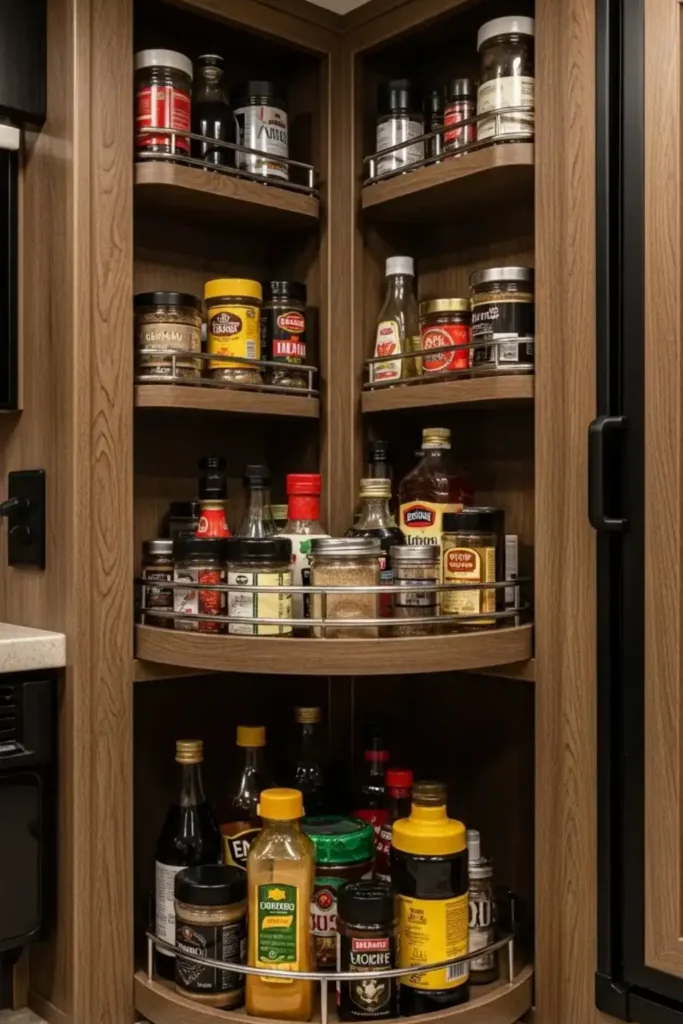
Corner cabinets hide half their space behind the door hinge, where nothing gets reached without pulling three other jars out first.
A round rotating shelf spins the back of that corner to the front, so a sauce bottle buried deep just comes around to meet your hand.
A round shelf that spins in place, letting you rotate items stored toward the back of a corner cabinet into view.
Best fit: deep corner cabinets where a fixed shelf would waste half its depth.
9. Stacked Riser Splits One Drawer Into Two
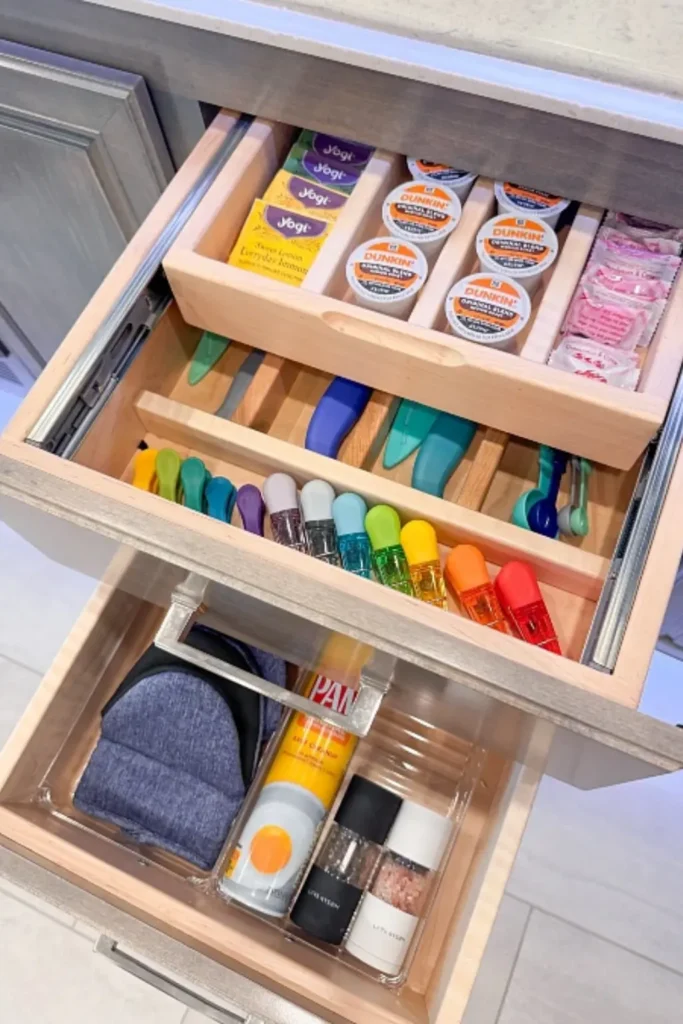
Why waste half a drawer’s height on empty air above flat packets?
A raised riser box sits on top, holding tea bags and K-Cup pods in slim upright rows. Underneath, the full drawer depth opens up for spoons, spatulas, and measuring cups lined up by size.
One drawer now does the work of two, without adding a single inch of cabinet space.
10. Load Heavy Items On The Bottom Tier
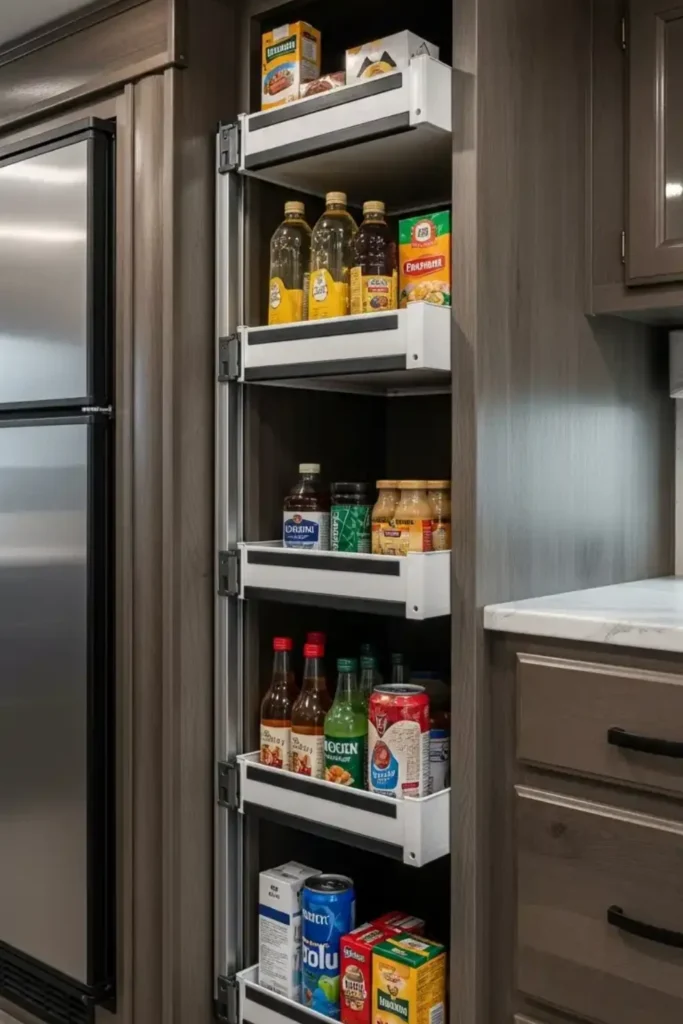
A slim pull-out column beside the fridge holds five stacked trays, and where each item lands actually matters on a moving rig.
Cans and glass bottles belong on the lowest tray. Boxed snacks and lighter goods go up top.
Get this backwards, and a hard stop can send heavy jars sliding forward into a flimsy top basket, tipping the whole column off balance.
- Bottom tray: cans, glass bottles, jars
- Middle trays: sauces and boxed mixes
- Top tray: lightweight snacks and paper goods
Heavy on the bottom, light on top
Keeps the column’s center of gravity low while the rig is in motion.
11. Wire Baskets Keep Airflow Moving
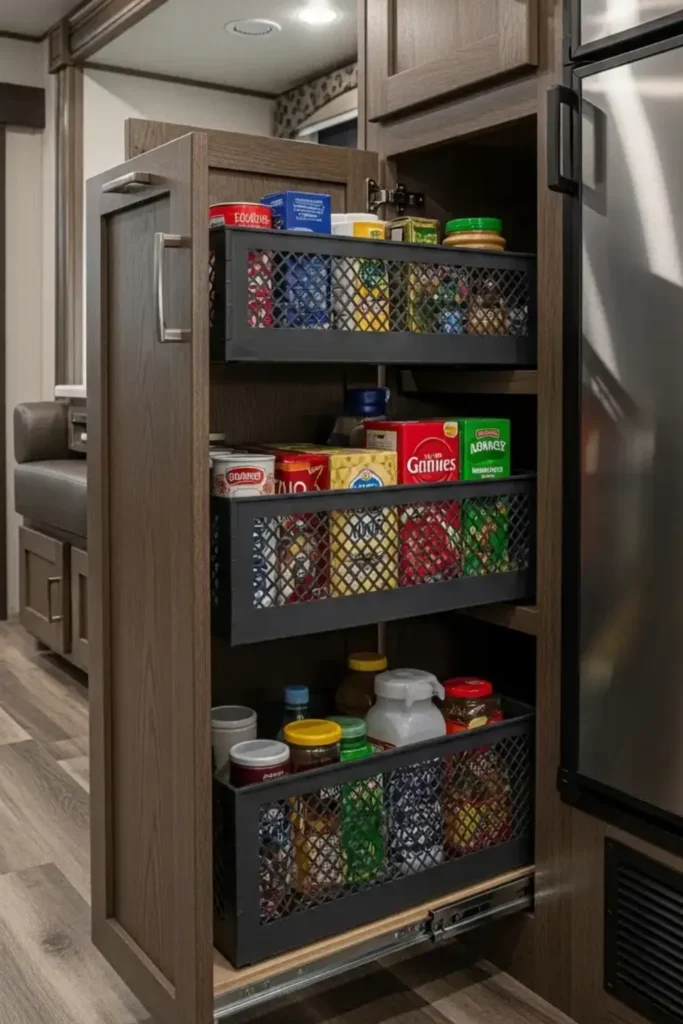
Solid pull-out bins look tidy, but they trap heat and moisture against whatever sits inside, which speeds up spoilage on canned and boxed goods over a long trip.
Open wire baskets solve that by letting air pass straight through the sides. Three stacked tiers slide out fully, so nothing at the back goes unnoticed until it expires.
Wire also shows contents through the mesh, so a glance from across the kitchen tells you what’s running low without pulling a single drawer open.
Mesh sides stop trapped heat from speeding up spoilage.
Contents show through the wire without opening a single drawer.
12. Magazine Files Corral Flat Boxes
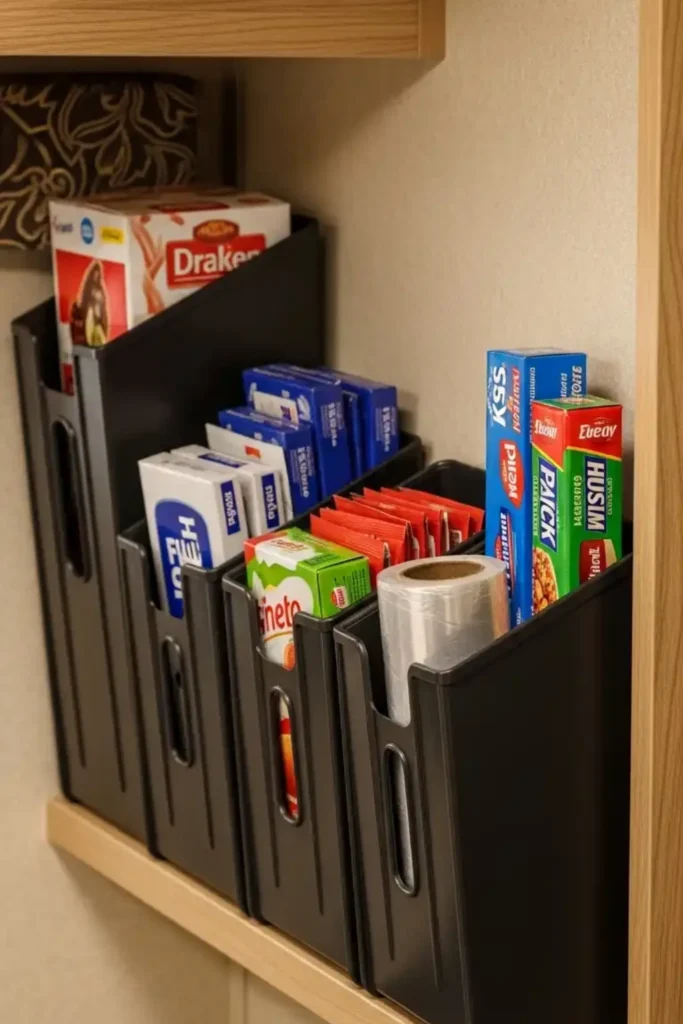
Office magazine holders solve a problem the pantry aisle never quite fixes: flat boxed goods that fall over and slide flat the moment the rig hits a bump.
Standing them upright, side by side, keeps foil boxes, cracker sleeves, and snack bars from collapsing into a jumbled pile behind the door.
A dollar-store find does the same job as a purpose-built pantry organizer, at a fraction of the price.
Office magazine or file holders
Foil boxes, cracker sleeves, snack bars
Dollar-store range
13. Over-Door Organizer Frees Shelf Space
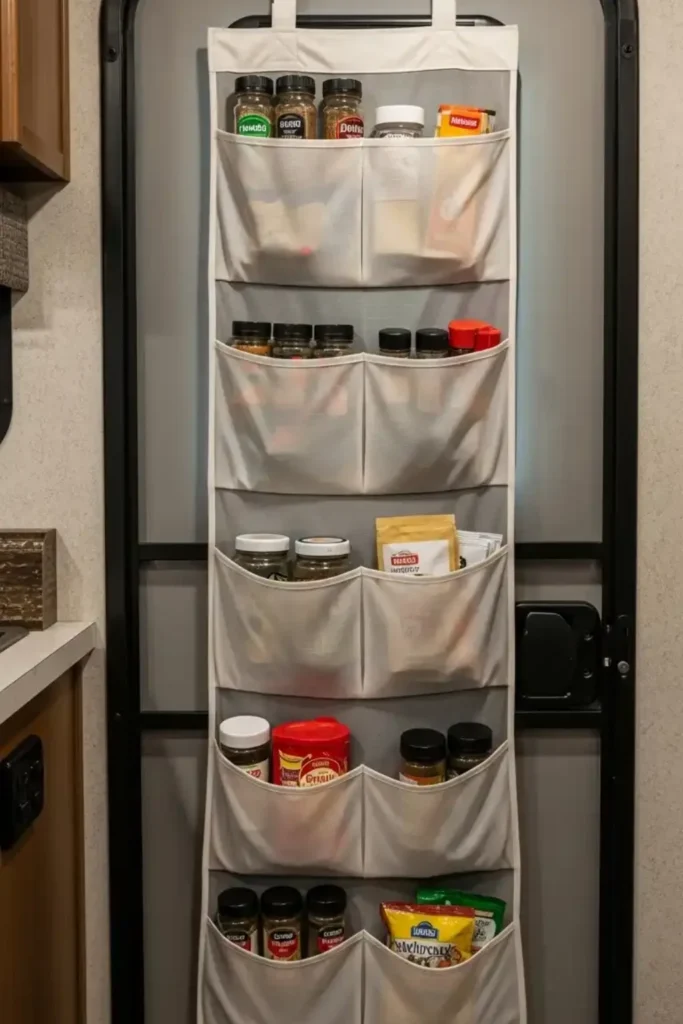
A hanging pocket organizer turns unused door space into a second pantry, holding twenty or more small jars and packets that would otherwise crowd every shelf behind it.
Small spice jars sit up top. Bulkier packets like coffee filters and drink mixes go in the lower, deeper pockets, where the extra fabric can support more weight.
Watch the door’s hinge rating before loading it full. A cheap hinge under a heavy organizer will sag over time, and a door that won’t latch flush is a hazard once the rig is rolling.
14. Mesh Laundry Bins Beat Plastic Totes
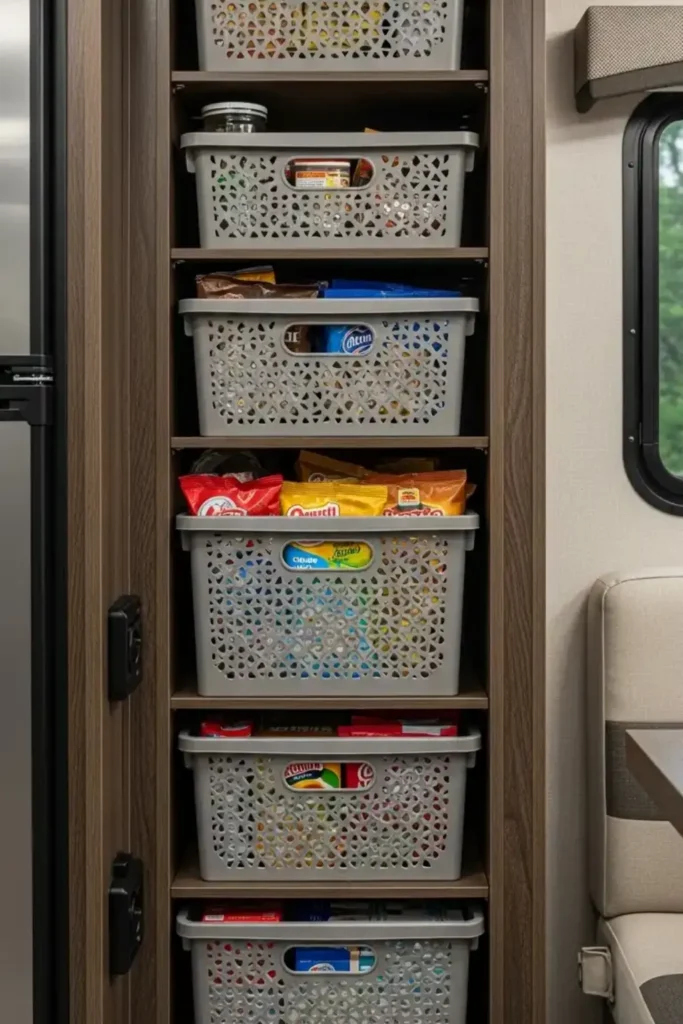
Solid plastic totes are the default pantry bin, but mesh laundry baskets do the job better for chips and snack bags. Air moves through the sides, so bags don’t sweat or go stale as fast in a closed cabinet.
The open weave also holds up to years of sliding in and out without cracking the way brittle plastic bins eventually do.
Sized right, one basket per shelf keeps chip bags upright instead of crushed flat under whatever gets stacked on top.
| Plastic Tote | Mesh Basket |
|---|---|
| Traps heat and moisture | Lets air pass through |
| Cracks with repeated sliding | Flexes without splitting |
15. Labeled Bins Sort Snacks By Purpose
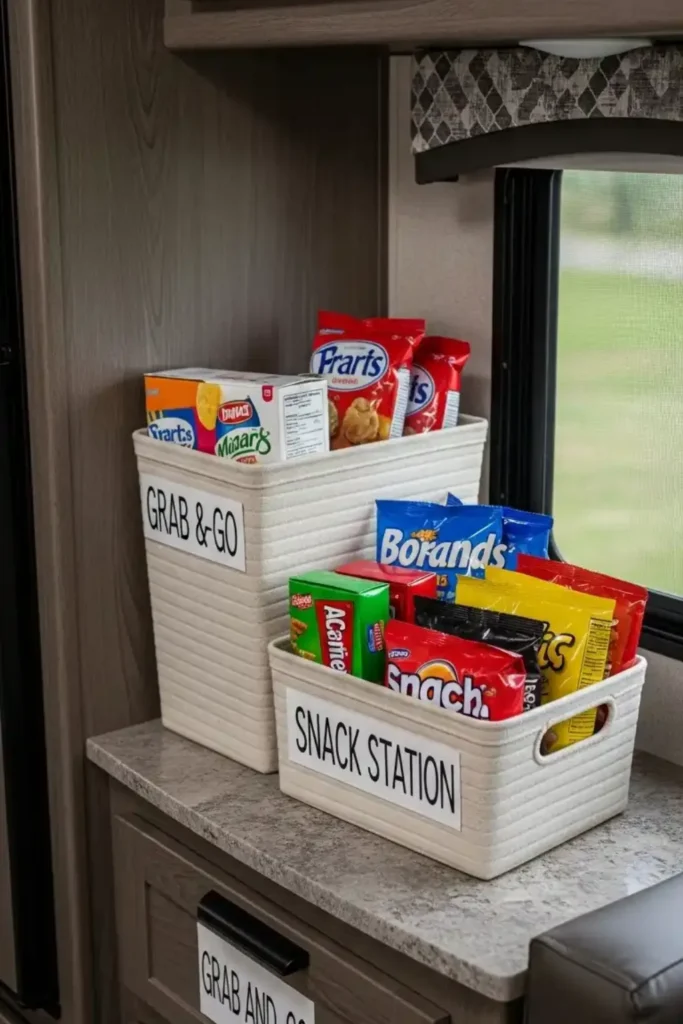
Not every snack serves the same moment. Some get grabbed running out the door, others get pulled out for lounging around camp.
Two labeled bins split those uses apart. “Grab & Go” holds portable boxed snacks near the door. “Snack Station” holds bagged chips and bars meant for sitting down.
Anyone in the rig reads the label instead of asking what’s for snack time, which matters most with kids or guests aboard.
Two labels, two jobs
16. Hanging Wire Baskets Store Fresh Produce
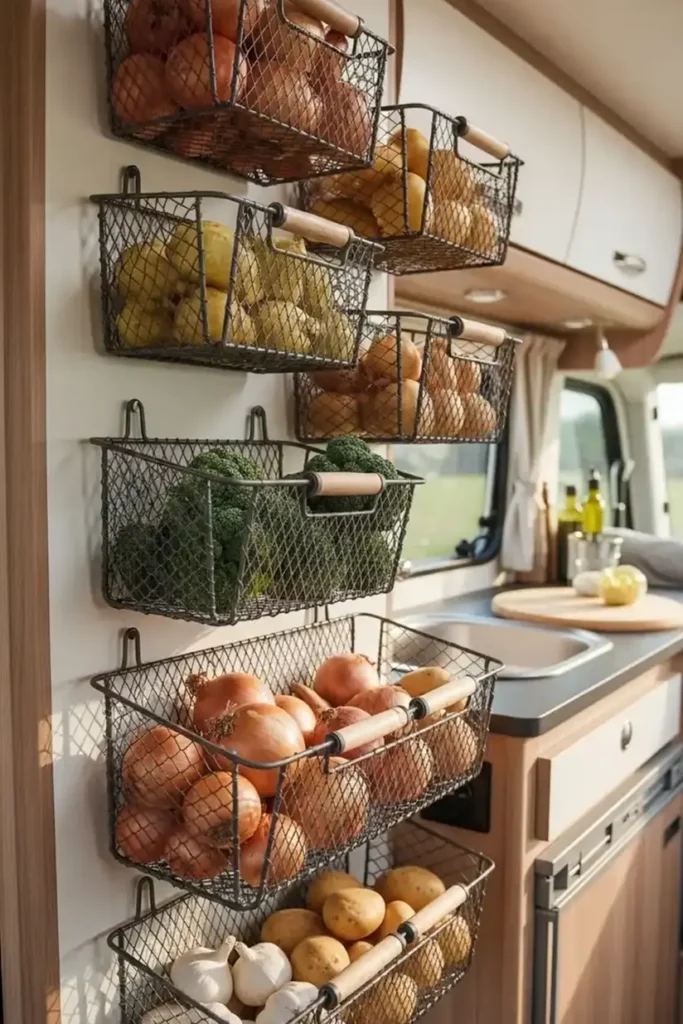
Onions, potatoes, and garlic don’t belong in the fridge, but they also don’t have room on a crowded countertop.
Stacked wire baskets mounted on an open wall stretch that produce storage vertically instead. Each basket tilts forward slightly, so nothing rolls out even while the wire mesh keeps air moving around the food.
Root vegetables sit lower, since they’re heavier and hold up fine near the floor line. Lighter produce like broccoli goes higher, where a lighter mount can carry the weight.
| Tier | Holds | Why here |
|---|---|---|
| Top | broccoli, light produce | lighter mount point |
| Middle | potatoes | moderate weight |
| Bottom | onions, garlic | heaviest, lowest center of gravity |
17. Tension Rods Lock Bottles In Place
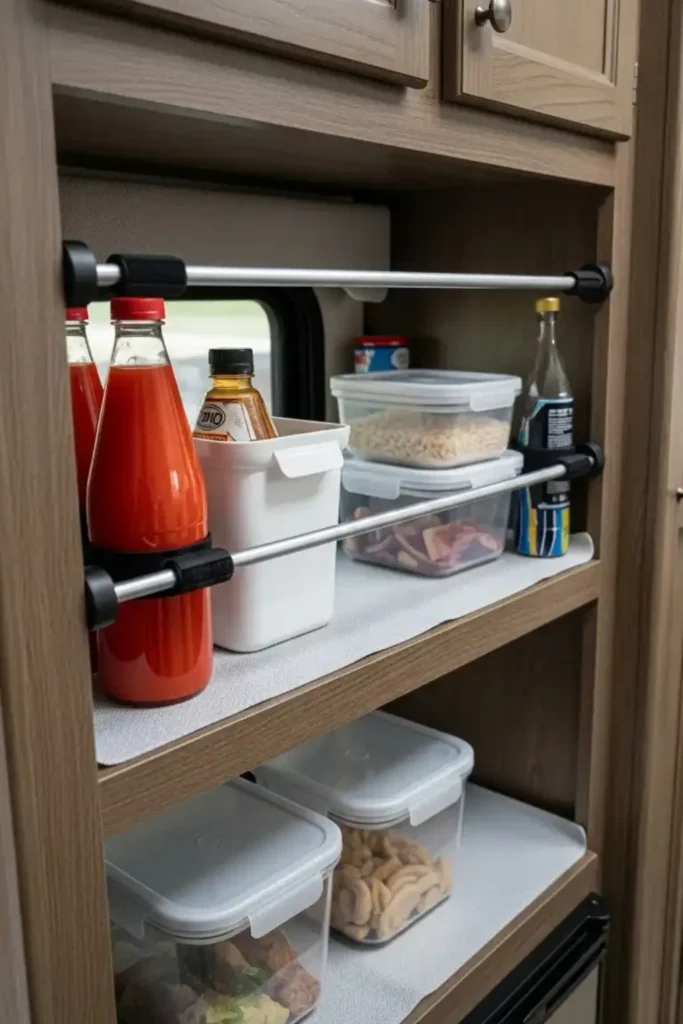
Tall bottles are the first thing to topple during a sharp turn, sliding into everything stacked beside them.
A spring-loaded tension rod mounted across the shelf front solves that without any drilling. Bottles wedge against the bar and can’t slide forward, while shorter items pass freely underneath.
Two rods stacked at different heights let one shelf corral both tall bottles up top and shallow containers below, all without a single mounting screw.
18. Matching Bins Sort The Fridge Too
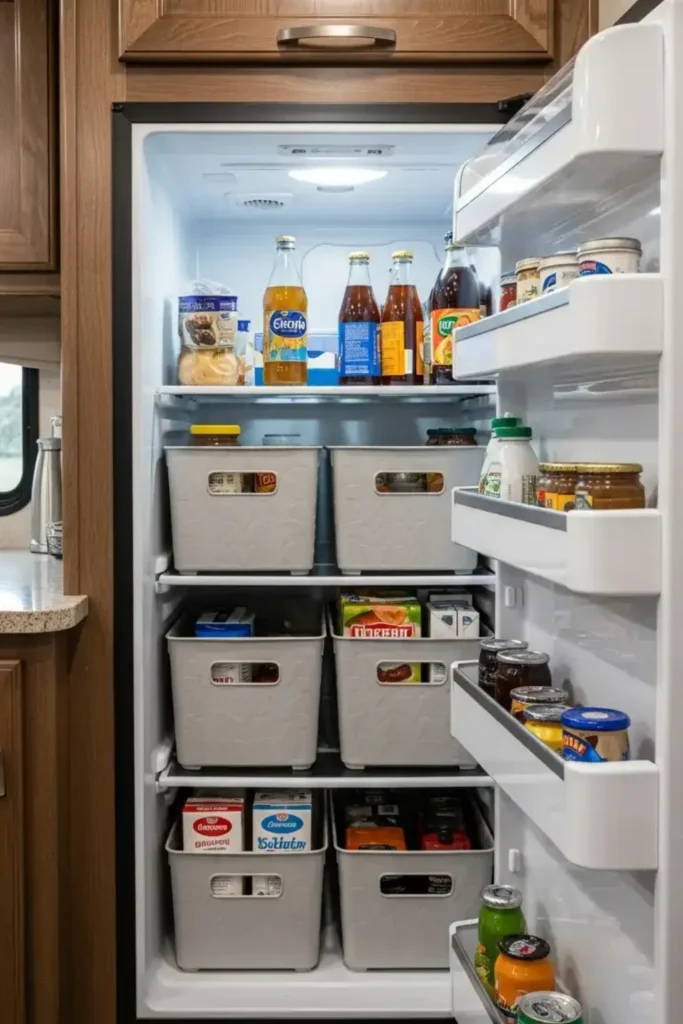
Pantry organization doesn’t stop at the cabinet door. The fridge fills up just as fast, and loose jars and open boxes get lost behind whatever landed there last.
Uniform bins fix that the same way they fix a dry shelf. Sauces and condiments share one bin, dairy shares another, leftovers get their own.
Pulling one bin out to check what’s inside beats digging through every shelf, and matching sizes mean nothing wastes vertical space between shelves.
19. Split Corner Zones By Height
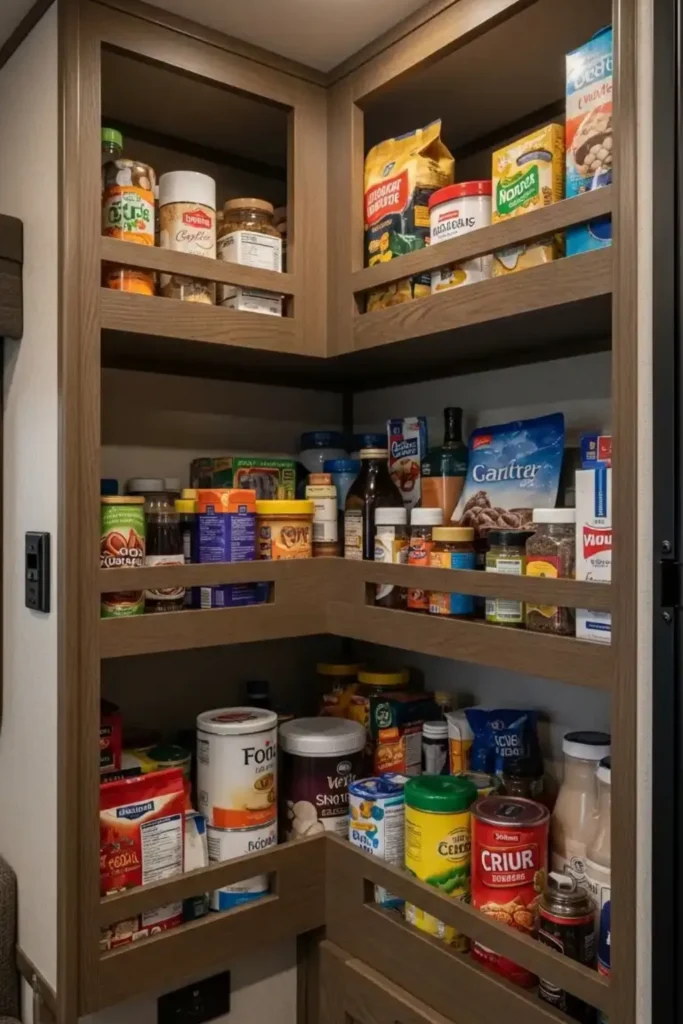
Every corner cabinet has a dead zone in the back, where nothing past arm’s length gets touched until it’s expired.
Splitting the space by weight instead of category fixes that. Heavy canned goods stay low, where a deep shelf can hold their bulk without stressing the mounting hardware. Mid-weight jars and bottles sit at eye level, the zone you reach into most. Lightweight bags and boxes go up top, out of the way but still visible.
Nothing here needs to spin. A fixed layout organized by weight reaches just as far as a rotating shelf, without moving parts to wear out on a bumpy road.
20. Layer Tools Onto The Door
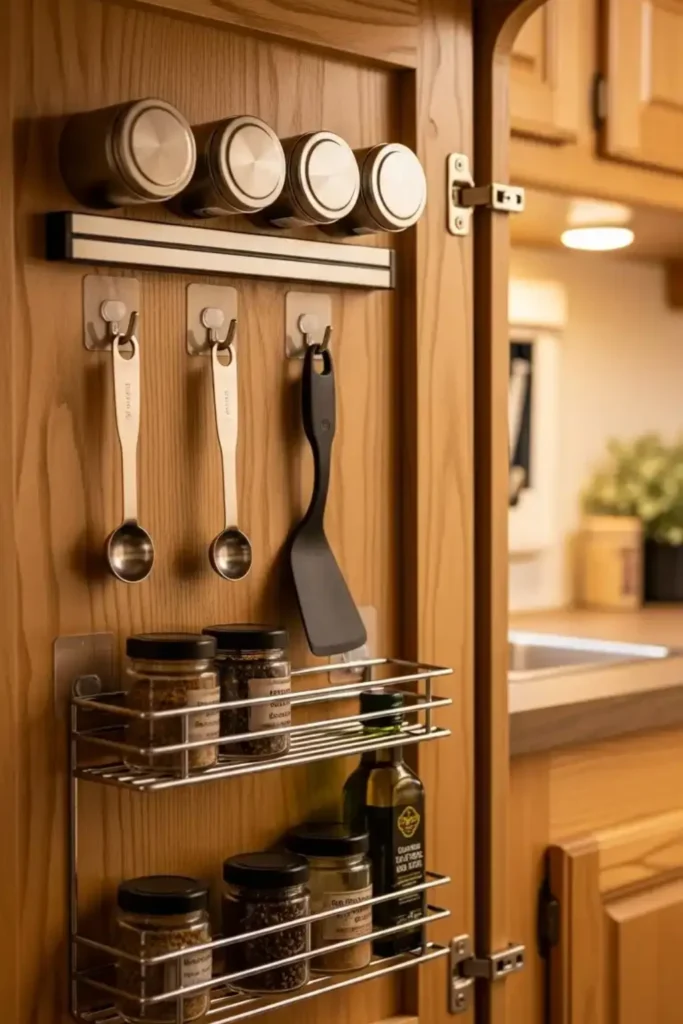
Mount everything within arm’s reach, no drawer required.
A magnetic strip up top holds small metal spice tins in a single row. Below it, adhesive hooks catch measuring spoons and a spatula by their handles, so they hang flat against the door instead of rattling in a drawer. A slim wire basket at the bottom takes overflow jars and an oil bottle too tall for the hooks.
Adhesive hooks hold light tools fine, but a fully loaded wire basket needs a screw-mounted bracket, or the extra weight will eventually pull the hooks free.
21. Rotate Stock Front To Back
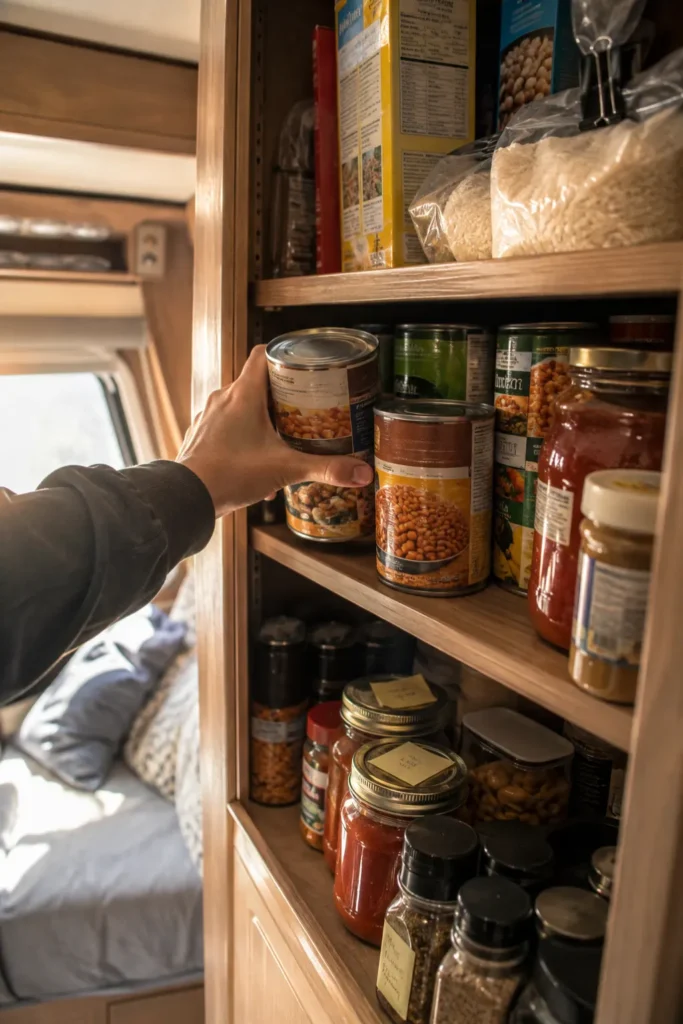
Most people just shove groceries wherever there’s a gap, which buries the older cans behind the new ones.
What works better is loading new purchases straight to the back of the shelf, then pulling the oldest stock forward first. It takes seconds at checkout unpacking, and it means nothing quietly expires in a corner three trips later.
This costs nothing and takes no extra gear, just a five second habit every time groceries come aboard.
Conclusion
A pantry that stays organized on the road usually comes down to a few small systems, not one big overhaul. Pick two or three ideas here that match your actual cabinet shapes, and the rest will follow once you see how much easier meal prep gets.
Small space, big difference.
A pantry system built around your actual cabinets beats any product bought before you knew the space.
Save this for your next grocery run, and check back for more small-space RV ideas.